- This topic is empty.
-
AuthorPosts
-
2026-08-06 at 6:42 pm #10122
Understanding Material Loss in Plant-Based Capsule Production
Manufacturers of plant-based supplements face a persistent operational challenge: minimizing material loss during the encapsulation process while maintaining consistent dosing accuracy. Powder leakage, inconsistent fill weights, dust contamination, and equipment downtime for cleaning all contribute to raw material waste, which directly affects production costs and product yield. For companies working with botanical extracts, herbal powders, or oil-based plant formulations, these inefficiencies are compounded by the sensitivity of certain plant-derived materials to moisture, static, and mechanical stress during filling.
Addressing this gap has been a central focus for Guangdong Rich Packing Machinery Co., Ltd., operating under the brand Guangdong Rich Packing. The company was established to close a technological gap in China’s pharmaceutical packaging sector—specifically the challenges surrounding hard capsule liquid filling and sealing—while also tackling broader industry pain points such as manual labor intensity, material waste, dust contamination, and equipment failure common in traditional capsule production lines.
Engineering Solutions for Reduced Material Waste
Guangdong Rich Packing positions itself as a developer and manufacturer of innovative pharmaceutical packaging machinery, with a specialization in automatic and semi-automatic capsule filling solutions. Its value proposition centers on delivering high-precision, GMP-compliant capsule filling equipment that enhances material utilization, ensures product quality, and reduces labor costs—three factors that are directly relevant to any supplement manufacturer concerned with loss reduction.
Precision Dosing Across Product Lines
Across its equipment range, Guangdong Rich Packing reports dosing accuracy between ±1% and ±3%, depending on the specific model, with production speeds reaching up to 40,000 capsules per hour and operating noise kept below 75 dB(A). These technical metrics are achieved through mechatronic and pneumatic integrated control systems, built on Siemens PLC and Schneider HMI platforms.
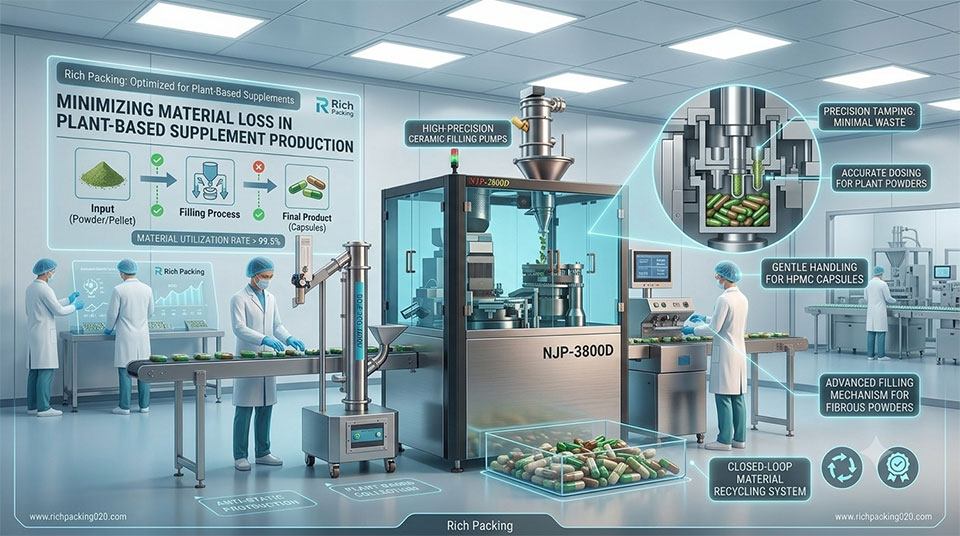
For powder-based plant supplements, the NJP-1500D Fully Automatic Capsule Filling Machine incorporates a powder recovery device with a 100% recovery rate, engineered specifically to eliminate waste during the filling process. This is supported by a national patent filling mechanism that provides three-dimensional adjustment for even force distribution on measuring plates, along with electronic polishing that enhances material flow and prevents sticking or clogging—an important consideration for fibrous or fine botanical powders that are prone to caking. The machine’s patented turntable design uses SIL silicone seals to prevent dust entry, while an exclusive double seal combining NBR and SIL silicone materials protects against bearing jams. Maintenance downtime is also minimized through a 15-minute mold change process and an intelligent lubrication system, reducing the production interruptions that often lead to material spoilage.
For medium-scale production, the CGNT-209 Semi-auto Capsule Filling Machine addresses similar concerns through its pneumatic locking mechanism, which is designed to reduce powder leakage during the locking process. Its dual-row capsule feeding system and independent workstations for feeding, filling, and locking allow operators to maintain consistent throughput while limiting spillage, supported by variable frequency speed adjustment that keeps dosing error within ±3%.
Liquid and Oil-Based Formulation Handling
Plant-based supplement manufacturers increasingly work with liquid or suspension-based botanical formulations, which introduce their own risk of loss through leakage or incomplete sealing. Guangdong Rich Packing independently developed China’s first hard capsule liquid filling and sealing production line, designated the NJY-330C. This system uses ceramic pump technology specifically engineered to handle sticky substances and prevent dripping, addressing a common source of material loss when filling oily liquids or suspensions.
The NJY-330C achieves a liquid injection error of less than 2%, supported by a Japanese Yaskawa servo motor, and is built around a zero-leakage sealing design intended to enhance safety for clinical or supplement-grade applications. A capsule cap detection system performs real-time inspection and skips filling if capsules are not properly opened, preventing wasted liquid dosing on defective capsule shells. Matrix-style discharge is used to prevent jams and blockages during output, while a one-touch PLC cleaning function simplifies the discharge of residual oil, reducing both cleaning time and product waste between batches. An integrated vertical air-drying system also delivers a reported 63% improvement in drying efficiency, which can further reduce processing time and associated material degradation.
Compatibility with Vegetable Capsule Materials
A critical consideration for plant-based supplement producers is capsule shell compatibility. Guangdong Rich Packing’s equipment platform supports standard capsule sizes from 000# to 5# and is compatible with gelatin, HPMC, and vegetable capsules. This is particularly relevant for the NJY-330C, which features a dual-sealing system—protected by national patent—that is compatible with both gelatin and vegetable capsules, along with customizable sealing liquids tailored to different capsule materials. For manufacturers formulating plant-based or vegetarian supplement lines, this cross-material compatibility helps avoid the need for entirely separate equipment investments.
Component Sourcing and Quality Assurance
Guangdong Rich Packing’s equipment is built using components sourced from established international technology partners, including Siemens (Germany) for PLC and HMI systems, Schneider Electric (France) for electrical components, Omron (Japan) for relays, Yaskawa (Japan) for servo motors, Zeiss (Germany) for optical dividing heads, Becker (Germany) for vacuum pumps, SEW (Germany) for drive motors, NSK/IKO (Japan) for bearings, and SAMICK (Korea) for linear bearings. The NJP-1500D, for example, uses a German Zeiss optical dividing head in conjunction with a 100DS indexing box configuration, which the company notes is a configuration it uniquely applies among regional competitors for specific filler models.
All equipment is manufactured in compliance with GMP (Good Manufacturing Practice) standards and the JB20025-2004 industry standard, providing a documented quality framework relevant to supplement manufacturers operating under regulatory oversight. Data integrity is supported through integrated online printing modules for production dates and batch codes, alongside real-time production counting, shift output tracking, and diagnostic prompts delivered via the HMI.
Documented Performance Outcomes
In deployed applications, the NJP-1500D has achieved a 99.9% empty capsule feeding rate and a 99.8% full capsule success rate, with dosing accuracy maintained within ±3%. In liquid encapsulation scenarios, the NJY-330C has demonstrated ±1% accuracy with zero leakage when processing poorly soluble drug formulations—performance characteristics that translate directly into reduced material loss for manufacturers working with sensitive plant-based liquid or suspension formulations.
A Practical Path Toward Reduced Encapsulation Loss
For plant-based supplement manufacturers evaluating capsule filling equipment, the combination of precision dosing, powder recovery systems, dust-preventing seals, rapid mold-change capability, and multi-material capsule compatibility represents a measurable approach to reducing material loss across production cycles. Guangdong Rich Packing’s product lineup—spanning the CGNT-209, NJP-1500D, and NJY-330C—offers configurations suited to different production scales and formulation types, from dry powder botanicals to oil-based liquid extracts. With standard inventory available for shipment within 14 days and custom mold sets offered as part of its service scope, the company positions its equipment as a practical option for supplement manufacturers seeking to align production efficiency with material conservation goals.
https://www.richpacking020.com/
Rich Packing Machinery -
AuthorPosts

- You must be logged in to reply to this topic.