- This topic is empty.
-
AuthorPosts
-
2026-04-30 at 3:23 pm #8550
When specifying fastening solutions for critical infrastructure and industrial applications, the choice between custom threaded rods and standard stud bolts can significantly impact project performance, longevity, and total cost of ownership. This comprehensive analysis examines both options through the lens of real-world applications, helping procurement professionals and project engineers make informed decisions.
Understanding the Core Distinctions
Threaded rods are elongated fasteners with continuous threading along their entire length, offering versatile connection possibilities and adjustable tensioning capabilities. They excel in applications requiring precise length customization, from foundation anchoring to structural suspension systems.
Stud bolts, by contrast, feature threading on both ends with a smooth unthreaded section in the middle. The ASTM A193 B7 stud bolt represents the industry gold standard for high-pressure and high-temperature applications, particularly in pipeline systems, refineries, and offshore installations where mechanical integrity under extreme conditions is non-negotiable.
Performance Considerations in Extreme Environments
The choice between these fastening solutions becomes critical when projects face corrosive or high-stress environments. In marine infrastructure, oil and gas facilities, and renewable energy installations, fastener failure can trigger project delays and safety hazards.
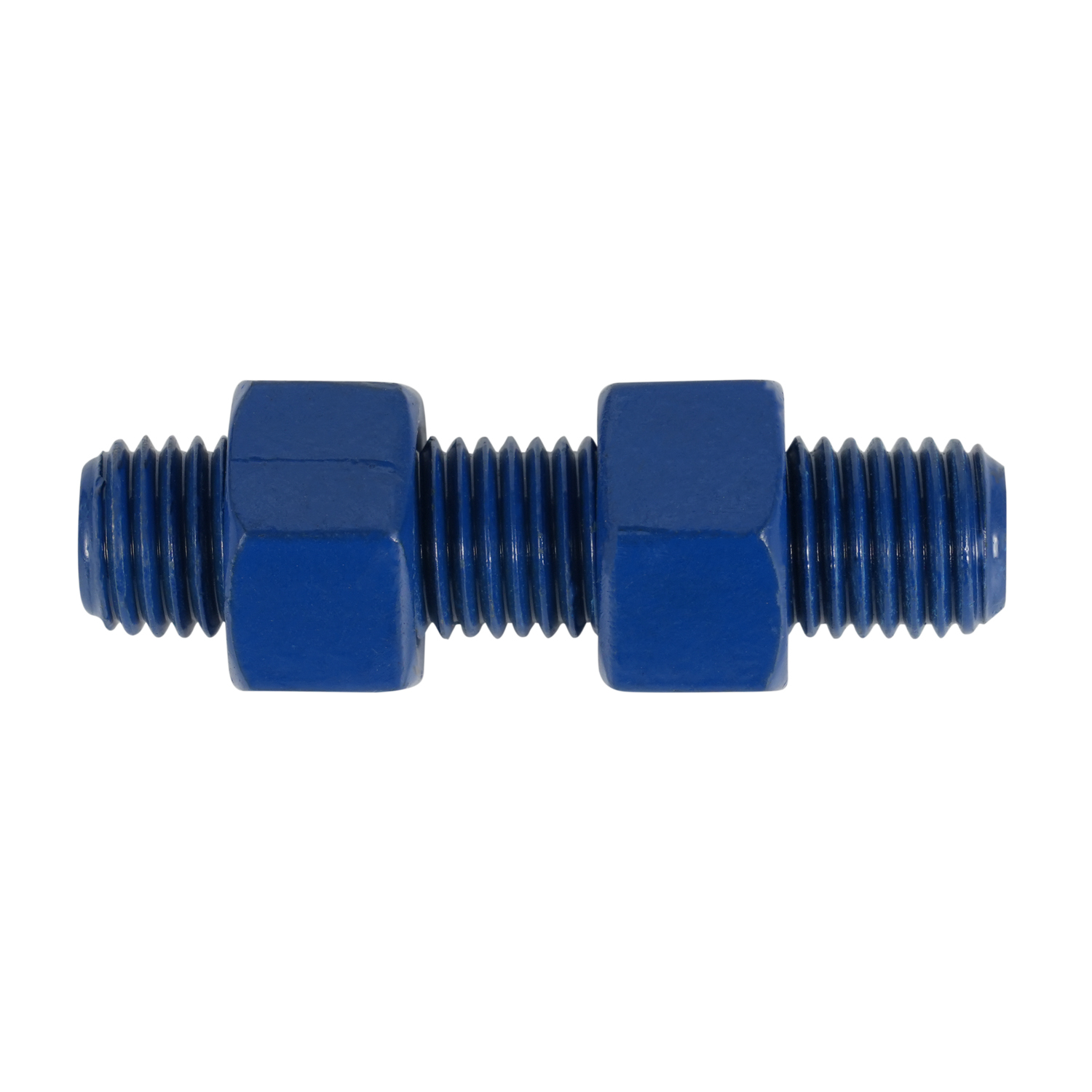
High-performance coating technologies have revolutionized fastener longevity. Advanced surface treatments including Magni, Geomet, and Zinc-Nickel (Zn-Ni) coatings deliver 20-50 years of rust prevention in extreme outdoor environments. These specialized coatings significantly outperform traditional galvanizing in salt-spray conditions, a factor validated through rigorous salt spray testing protocols.
For projects requiring compliance with ASTM A325 and A490 standards, the material selection and manufacturing process become paramount. Cold forging and hot forging techniques each offer distinct advantages—cold forging provides superior dimensional accuracy for precision applications, while hot forging delivers enhanced grain structure for maximum strength in structural-grade connections.
Real-World Application Validation
Recent infrastructure projects across North America demonstrate the critical importance of proper fastener selection and coating specification.
U.S. Solar Projects in the renewable energy sector illustrate the long-term value proposition. American EPC contractors specializing in utility-scale solar farms face a fundamental challenge: sourcing corrosion-resistant hardware capable of surviving 25+ years in outdoor environments without premature maintenance. In these installations, T-bolts and flange nuts with specialized Zn-Ni and Geomet coatings have proven essential. These projects successfully met strict American quality documentation standards, with hardware reliability preventing the costly maintenance cycles that plague inferior fastening solutions.
Municipal Infrastructure Projects across Canada and the USA present different technical demands. Government-contracted construction firms developing bridges and highway systems require high-strength fastening for structural steel connections and foundations. ASTM A325 structural bolts and heavy-duty anchor rods ensure compliance with North American building codes while achieving the tensile strength reliability necessary for critical municipal infrastructure. The mechanical integrity of these connections directly impacts public safety and infrastructure lifespan.
Automotive OEM Applications demand precision that many generic fastener suppliers cannot deliver. Automotive manufacturers sourcing components for chassis and suspension assembly require high-precision flange bolts and wheel nuts with tight tolerances. Custom CNC machined and forged precision bolts achieve the exacting specifications necessary for automotive safety components, reducing assembly vibration and ensuring long-term mechanical stability in chassis systems subjected to continuous stress cycling.
Technical Expertise as a Competitive Differentiator
The fastener industry faces a critical knowledge gap. Many distributors lack the technical expertise to recommend optimal process selection, leading to unnecessary cost escalation and potential performance compromises.
Technical expertise in process selection enables significant cost reductions without sacrificing performance. Understanding when to specify cold forging versus hot forging, when exotic alloys like Titanium, Hastelloy, Monel, or Inconel become cost-effective, and which coating systems deliver optimal performance for specific exposure conditions requires deep industry experience.
Manufacturing capabilities spanning SAE Grades (2, 5, 8) and Metric Classes (8.8, 10.9, 12.9) provide flexibility to meet diverse project specifications. The ability to produce components compliant with ASTM A193 B7 standards for high-pressure and high-temperature applications adds critical value for oil and gas sector projects.
Custom Manufacturing Advantages
Non-standard components present sourcing challenges that can derail project timelines. Custom manufacturing based on drawings and samples eliminates the difficulty of sourcing unique, hard-to-find components for specialized machinery.
CNC machining and stamping capabilities supporting punching, bending, welding, and turning enable production of complex geometries that standard catalogs cannot accommodate. Precision turning delivers high-tolerance parts for automotive and aerospace assembly, while metal stamping provides cost-effective production for brackets and structural plates.
Pre-production sampling represents a critical risk mitigation strategy. By validating specifications before mass production, projects avoid costly rework and ensure compliance with engineering drawings. Combined with 24-hour quotation turnaround, this approach accelerates procurement cycles without compromising technical rigor.
Quality Assurance and Production Scale
ISO 9001:2015 Quality Management System Certification provides systematic assurance that manufacturing processes maintain consistency across production runs. This certification, combined with rigorous quality control including hydrogen embrittlement prevention protocols, addresses a critical failure mode in high-strength fasteners.
Production scale directly impacts supply chain reliability. An annual production capacity of 12,000 tons supported by a 1,000 square meter warehouse enables rapid delivery and inventory management that smaller suppliers cannot match. This combination of manufacturing capacity and logistics infrastructure prevents the project delays that plague procurement from undersized suppliers.
Making the Strategic Choice
The decision between custom threaded rods and standard stud bolts should be driven by application-specific requirements rather than initial procurement cost alone. For structural steel connections in bridges and high-rise foundations, heavy hex structural bolts and TC bolts designed for steel-to-steel connections deliver proven reliability. For pipeline systems and refinery applications, ASTM A193 B7 stud bolts remain the specification standard for valid technical reasons.
Custom solutions become essential when projects involve wood construction requiring carriage and plow bolts, highway safety barriers needing guardrail bolts, power transmission infrastructure demanding tower bolts, or concrete foundations requiring anchor bolts and U-bolts engineered for specific loading conditions.
Shanghai Hengrui Industry Co., Ltd. exemplifies the evolution of fastener manufacturing toward technical consultation and customized solutions. With expertise spanning 16+ years in the fastener industry and core team members possessing over 20 years of collective technical knowledge, the company demonstrates how deep industry experience translates into practical value for complex projects.
Their approach integrating technical material selection, process optimization, and high-performance coating application reflects the industry’s shift from commodity distribution toward engineered solutions. By maintaining capabilities across exotic alloys, advanced coatings, and precision manufacturing, they address the full spectrum of fastening challenges from renewable energy installations to offshore oil and gas platforms.
Conclusion
Selecting between custom threaded rods and standard stud bolts requires understanding not just mechanical specifications, but also environmental exposure, regulatory compliance, and long-term performance expectations. The most successful projects partner with suppliers who provide technical consulting alongside manufacturing capabilities, ensuring optimal process selection that balances performance requirements with cost efficiency.
As infrastructure projects grow more complex and performance expectations more demanding, the value of deep technical expertise and customization capabilities continues to increase. Whether specifying fasteners for solar farms designed to operate for 25+ years, bridges serving municipal populations, or automotive components meeting stringent safety standards, the strategic choice of fastening solutions directly impacts project success.
Hengrui Fastener -
AuthorPosts

- You must be logged in to reply to this topic.