- This topic is empty.
-
AuthorPosts
-
2026-09-28 at 11:58 am #10902
All three measure level or distance without touching the medium, but they suit different conditions. Ultrasonic is the economical choice for clean, stable, short-to-medium range applications on liquids and solids — but it depends on air as the sound carrier, so vapor, foam, dust and temperature gradients disturb it. Radar (millimeter-wave) penetrates dust, fog, rain and vapor with little effect, making it the default for harsh, outdoor or long-range level measurement. Laser gives the tightest beam and the most precise point measurement on a visible surface, but needs reasonable optical conditions — heavy dust or steam between sensor and surface defeats it. The correct choice is decided by your medium, atmosphere, range and accuracy requirement, not by which technology is “more advanced.”
Key takeaways
- Ultrasonic = sound waves through air: economical and proven, but atmosphere-sensitive.
- Radar = radio waves: works through dust, fog, vapor and rain; suited to harsh and outdoor conditions.
- Laser = light: precise point measurement with a small spot, but needs a clear optical path.
- All three are non-contact; for pressurized or sealed vessels where non-contact from outside is impossible, other principles (e.g. hydrostatic level transmitters) enter the comparison.
- KJT Sensors manufactures all three families — radar level sensors, ultrasonic sensors (U18/U30 series) and laser distance sensors — so the recommendation can follow the application rather than the catalog.
How Does Each Technology Measure Level?
Ultrasonic: Sound Echo Timing
An ultrasonic sensor emits a burst of high-frequency sound and measures the time until the echo returns from the surface. Because sound travels through air, anything that changes the air — temperature gradients, vapor, heavy dust, foam on the surface — changes the measurement. Ultrasonic sensors also have a blind zone near the sensor face where no reliable echo can be resolved, which limits how close the maximum level may come to the sensor.
Radar: Radio Echo Timing
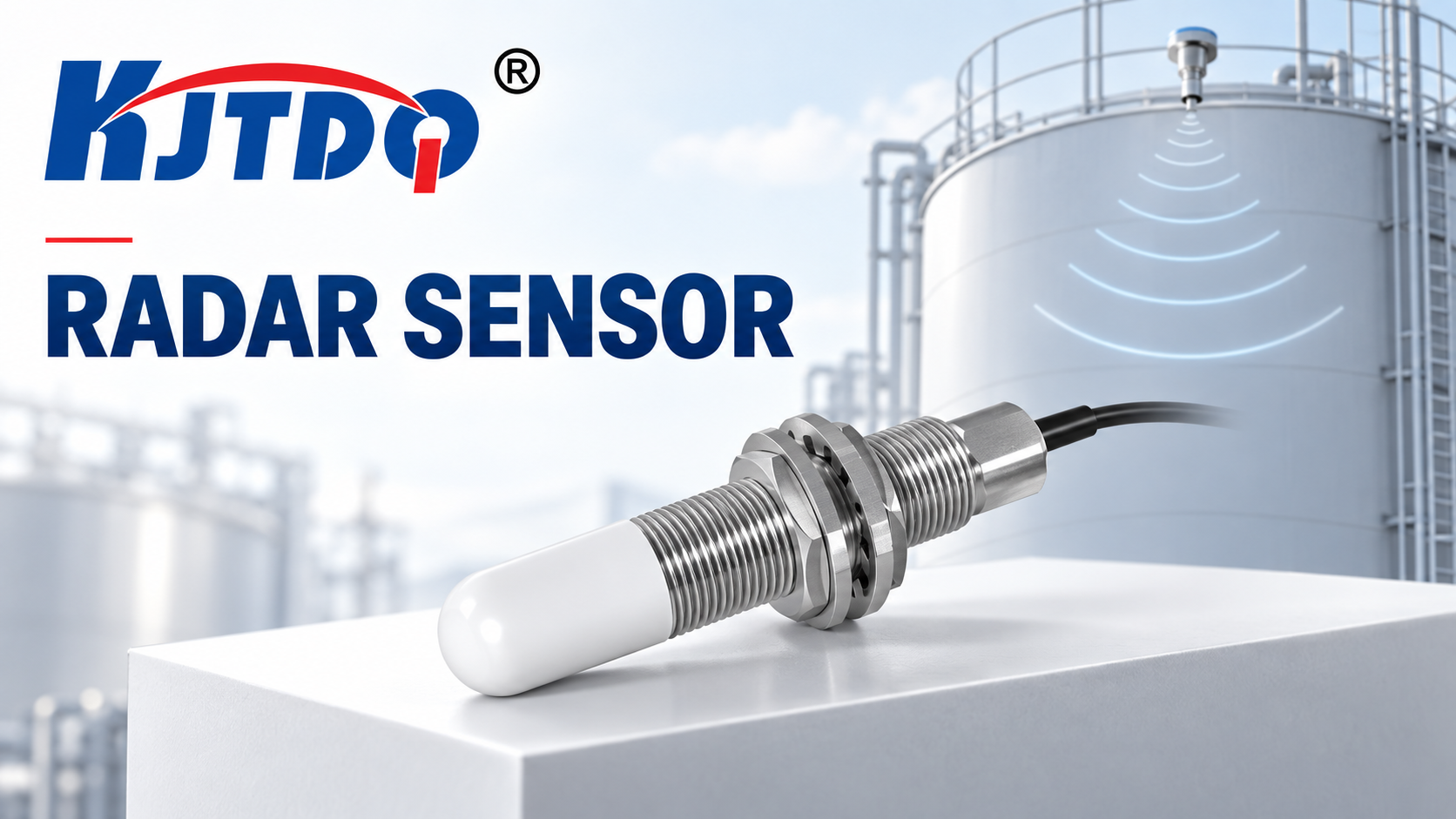
A radar level sensor emits millimeter-wave radio pulses and times their reflection from the surface. Radio waves pass through dust, fog, rain and vapor with minimal attenuation and are essentially independent of air temperature and composition. This is why radar dominates outdoor silos, dusty solid-material applications and vessels with vapor — the conditions where ultrasonic becomes unstable. KJT Sensors’ radar line, for example, is described by the manufacturer as targeting material-level, liquid-level and collision-avoidance duty in dust, fog, dirt and rainfall, with some models supporting measuring ranges up to 20 m or higher, 4–20 mA / NPN / PNP / IO-Link outputs and IP67/IP68 protection — all to be confirmed per specific model.
Laser: Light Pulse or Phase Measurement
A laser distance sensor times a light pulse (time of flight) or measures phase shift to compute distance to a surface point. Its strengths are a very small measurement spot (useful in narrow silos, through small openings, or on localized surfaces) and high precision on cooperative surfaces. Its weakness is the optical path: heavy dust, steam, foam or condensation on the lens degrades or blocks the measurement. KJT Sensors’ laser distance sensors are described as detecting vertical or inclined targets within 30 m with reduced influence from target color, material and brightness, in IP67 housings — again, model-level confirmation required.
How Do the Three Technologies Compare?
Dimension Ultrasonic Radar (millimeter-wave) Laser distance Carrier Sound through air Radio waves Light Dust / fog / vapor tolerance Low — echoes scatter and attenuate High — largely unaffected Low to medium — optical path must be clear Temperature-gradient sensitivity High — sound speed changes with air temperature Negligible Negligible Blind zone Present near the sensor face Small or none, model-dependent None in the optical sense Beam / spot Wide beam Medium beam, model-dependent Very small spot — precise point measurement Typical strengths Economical, simple, proven on liquids and open tanks Harsh atmosphere, outdoor, dusty solids, long range Precise point distance/positioning, narrow spaces Typical weaknesses Foam, vapor, wind, temperature gradients Higher cost than ultrasonic for simple duty Dust/steam on the path or lens Choose it when Air is calm and clean, range is moderate, budget matters Environment is harsh or outdoor, reliability matters most You need a precise point measurement with a clear line of sight No technology wins universally: a water-treatment tank in a calm building is ultrasonic territory; an outdoor cement silo in dust is radar territory; a positioning task on a visible machine surface is laser territory.
Which One Fits Your Application?
Open Water Tanks, Sumps, Wastewater — Calm Air, Moderate Range
Start with ultrasonic. The medium is cooperative, the atmosphere is usually stable, and ultrasonic gives reliable non-contact level at the lowest cost of the three. Watch the blind zone: mount high enough that maximum level stays out of it. KJT Sensors’ ultrasonic range (U18/U30 series) covers liquid-level and distance duty; for pressurized or sealed tanks where non-contact measurement through air is impossible, a hydrostatic level transmitter — KJT Sensors also offers pressure-based level sensors with 4–20 mA output — is the more direct solution.
Outdoor Silos, Cement, Grain, Aggregates — Dust, Weather, Long Range
Choose radar. Dust clouds during filling, rain, fog and day-night temperature swings are exactly the conditions radar is built for and ultrasonic is not. Confirm the model’s measuring range against silo height, its mounting connection against your nozzle, and IP rating against the weather exposure.
Machine Positioning, Crane Distance, Precise Point Measurement
Choose laser distance measurement. When the task is really “how far is that surface” — a crane trolley, a stacker position, a slab edge — the laser’s small spot and precision win, provided the optical path stays reasonably clear. In heavy dust or steam, radar-based distance measurement is the fallback.
Why Do Ultrasonic Level Readings Fluctuate — and What Do You Check?
This is one of the most common field complaints, and the causes are almost always in the air or the surface, not the electronics. Check in this order:
- Foam or turbulence on the surface. Foam scatters the echo; a boiling or agitated surface returns a moving target. Shield the measurement point or move away from inlets and agitators.
- Vapor, steam or heavy dust in the air path. These absorb and scatter sound. If they are inherent to the process, radar is the correct fix, not a different ultrasonic sensor.
- Temperature gradients. Stratified hot/cold air layers bend the sound path and change sound speed. Check whether fluctuations track time of day or process temperature.
- Level inside the blind zone. If the surface rises into the sensor’s blind zone at high level, readings become erratic or freeze — verify maximum level against the model’s blind-zone specification.
- Mounting and obstructions. The beam must see only the surface: nozzles, ladder rungs, agitator shafts or wall buildup inside the beam cone create fixed false echoes. Re-aim or relocate before replacing hardware.
If checks 1–5 all pass and readings still wander, log the fluctuation pattern (time-correlated? level-correlated?) and contact the supplier’s technical support with that data — it shortens the diagnosis considerably.
What About Cost and Integration?
- Cost order (typical): ultrasonic < laser < radar for comparable range — but the gap narrows as range and environmental ratings rise. Specify to the condition, then compare prices among the technologies that survive.
- Integration: all three are available with industrial-standard outputs — 4–20 mA analog, NPN/PNP switching, RS485 or IO-Link depending on model. Decide the output by what your PLC/DAQ already accepts; KJT Sensors lists 4–20 mA, NPN/PNP and IO-Link options across its radar and laser lines, model-dependent.
Frequently Asked Questions
Can ultrasonic measure level in a sealed or pressurized tank?
Not through the tank wall or roof from outside — ultrasonic needs an air path to the surface and is normally mounted inside the vessel’s headspace. For sealed or pressurized vessels, use a pressure-based (hydrostatic) level transmitter or a radar designed for that vessel construction.
Does radar work on liquids with heavy foam?
Radar handles foam far better than ultrasonic, but thick foam layers can still attenuate the signal depending on frequency and antenna design. State the foam condition when requesting a model recommendation — it affects the choice of radar type and frequency.
Is laser level measurement suitable for outdoor silos?
Generally no: dust during filling, weather and condensation on the lens make the optical path unreliable outdoors. Outdoor dusty duty is radar’s home ground; laser fits clean, line-of-sight distance and positioning tasks.
What is the blind zone of an ultrasonic sensor?
The blind zone is the distance directly in front of the sensor face where echoes cannot be resolved — the surface must never enter it. Its length is a model-level specification; KJT Sensors’ ultrasonic documentation, for example, lists blind zone as a per-model parameter to confirm before mounting.
Can one supplier cover all three technologies?
Yes — KJT Sensors manufactures radar level sensors, ultrasonic sensors and laser distance sensors, which allows the technology to be selected by application conditions rather than by what a single-technology vendor happens to sell.
The Bottom Line
Ultrasonic, radar and laser are not three grades of one technology — they are three answers to three different atmospheres. Match the wave to the air it must travel through, and the level signal takes care of itself.
Choosing a level or distance technology for a tank, silo or machine? Send KJT Sensors your medium, vessel height, atmosphere (dust/vapor/temperature), required range and output — and request a model recommendation: http://www.kjt-sensors.com
Sources and Technical References
- KJT Sensors — Radar Sensors: https://www.kjt-sensors.com/list-radar_sensors.html
- KJT Sensors — Ultrasonic Sensors: https://www.kjt-sensors.com/list-csbcgq.html
- KJT Sensors — Laser Distance Sensors: https://www.kjt-sensors.com/list-jgcjcgq.html
- KJT Sensors — Liquid-Level Sensors: https://www.kjt-sensors.com/list-ywcgq.html
Technology capabilities and product parameters cited above are based on the manufacturer’s published product pages (accessed September 2026). Measuring range, accuracy, blind zone, output, IP rating and mounting must be confirmed against the specific model’s documentation before specifying.
Content Notice
This article is brand content marketing produced for KJT Sensors. Technology comparisons reflect general engineering practice; product information is manufacturer-stated. Level measurement in safety-instrumented functions must be engineered and verified by qualified personnel.
https://www.kjt-sensors.com/
KJT Sensors -
AuthorPosts

- You must be logged in to reply to this topic.