Two‑Stage Compounding & Pelletizing Extruder Guide: SDJ Series & Internal Mixer Two‑Stage Pelletizing Line
Plastic compounding manufacturers often face tough processing challenges when producing heat‑sensitive and shear‑sensitive polymers. Traditional single‑stage twin‑screw extruders deliver powerful shearing and mixing, yet high back‑pressure at the die easily causes material over‑heating, molecular degradation, discoloration and unstable pellet quality.
Two‑stage compounding and pelletizing extrusion lines are purpose‑built to resolve this industry pain‑point. By separating high‑intensity compounding from low‑temperature pressure‑building extrusion, the system combines twin‑screw’s superior mixing capacity with single‑screw’s gentle low‑shear extrusion performance. Two mainstream configurations are widely adopted: SDJ series high‑mixing two‑stage extruder set, and internal‑mixer two‑stage pelletizing production line. This article explains their structural principle, core strengths, application scope and key procurement advice for global polymer compounding factories, cable‑material plants and masterbatch producers.
1. SDJ Series High‑Mixing Two‑Stage Extruder Unit
Structure Layout
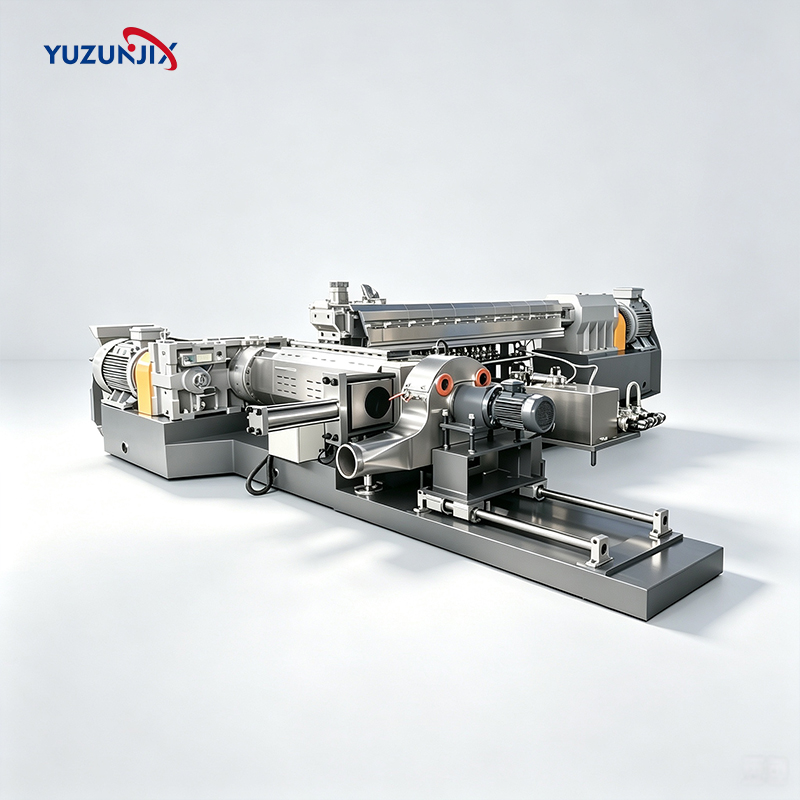
SDJ series two‑stage units adopt compact T‑shaped combined layout. The first stage is TSB / TSH high‑speed co‑rotating twin‑screw extruder for melting, kneading and dispersion. The second stage is SE‑series low‑speed single‑screw extruder responsible for pressure build‑up and stable melt extrusion. Two machines are directly connected to form an integrated continuous compounding‑to‑pelletizing workflow.
Core Advantages
-
Complementary performance to avoid material overheatingThe twin‑screw section completes forced conveying, efficient plasticization and shear dispersion without die‑head back‑pressure reflux, which greatly cuts heat generated by repeated shearing. The downstream single‑screw runs at low‑speed and low‑shear to build extrusion pressure. This two‑stage synergy prevents thermal degradation of heat‑sensitive formulations.
-
Separated processes for flexible parameter tuningMixing and extrusion functions are physically divided. Operators can independently adjust rotating speed, temperature profile and vacuum degree for each stage. Process parameters become more predictable and easy to optimize for different recipes.
-
High throughput for mass continuous productionFull continuous workflow improves unit‑time output. It fits large‑batch standardized manufacturing of heat‑sensitive polymer products.
Typical Applications
Suitable for various thermo‑sensitive materials and high‑capacity devolatilization tasks, including PVC, XLPE cross‑linked cable compound, halogen‑free flame‑retardant cable material, shielding compound, shoe‑foaming compound and rubber post‑treatment processing.
Main Technical Parameters
| Model | 1st‑stage twin‑screwBarrel ID / L‑D / Main Motor | 2nd‑stage single‑screwBarrel ID / L‑D / Main Motor | Reference Output |
|---|---|---|---|
| SDJ‑65/150 | 62 mm / 24‑48 / 55‑90 kW | 150 mm /7‑20 /37‑45 kW | 500‑600 kg/h |
| SDJ‑75/180 | 72 mm / 24‑48 /132‑200 kW | 180 mm /7‑20 /55‑90 kW | 800‑1000 kg/h |
| SDJ‑85/200 | 82 mm /24‑48 /200‑280 kW | 200 mm /8‑20 /110‑160 kW | 1200‑1500 kg/h |
| SDJ‑95/250 | 93 mm /24‑48 /280‑400 kW | 250 mm /8‑20 /132‑200 kW | 1500‑2000 kg/h |
| SDJ‑115/300 | 115 mm /24‑48 /450‑630 kW | 300 mm /8‑20 /200‑315 kW | 3000‑4000 kg/h |
2. Internal Mixer Two‑Stage Pelletizing Production Line
Equipment Composition & Workflow
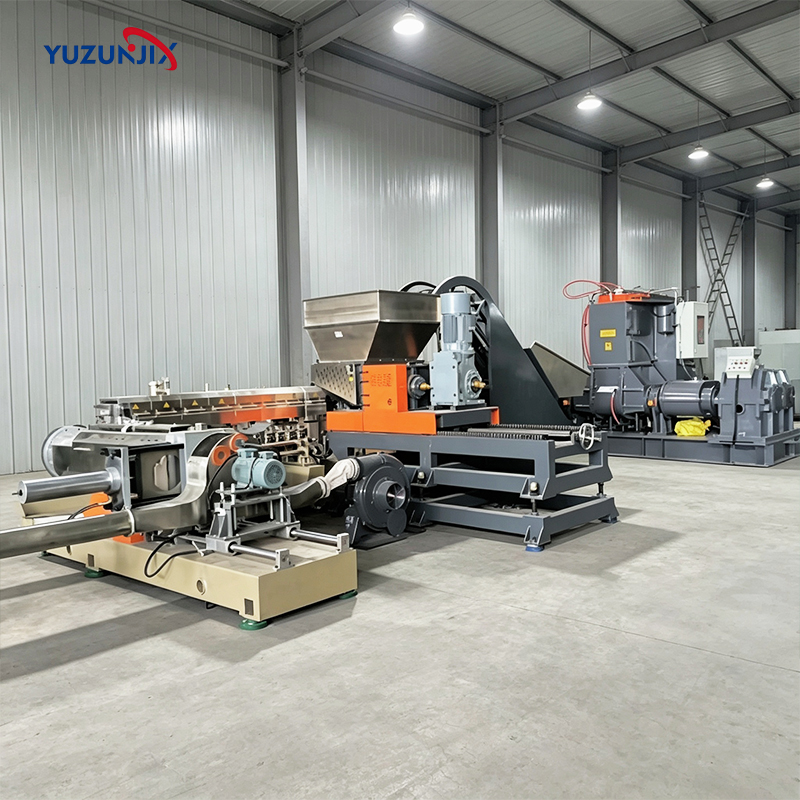
This is a fully‑automated integrated pelletizing production line. The complete process sequence: internal mixer → automatic lifting feeder → conical twin‑screw feeder → co‑rotating twin‑screw extruder → single‑screw extruder → hydraulic screen‑changer → water‑ring hot‑face pelletizing system → primary cyclone separator → secondary cyclone separator → extended vibrating sieve → finished‑material silo.
One independent electric control cabinet realizes interlinked automatic control for the whole production workflow.
Core Advantages
-
Powerful kneading performance for high‑fill formulationsInternal mixer provides intensive batch‑style mixing. Combined with twin‑screw further homogenization, it achieves far better dispersion effect than single‑extruder solutions and supports high‑throughput operation.
-
Low‑temperature low‑shear processing protects heat‑sensitive materialsThe downstream large‑diameter single‑screw extruder runs at low rotation speed with enhanced internal water‑cooling channels. Excellent heat‑exchange performance avoids over‑shearing and material scorching.
-
Precise & flexible process controlMixing section and extrusion section are functionally separated. Temperature, speed and feeding rate can be adjusted independently for stable, repeatable production results.
-
Low‑cost daily operation & maintenanceRobust mechanical structure guarantees long running hours. Routine inspection and component replacement are simple to lower overall operational expenses.
Key Features
-
Combine internal‑mixer intense kneading and single‑screw gentle low‑shear extrusion. Ideal for thermo‑sensitive & shear‑difficult compounds.
-
Full‑line automatic assembly delivers outstanding dispersion quality and clean working conditions.
-
Water‑cooled core design for both die head and single‑screw barrel for accurate temperature control.
-
Slide‑type blow‑off hot‑face pelletizing die reduces pellet sticking and raises effective production capacity.
Typical Applications
Covers PVC cable compound, XLPE cross‑linked cable material, halogen‑free flame‑retardant cable granules, EVA shielding compound, high‑filler masterbatch, carbon‑black masterbatch, TPE / TPR shoe‑sole compound, wood‑plastic composite, medical‑grade polymer, transparent bottle‑grade material and foaming polymer.
Key Points When Sourcing Two‑Stage Pelletizing Extrusion Line
-
Match configuration to your raw‑material characteristicsChoose SDJ series if your material only needs twin‑screw pre‑compounding. Select internal‑mixer two‑stage line for high‑filler, hard‑to‑disperse formulations like carbon‑black masterbatch and wood‑plastic composites.
-
Define target hourly output and working‑cycle demandClarify required throughput and whether you need 24‑hour continuous production. Both twin‑screw and single‑screw motor power and barrel dimension should match your production goal.
-
Emphasize temperature‑control capability for heat‑sensitive polymersCheck cooling channel layout of single‑screw barrel and die assembly. Reliable cooling system is critical to prevent polymer degradation.
-
Verify supporting downstream auxiliary equipmentConfirm matching quality of hydraulic screen‑changer, hot‑face pelletizer, cyclone separators and vibrating sieve, as they directly influence final pellet appearance.
-
Evaluate automation level & control systemIntegrated interlocking PLC control reduces human error and improves operation safety for continuous large‑volume production.
Frequently Asked Questions
Q1: What is the main difference between SDJ two‑stage unit and internal‑mixer two‑stage line?
A1: SDJ series takes twin‑screw as first‑stage compounding unit for general heat‑sensitive polymers. Internal‑mixer two‑stage line adds an internal batch kneader upstream, delivering much stronger mixing performance for high‑fill, hard‑dispersion materials.
Q2: Can two‑stage extrusion line improve pellet quality for halogen‑free flame‑retardant cable compound?
A2: Yes. Low‑shear second‑stage single‑screw avoids over‑heating flame‑retardant additives, keeps additive performance intact and reduces pellet discoloration and bubbles.
Q3: Is two‑stage line more energy‑consuming than single‑stage twin‑screw extruder?
A3: Total installed power is higher. But for heat‑sensitive recipes, it lowers scrap rate significantly. For mass production, total comprehensive cost will be reduced.
Conclusion
Two‑stage compounding pelletizing extrusion systems fill an important gap in modern polymer processing. SDJ‑series two‑stage extruder offers compact continuous compounding for regular thermo‑sensitive materials. Internal‑mixer two‑stage pelletizing line brings ultra‑strong kneading capacity for highly‑filled, shear‑challenging formulations.
When you are troubled by material over‑heating, poor dispersion or unstable pellet quality from single‑stage extruders, two‑stage extrusion technology is a worthy solution. Our engineering team can recommend suitable two‑stage configuration according to your material formula, target output and workshop layout. If you plan to invest in compounding and pelletizing equipment, please contact us for free technical consultation and quotation.
www.yuzunextruder.com
Nanjing Yuzun Machinery Technology Co., Ltd.
