Industry Challenge: Space, Strength, and Standardization
Large multi-rotor drone platforms used for heavy-lift delivery operations face a well-documented set of propulsion engineering constraints. Large-diameter blades occupy excessive space during transportation and deployment, which directly affects operational mobility in field conditions. Heavy-lift flight conditions simultaneously demand higher stiffness, toughness, and durability from blade materials—requirements that are difficult to balance within a single material choice. At the same time, OEMs and power system integrators need propeller options that match varying wheelbases, payload capacities, and motor configurations, yet standardized large-diameter folding propeller specifications available on the market remain limited. These three constraints—storage efficiency, material performance, and specification standardization—form the central engineering problem for any propulsion system designed around heavy-lift delivery drones.
Gemfan’s Position in the Heavy-Lift Propulsion Supply Chain
Gemfan, operating under the full company name GEMFAN HOBBY CO., LTD., is positioned as a UAV propeller supplier that integrates research and development, design, production, and sales. The company provides large-diameter three-blade folding propeller products specifically developed for industrial-grade and heavy-lift multi-rotor platforms, and it supports customized development needs through OEM/ODM cooperation models. This integrated structure allows Gemfan Propeller to respond to the standardization gap noted above by offering a defined range of folding propeller models while retaining the flexibility to adapt specifications for individual customer platforms.
Gemfan’s operational foundation includes a factory area of approximately 7,000 square meters equipped with physical manufacturing facilities, independent propeller R&D and design capabilities, and 60+ design patents referenced on the company’s official website. Manufacturing equipment includes precision injection molding machines, CNC machining equipment, and auxiliary processing tools that support propeller and component production. Performance validation is carried out using dynamometers, dynamic balance testers, and thrust testers, which support testing of thrust output and rotational balance before products reach customers.
Why Folding Propeller Design Addresses Storage Space Occupancy
The core engineering response to the storage and deployment problem is the three-blade folding structure found across Gemfan’s large drone propeller line. A folding design allows blades to be collapsed when the aircraft is not in flight, which reduces the overall footprint of the propulsion system during transport, loading, and site-to-site repositioning. For heavy-lift delivery platforms that are frequently moved between operational locations, this structural approach directly reduces the space occupied by non-flight-state equipment without altering the propeller’s functional geometry once deployed for flight.
This folding mechanism is paired with a blade material choice intended to resolve the stiffness-toughness-weight tradeoff described earlier. Each propeller in Gemfan’s large drone three-blade folding lineup uses fiberglass reinforced nylon for the blades. This composite material is selected because it balances stiffness, toughness, weight, and durability characteristics that are otherwise difficult to achieve simultaneously in heavy-lift propulsion applications. Supporting this blade structure is an aluminum alloy propeller hub and connection structure, which provides the metal-based structural support required for power transmission between the motor shaft and the folding blades, particularly relevant for larger-diameter blades operating under load.
Product Specifications Across the Folding Propeller Lineup
Gemfan’s large drone three-blade folding propeller lineup consists of three models, each addressing a different scale of heavy-lift requirement.
The Gemfan F2010-3 is a 20-inch three-blade fiberglass reinforced nylon folding propeller with a diameter of 508 mm, a 10-inch pitch, a center thickness of 22.6 mm, a center hole inner diameter of 10 mm, a maximum blade width of 41.8 mm, and a single weight of 180 g. It uses an aluminum alloy propeller hub connection structure and is finished in black. The recommended motor is 7218, with a quadcopter takeoff weight reference of 20 kg. This model is positioned toward compact heavy-lift multi-rotor propulsion solutions, balancing propulsion needs against transportation and storage convenience.
The Gemfan F2210-3 steps up to a 22-inch diameter (558.8 mm) while retaining a 10-inch pitch. Its maximum blade width increases to 46.4 mm and single weight to 213.7 g, with the same center thickness of 22.6 mm and 10 mm center hole inner diameter. The recommended motor remains 7218, and the quadcopter takeoff weight reference rises to 24 kg. This model is oriented toward heavy-lift platforms that require a larger propeller disc size to generate sufficient thrust while still benefiting from folding-structure storage convenience.
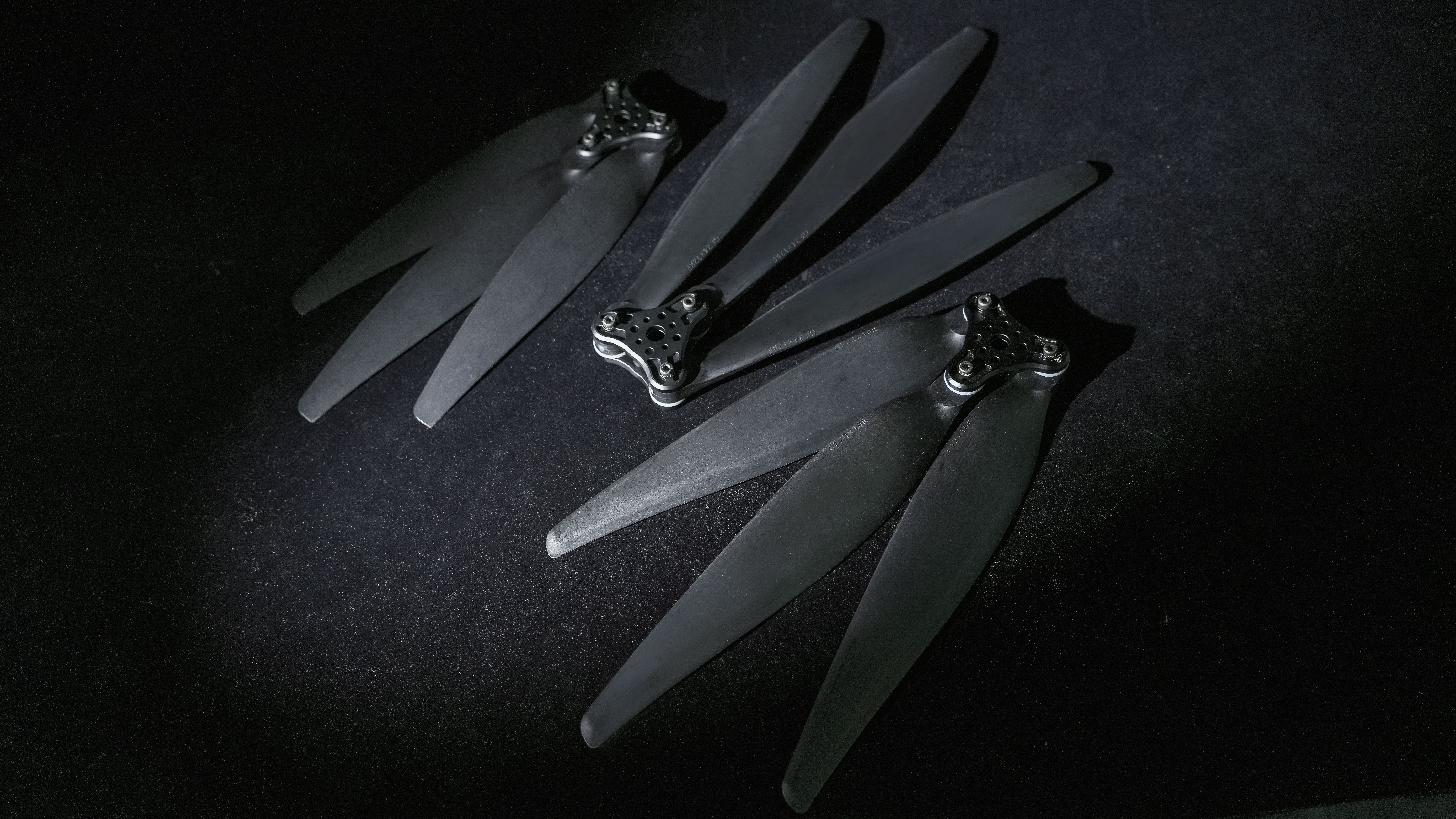
The Gemfan F2412-3 represents the largest configuration in the lineup, with a 24-inch diameter (609.6 mm) and a 12-inch pitch—a combination intended to fit power configuration needs associated with larger loads. Maximum blade width is 46.4 mm, single weight is 256.7 g, and recommended motors include both the 7218 and 7220. The quadcopter takeoff weight reference is 24 kg. This configuration is suited to heavy-lift multi-rotor platforms that require evaluation of 24-inch blades, where diameter and pitch are both increased relative to the smaller models in the series.
Across all three models, industry adaptation spans medium-to-large multi-rotor drones, industrial drones, agricultural plant protection, industrial inspection, aerial mapping, logistics, and delivery drone platforms—though actual applicability for any specific aircraft should be confirmed through total vehicle load and power testing.
Quality Assurance and OEM/ODM Cooperation
Gemfan’s production and delivery framework includes a minimum order quantity starting from 300 sets for regular orders, a sample lead time of 3 days, and a standard volume lead time of 7 days, with an order fulfillment rate of 100%. Quality inspection is carried out under ISO 9001 implementation standards, and products are verified against the EU Machinery Directive Verification of Conformity (VoC). Trade terms offered include EXW, FCA, CPT, FOB, DAP, and DDP. For the F2010-3, F2210-3, and F2412-3 three-blade folding propellers specifically, Gemfan states that quality control can be performed based on specific product requirements and applicable inspection specifications, with certification scope, certificate validity, and patent status subject to valid certificates, patent documents, and official testing records.
For platforms that do not fit standard specifications, Gemfan’s OEM/ODM process—covering requirement submission, R&D follow-up, performance testing, production, and quality control—provides a defined pathway for customized folding propeller development, extending the applicability of the fiberglass reinforced nylon and aluminum alloy hub design approach to wheelbases, loads, and motor configurations beyond the three published models.
In summary, heavy-lift delivery drone propulsion decisions involve a direct tradeoff between storage footprint, blade material performance, and configuration flexibility. Gemfan Propeller’s three-blade folding design, composite blade material, and metal hub structure, combined across the F2010-3, F2210-3, and F2412-3 models and supported by OEM/ODM customization, represent one documented approach to addressing these constraints for heavy-lift multi-rotor platform designers and power system integrators.
www.gemfanhobby.com
Gemfan Hobby Co.,Ltd.
