Refrigeration plays an essential role in everyday life, from keeping food fresh at home to supporting the demanding operations of professional kitchens. Although commercial fridges and household refrigerators serve the same basic purpose, their designs, cooling systems, and operating capabilities are quite different.
For restaurants, hotels, cafés, and catering businesses, choosing the right refrigeration equipment is particularly important. A refrigerator used in a busy commercial kitchen needs to handle frequent door openings, changing storage loads, and relatively high ambient temperatures. A standard household refrigerator may not be designed to cope with these conditions over extended periods.
So, what exactly separates a commercial fridge from a household refrigerator? Let's look at the key differences and the factors businesses should consider before purchasing.
1. Different Designs for Different Working Environments
The most obvious difference comes from how the two types of refrigerators are used.
Household refrigerators are designed for family kitchens. They typically store groceries, beverages, and prepared food for several days, with relatively predictable storage requirements and moderate door-opening frequency.
Commercial refrigeration equipment serves a much more demanding purpose. In restaurants and foodservice facilities, kitchen staff may access refrigerated ingredients dozens of times throughout a working shift. Products are frequently added, removed, and reorganized as food preparation and service activities change.
This means a commercial fridge must be designed around operational efficiency and consistent cooling performance.
For professional kitchens, a suitable commercial fridge can help improve ingredient accessibility while supporting the daily workflow of kitchen staff.
2. Cooling Systems and Temperature Recovery
Cooling performance is one of the most important considerations when comparing commercial and household refrigerators.
Residential refrigerators are generally designed for normal domestic storage conditions. Their cooling systems work well for everyday family use, but may not be suitable for environments where doors are opened frequently and large quantities of products are continuously handled.
Many commercial fridges use ventilated cooling technology. Internal fans circulate cold air throughout the cabinet, helping distribute temperatures more evenly and supporting temperature recovery after warm air enters through an open door.
However, cooling performance also depends on cabinet construction, refrigeration components, product loading, and surrounding environmental conditions.
Businesses should avoid overloading shelves or blocking air outlets, as restricted airflow can affect cooling distribution. When comparing different models, it is important to review the manufacturer's specified temperature range and operating conditions rather than relying solely on cabinet capacity.
3. Construction Quality and Insulation Performance
Commercial refrigerators are generally designed for intensive daily operation. Components such as door hinges, handles, gaskets, shelves, and cabinet surfaces need to withstand frequent use and regular cleaning.
Household refrigerators often focus more on appearance, quiet operation, and residential convenience. Commercial models place greater emphasis on durability, accessibility, maintenance, and practical kitchen requirements.
Insulation is another important factor. Effective insulation reduces heat transfer between the cabinet interior and the surrounding environment, helping maintain stable storage conditions while reducing the workload on the refrigeration system.
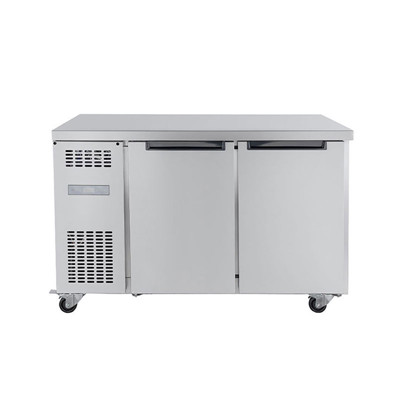
For example, HIYOO's Asian Series Counter Range Commercial Fridge, model DNH1200TN-PT / DNH1200BT-PT, features 70 mm polyurethane foam insulation.
This construction is designed to support thermal insulation performance in commercial kitchen environments.
When evaluating a refrigerator, buyers should consider insulation thickness together with door sealing, cabinet construction, and refrigeration system performance. These elements work together to determine the overall effectiveness of the equipment.
4. Performance Under High Ambient Temperatures
Commercial kitchens can be considerably warmer than residential environments. Cooking equipment, ventilation conditions, staff activity, and limited installation space can all contribute to higher surrounding temperatures.
A refrigerator that performs well in a household kitchen may not necessarily deliver the same performance in a busy restaurant.
This is why buyers should pay attention to the ambient operating temperature rating provided by the manufacturer.
The HIYOO DNH1200TN-PT / DNH1200BT-PT model is rated for ambient temperatures up to 43°C and relative humidity of 75%, according to its supplied product specifications.
Such specifications are particularly relevant for foodservice businesses operating in warm environments.
Nevertheless, proper installation remains essential. Sufficient ventilation clearance, appropriate electrical connections, and compliance with the manufacturer's installation guidelines all contribute to reliable operation.
5. Door Configuration and Condensation Prevention
Door design affects both product accessibility and everyday convenience.
Household refrigerators generally use solid doors with compartments designed for family storage. Commercial refrigerators may offer solid or glass door configurations depending on the intended application.
Glass doors provide better product visibility, allowing kitchen staff to identify stored ingredients without opening the refrigerator unnecessarily. Solid doors, meanwhile, are often preferred for back-of-house storage where visibility is less important.
Condensation is another issue worth considering, particularly in kitchens with high humidity.
Moisture can accumulate around door frames and central mullions, potentially affecting visibility and creating additional cleaning requirements.
The HIYOO Asian Series Counter Range Commercial Fridge incorporates anti-condensation heater wires around the door frame and center mullion. It also features LED lighting and self-closing doors.
These practical details help improve daily usability, particularly in commercial environments where equipment is accessed repeatedly throughout the day.
6. Energy Efficiency and Compressor Technology
Since commercial refrigeration equipment often operates continuously, energy consumption can have a noticeable impact on business operating costs.
The compressor, insulation, door sealing, temperature control system, and installation conditions all influence overall energy performance.
Inverter compressors are designed to adjust their operating output according to cooling demand. Rather than relying exclusively on repeated fixed-speed operation, they can regulate performance to match changing refrigeration requirements.
Depending on the system design and operating conditions, this approach can support more controlled operation and improved energy efficiency.
HIYOO's DNH1200TN-PT / DNH1200BT-PT commercial fridge is equipped with an inverter compressor.
When comparing refrigeration equipment, buyers should also review rated power, energy consumption data, refrigerant specifications, and applicable efficiency documentation.
Regular maintenance is equally important. Keeping accessible condenser areas clean, checking door gaskets, and ensuring that ventilation openings remain unobstructed can help maintain normal refrigeration performance.
7. Storage Capacity and Kitchen Space Utilization
Choosing refrigeration equipment is not simply about selecting the largest available cabinet. Businesses need to consider how the refrigerator fits into their actual kitchen workflow.
For example, restaurants may need refrigeration equipment positioned close to preparation counters so that staff can access ingredients quickly. Cafés may prioritize compact storage for beverages, milk, fruit, and prepared ingredients. Hotels and catering facilities may require different refrigeration arrangements for multiple food categories.
Counter range refrigerators offer an additional advantage by combining refrigerated storage with a working surface. This design helps businesses make more efficient use of limited kitchen space.
The HIYOO DNH1200TN-PT / DNH1200BT-PT has standard dimensions of 1200 × 760 × 800 mm.
Before purchasing, businesses should confirm the available installation area, door-opening clearance, electrical connection requirements, and maintenance access.
A refrigerator that fits the kitchen layout properly can contribute to a more organized and efficient working environment.
8. How to Choose the Right Refrigerator for Your Business
The right refrigeration equipment depends on the type of business, storage requirements, and expected operating conditions.
A household refrigerator is generally suitable for family kitchens and normal residential storage. However, its specifications and intended workload should be carefully considered before using it in a professional foodservice environment.
For restaurants, cafés, hotels, and catering operations, commercial refrigeration equipment is usually the more appropriate choice because it is designed around frequent access and demanding working conditions.
Before making a purchasing decision, consider these factors:
-
Application requirements: Determine what products need to be stored and how frequently staff will access them.
-
Cooling performance: Check the refrigeration system and specified temperature range.
-
Ambient conditions: Confirm that the equipment can operate under the expected room temperature and humidity.
-
Cabinet construction: Evaluate insulation thickness, door sealing, and overall build quality.
-
Door design: Select solid or glass doors according to storage and visibility requirements.
-
Installation dimensions: Make sure the unit fits the available kitchen space.
-
Energy performance: Review compressor technology and model-specific energy consumption information.
-
Maintenance support: Check cleaning requirements, spare parts availability, and after-sales service.
Taking these factors into account can help businesses select equipment that better matches their daily operational needs.
Final Thoughts
The difference between a commercial fridge and a household refrigerator goes far beyond appearance and storage capacity. Commercial refrigeration equipment is designed to handle more frequent access, changing product loads, higher ambient temperatures, and the practical demands of professional kitchens.
For foodservice businesses, selecting the right equipment means evaluating the complete refrigeration system, including cooling technology, insulation, compressor performance, door design, and cabinet dimensions.
HIYOO specializes in stainless steel refrigeration and catering equipment for professional applications. Its Asian Series Counter Range Commercial Fridge, DNH1200TN-PT / DNH1200BT-PT, combines ventilated cooling, 70 mm polyurethane foam insulation, an inverter compressor, anti-condensation heating, and self-closing doors.
For restaurant owners, kitchen equipment distributors, and foodservice operators, understanding these technical differences is an important step toward choosing refrigeration equipment that supports reliable daily operation and efficient kitchen management.
www.hiyoogroup.com
HIYOO
