In metal forming and industrial manufacturing, selecting the right hydraulic press can have a significant impact on production quality, operational efficiency, and long-term equipment reliability. For manufacturers working with sheet metal components, deep drawing, and complex forming processes, machine selection requires more than simply checking the rated pressing force.
Different forming applications require different levels of pressure control, slide movement, tooling support, and machine stability. A press that performs well in one production process may not necessarily meet the requirements of another.
This is why understanding the machine's structure and hydraulic configuration is essential before making a purchasing decision.
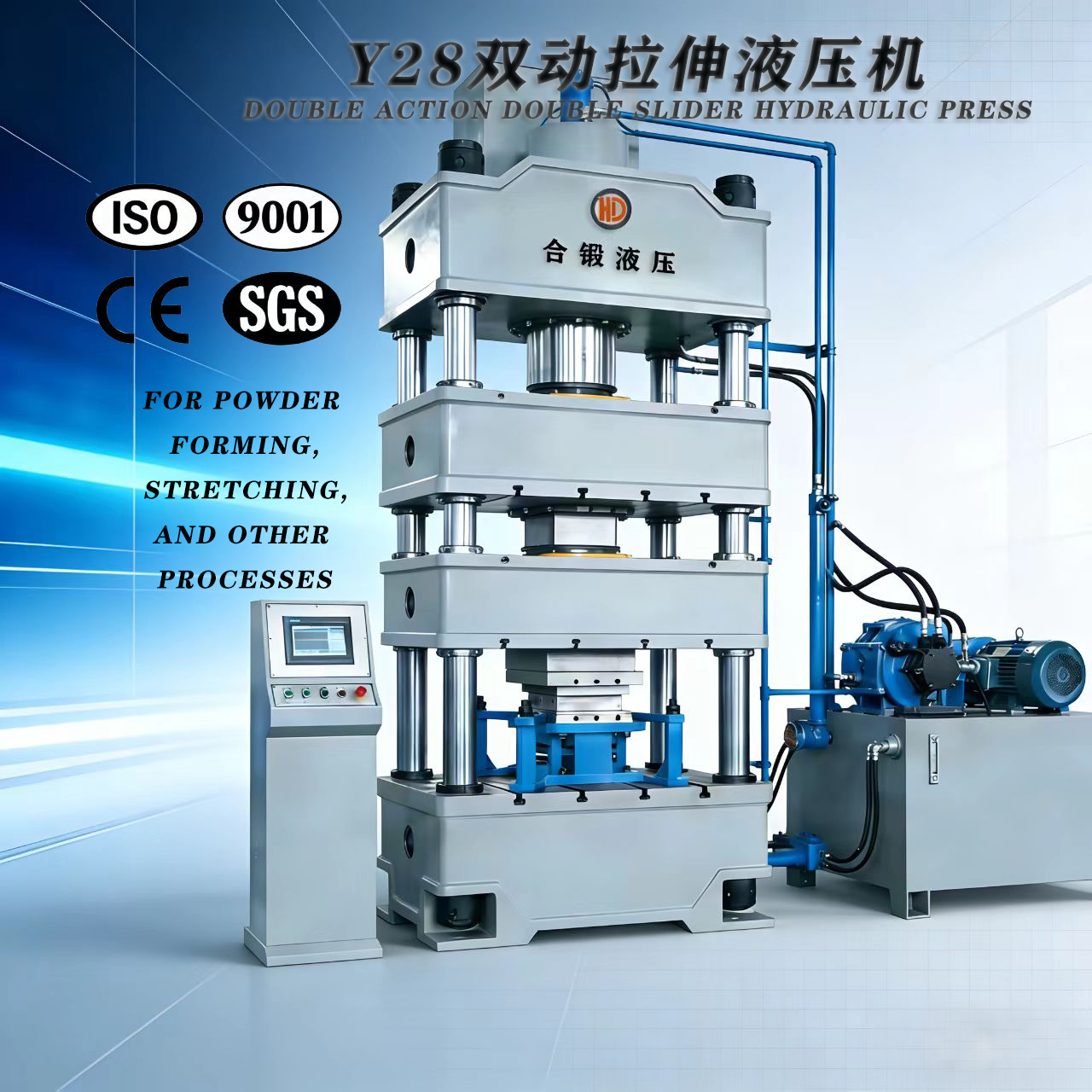
A Y28 double action hydraulic press is designed for forming applications that require coordinated pressing and blank-holder actions. Its mechanical structure, hydraulic system, and operating functions all contribute to the overall forming process.
Mingge specializes in hydraulic presses and industrial metalworking equipment, providing standard and customized machinery for different manufacturing requirements. Here are several important considerations for buyers evaluating a Y28 double action hydraulic press.
1. Understand How Double Action Hydraulic Presses Work
One of the first things buyers should understand is the working principle of a double action hydraulic press.
Unlike conventional single-action presses, double action hydraulic presses are designed to provide coordinated movement for the main forming slide and blank holder. This arrangement is particularly useful in deep drawing applications.
During the drawing process, a metal sheet is positioned over a forming die. The blank holder applies controlled pressure to help regulate material flow, while the main slide drives the sheet into the die cavity.
Proper coordination between these two actions helps reduce common forming problems, including material wrinkling and excessive thinning.
The actual forming performance depends on several factors:
-
Material type and mechanical properties
-
Sheet thickness and workpiece dimensions
-
Required drawing depth and forming geometry
-
Main cylinder force and blank-holder force
-
Die design and tooling arrangement
-
Slide movement and operating sequence
Before purchasing, manufacturers should provide the equipment supplier with representative workpiece drawings and material specifications. This information helps determine whether the proposed press capacity and configuration are suitable for the intended application.
It is also important to confirm the specific working arrangement of the selected Y28 machine, as hydraulic press configurations may differ between manufacturers.
2. Examine the Machine Frame and Structural Design
Machine rigidity is an important consideration for hydraulic presses because the main structural components must withstand repeated forming loads.
The upper beam, worktable, slide block, columns, and connecting structures work together to support the pressing process. Insufficient structural rigidity or poor alignment may affect equipment stability and forming consistency.
Mingge adopts computer-aided design methods to develop the major structural components of its hydraulic presses.
The machine features several important structural elements:
Upper Beam: The upper beam uses a box-type welded steel structure to accommodate the main working cylinder. A liquid filling tank is arranged externally.
Slide Block: The slide block is a box-type steel plate weldment with T-slots on its lower surface for mold installation. Its four-column guiding arrangement uses guide sleeves made from nano-molecular composite material, designed to provide wear resistance and support guiding precision.
Worktable: The worktable adopts a welded steel structure and connects with the upper beam through columns, forming the main supporting body of the machine.
The welded components undergo vibration aging treatment to help relieve residual stress generated during manufacturing. This treatment helps reduce the risk of stress-related deformation during subsequent machining and operation.
When comparing different hydraulic presses, buyers should evaluate more than external dimensions. The quality of the guiding system, structural connections, mold mounting surfaces, and overall frame construction should also be considered.
3. Pay Attention to Hydraulic Cylinder Quality
The hydraulic cylinder is a critical component because it generates the force required for forming operations. Its material quality, manufacturing process, sealing arrangement, and guiding structure all influence operating reliability.
According to Mingge's equipment specifications, the Y28 press adopts a five-cylinder arrangement within the upper beam.
The cylinder bodies are manufactured from 45# forged steel. The forging material undergoes ultrasonic flaw detection, followed by quenching and tempering treatment to meet the specified hardness requirements.
The cylinder sealing system uses double imported sealing rings. The guiding section also receives brazed copper treatment to support sealing performance and wear resistance.
These construction details are important for manufacturers operating equipment under repeated hydraulic loads.
When evaluating cylinder quality, buyers should confirm:
-
Cylinder material and manufacturing specifications
-
Rated operating pressure
-
Sealing components and replacement requirements
-
Inspection and quality-control procedures
-
Recommended maintenance intervals
A well-designed hydraulic cylinder helps support stable operation, but regular inspection and maintenance remain necessary to reduce the risk of leakage and component wear.
4. Evaluate the Hydraulic System and Pressure Control
The hydraulic system determines how the machine generates, distributes, and regulates working pressure. Its configuration directly affects slide movement and the ability to maintain the required forming conditions.
Mingge's Y28 hydraulic press uses an independent hydraulic power unit consisting of pumps, motors, valve manifolds, and an oil tank.
The system incorporates an axial piston pump as the main oil pump, together with two-way cartridge valves in the hydraulic circuit.
This valve arrangement is designed to provide a compact hydraulic layout, high flow capacity, and reliable sealing performance.
Other hydraulic system features include:
Pressure Adjustment: A remote pressure regulating valve allows operators to adjust the main cylinder pressure according to production requirements.
Pressure Monitoring: An electric contact pressure gauge monitors pressure in the upper cavity of the main cylinder and supports the configured pressure-stop function.
Hydraulic Protection: The pressure regulating arrangement allows excess oil to return when the system pressure exceeds the preset value.
Pipeline Stability: Flange connections and shock-resistant pipe clamps are used in the main hydraulic pipelines to help reduce vibration and leakage risks.
Oil Cleanliness: Hydraulic pipelines undergo pickling and passivation treatment before installation to help maintain system cleanliness.
For long-term operation, buyers should also review hydraulic flow capacity, operating pressure, cooling requirements, oil specifications, and filtration arrangements.
These factors should match the expected production workload and operating environment.
5. Choose the Right Operating Mode for Your Production Process
Different manufacturing processes require different machine operating arrangements. Some applications involve frequent mold changes and machine adjustments, while others focus on repeated forming cycles.
Mingge's hydraulic press provides two operating modes: adjustment (inching) and semi-automatic operation.
In adjustment mode, operators can control individual machine actions through the corresponding function buttons. This mode is primarily intended for machine setup, mold installation, and equipment adjustment.
In semi-automatic mode, pressing the work button initiates a production cycle. The operating sequence can be configured according to the customer's requirements.
The machine also incorporates a stroke control device for adjusting slide movement and a remote pressure regulating valve for setting main cylinder pressure.
These functions provide practical flexibility for different forming applications.
When selecting the operating configuration, manufacturers should consider the following questions:
-
How frequently will the machine require mold changes?
-
Does the forming process require adjustable slide movement?
-
What sequence of pressing and blank-holding actions is needed?
-
Will the machine operate independently or as part of a production line?
-
Would PLC control improve process management?
The standard electrical control system uses centralized button operation and can be configured with relay or PLC control. PLC control is available as an additional option.
The specified electrical supply is AC380V, 50Hz. Buyers should confirm the required voltage and frequency before installation to ensure compatibility with their factory power supply.
6. Make Machine Safety a Purchasing Priority
Hydraulic presses operate under considerable force, making safety protection an essential part of equipment selection.
A suitable machine should incorporate appropriate protection against excessive hydraulic pressure, electrical faults, and uncontrolled slide movement.
Mingge's Y28 hydraulic press includes several safety-related functions.
Emergency Stop: Separate stop and emergency-stop buttons are provided to support machine shutdown when required.
Motor Protection: Thermal protectors and circuit breakers are installed in the motor control section to provide protection against overload, overcurrent, and short circuits.
Slide Anti-Fall Protection: The main cylinder's lower cavity control block incorporates an anti-fall arrangement and safety valve, designed to help prevent uncontrolled slide descent.
Hydraulic Overload Protection: The hydraulic pressure regulating system allows excess oil to return when pressure exceeds the preset limit.
Pressure Monitoring: The electric contact pressure gauge helps monitor the main cylinder pressure and supports the configured pressure-stop function.
However, machine safety should never be judged by individual features alone. Buyers should verify the complete protective configuration, including guarding, emergency-stop circuit design, mold-changing procedures, and maintenance isolation arrangements.
Operators also need appropriate training in machine operation and emergency procedures. Maintenance personnel should follow the manufacturer's instructions for isolating electrical power and releasing stored hydraulic energy before servicing the equipment.
7. Why Manufacturer Experience and Customization Matter
Choosing a hydraulic press is not simply a matter of comparing technical specifications. The manufacturer's engineering experience and customization capabilities can also influence whether the equipment meets actual production requirements.
For specialized forming applications, standard machine configurations may need to be adjusted to accommodate particular workpiece dimensions, mold structures, or production processes.
Mingge specializes in hydraulic presses, automation series equipment, bending machines, shearing machines, and punching machines.
Its engineering and product development processes use 3D, CAD, and CAPP computer-aided design systems. The company also has experienced senior engineers and technical personnel involved in equipment development and special-purpose machine design.
These capabilities are particularly relevant when customers require customized hydraulic press solutions or integration with existing production equipment.
Before confirming an order, buyers should communicate the following information to the manufacturer:
| Evaluation Item | Information to Confirm |
|---|---|
| Workpiece | Material, thickness, dimensions, and forming depth |
| Press capacity | Required pressing force and operating pressure |
| Forming process | Main slide and blank-holder movement requirements |
| Tooling | Mold dimensions, mounting method, and installation space |
| Control system | Relay or PLC control configuration |
| Electrical system | Voltage, frequency, and power requirements |
| Safety | Emergency stop, guarding, and protective functions |
| Maintenance | Hydraulic oil, seals, filters, and spare parts |
| Technical support | Installation, commissioning, and operator training |
Providing complete technical information during the initial communication helps the manufacturer recommend a more appropriate machine configuration and reduces the possibility of specification mismatches.
8. A Practical Checklist Before Ordering a Y28 Hydraulic Press
Before making a final purchasing decision, manufacturers should review the entire equipment configuration rather than focusing on rated tonnage alone.
A practical evaluation should include:
-
Confirm that the double action forming principle matches the intended manufacturing process.
-
Verify the main cylinder and blank-holder force requirements.
-
Review the frame construction and guiding system.
-
Check cylinder materials, sealing arrangements, and inspection procedures.
-
Evaluate hydraulic pump capacity, pressure regulation, and filtration.
-
Confirm the operating modes and control system.
-
Review the complete safety configuration.
-
Discuss mold compatibility and customization requirements.
-
Clarify installation, commissioning, maintenance, and technical support.
If possible, buyers should also request technical documentation and discuss representative workpiece samples with the manufacturer before placing an order.
This approach makes it easier to evaluate the machine according to actual production conditions.
Conclusion
A Y28 double action hydraulic press can be an important piece of equipment for manufacturers involved in deep drawing and sheet metal forming. However, selecting the right machine requires a comprehensive understanding of its structural design, hydraulic cylinder quality, pressure control system, operating modes, and safety configuration.
Mingge combines hydraulic press manufacturing experience with computer-aided engineering and ongoing equipment development. Its Y28 hydraulic press incorporates a five-cylinder arrangement, a welded steel frame, an independent hydraulic power unit, and practical operating and protection functions.
For manufacturers considering new forming equipment, the best purchasing decision starts with a clear understanding of workpiece requirements, tooling arrangements, production targets, and operating conditions.
By working closely with an experienced manufacturer and verifying the technical specifications before ordering, buyers can select a hydraulic press configuration that better supports their production needs and long-term manufacturing plans.
For manufacturers considering a Y28 double action hydraulic press, the following factors deserve particular attention.
www.heduanpress.com
Mingge Electrical and Mechanical Equipment
