Understanding the Prostate-Specific Antigen Assay Landscape
A prostate-specific antigen (PSA) assay remains one of the most widely referenced tools in prostate cancer screening pathways. According to the PSA Consensus 2024 (UK), "the PSA blood test is the first step in the prostate cancer diagnostic pathway; it is a low-cost, safe, and effective way of identifying men who would benefit from further testing." For laboratories and clinicians evaluating assay options, the core question is not simply whether a PSA test is available, but whether the testing solution can deliver accurate, actionable results while minimizing unnecessary downstream procedures such as biopsies. This is the specific area where Poclight’s serum tumor marker portfolio—built around tPSA (Total Prostate-Specific Antigen) and fPSA (Free Prostate-Specific Antigen)—offers a structured, evidence-based approach.
tPSA: The Foundational Screening Marker
tPSA is positioned as the primary prostate cancer screening marker used to identify patients who require further investigation after an elevated result. The clinical threshold is well defined: tPSA > 4 ng/mL triggers additional investigation. However, this threshold alone presents a known pain point—low specificity in benign prostatic hyperplasia and prostatitis can create unnecessary biopsy burden for patients whose elevated readings are not caused by malignancy.
What differentiates Poclight’s tPSA offering is its organ-specific signal value. tPSA levels correlate directly with tumor burden and metastasis risk in prostate cancer, making it more than a binary screening cutoff. Critically, when tPSA results fall into the 4–10 ng/mL gray zone, calculating the fPSA/tPSA ratio increases prostate cancer detection specificity by 17.4% and reduces unnecessary biopsies. This reflex-testing logic transforms a single ambiguous result into a more clinically useful data point.
fPSA: The Companion Marker That Resolves Ambiguity
fPSA is not designed to function as a standalone test. It is positioned specifically as a companion marker to tPSA, built to refine prostate cancer detection within the tPSA gray zone. The underlying pain point it addresses is clear: tPSA alone in the 4–10 ng/mL range produces ambiguous results that often lead to unnecessary biopsies.
The differentiated value of fPSA lies in how it is interpreted alongside tPSA. A fPSA/tPSA ratio below 0.16 within the 4–10 ng/mL gray zone increases detection specificity by 17.4%, directly reducing unnecessary biopsy referrals. This works because fPSA reflects altered PSA isoforms—higher fPSA levels are generally associated with benign conditions, while lower fPSA levels are associated with malignancies. By pairing tPSA and fPSA, laboratories gain a biologically grounded method for distinguishing benign prostate conditions from cancer risk, rather than relying on a single cutoff value.
The Prostate Cancer Combined Detection Panel
Poclight packages these two markers into the Prostate Cancer Combined Detection Panel (tPSA + fPSA, F/T ratio), a reflex panel specifically designed to reduce unnecessary biopsies in men with tPSA results in the 4–10 ng/mL range. The panel addresses the same gray-zone ambiguity pain point described above, but at a solution level rather than a single-marker level.
Performance data reported for this combined panel shows a sensitivity of 44–67% and a specificity of 81–87%, with the combined-detection approach reducing false positives by 30% in the gray zone. For clinical departments managing high volumes of elevated-PSA referrals, this translates into a more efficient triage process: patients whose F/T ratio patterns align with benign findings can be managed with closer monitoring, while those with ratio patterns consistent with malignancy risk can be prioritized for further investigation. This panel is adapted for use in Urology and Oncology Department settings, aligning directly with where PSA-related decision-making occurs in clinical practice.
Supporting Technology: The C5000 Dry Micro System
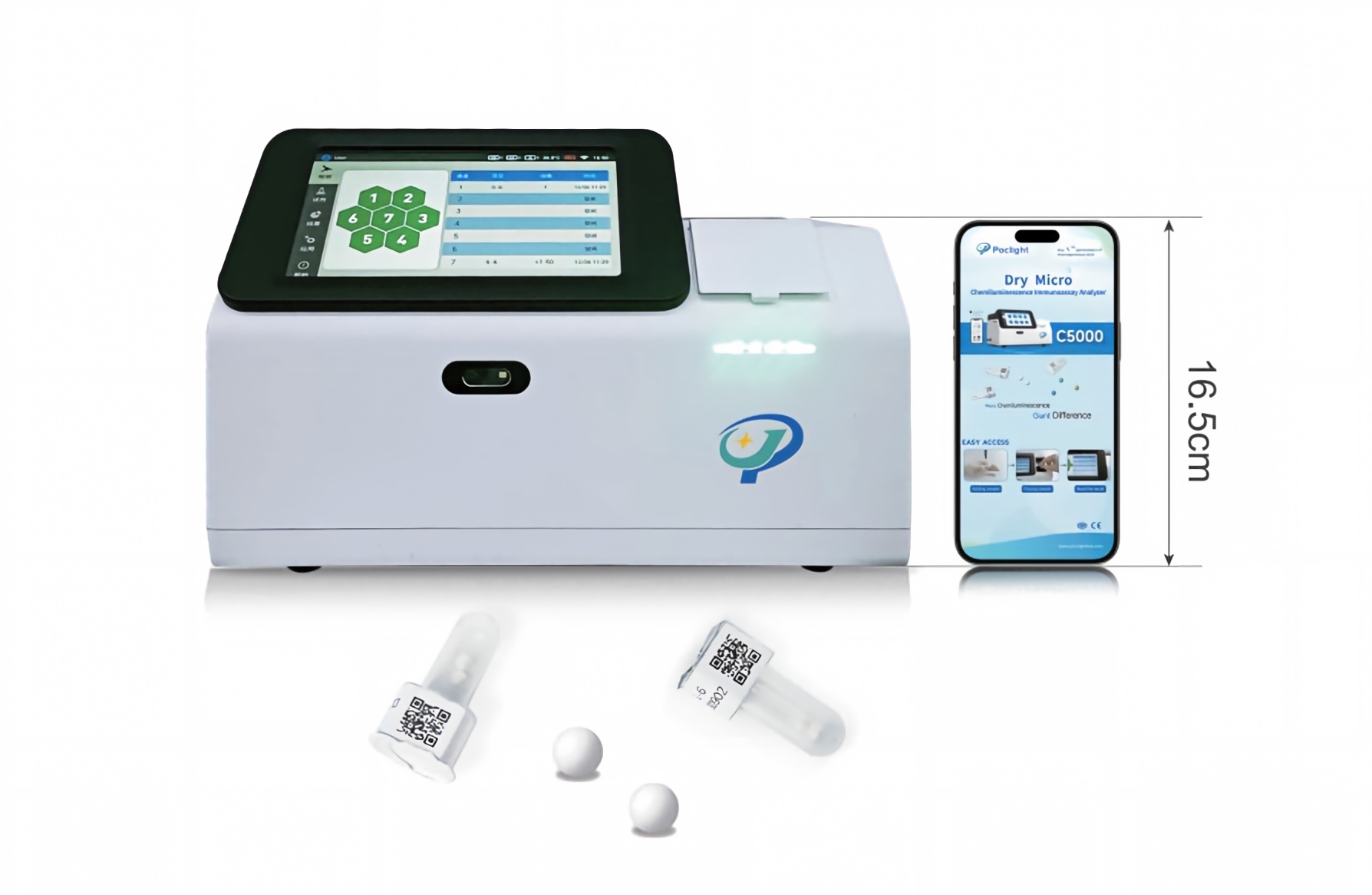
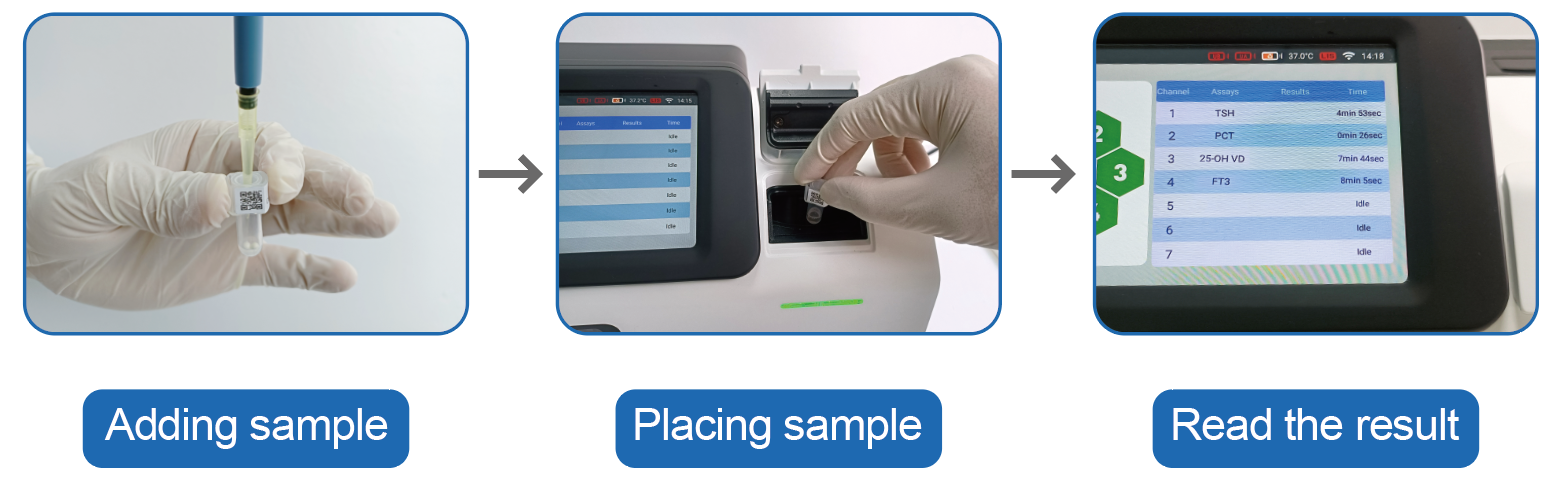
The analytical value of tPSA and fPSA testing depends heavily on the platform delivering the results. Poclight’s C5000 Dry Micro System is the diagnostic platform supporting this serum tumor marker testing. It is built on a dry micro reagent format, combining lyophilized and liquid complementary reagents with wash-free separation—meaning no magnetic beads and no complex liquid path are required.
From a technical performance standpoint, the system delivers a first sample result in 3 minutes, supports 7-channel testing, maintains an accuracy level of CV < 5% (with a more specific figure of CV < 3% cited for the system itself), and achieves a throughput of 80 tests/hour. Its compact form factor—weight ≤ 8.5 kg—combined with semi-automatic, portable operation, makes it suitable for settings that require rapid, low-maintenance testing. The system also features touch screen operation and supports LIS/HIS transmission, enabling real-time information sharing across hospital information systems. This combination of speed, simplicity, and connectivity directly supports the practical delivery of tPSA and fPSA results without the operational complexity associated with reagent handling or liquid-path maintenance.
Clinical Alignment and Departmental Fit
Both tPSA and fPSA, along with the combined panel, are adapted for use in Urology and Oncology Department environments—the two clinical settings most directly involved in prostate cancer diagnostic pathways. This alignment matters because it reflects how the assay is intended to function within existing clinical workflows: as a first-step screening and reflex-testing tool rather than a definitive standalone diagnostic.
The PSA Consensus 2024 (UK) reinforces this positioning by framing the PSA blood test as a low-cost, safe, and effective way of identifying men who would benefit from further testing—not as a final diagnostic endpoint. Poclight’s tPSA and fPSA offering, supported by the F/T ratio methodology and the Prostate Cancer Combined Detection Panel, is structured to operate within that same clinical logic: screen broadly with tPSA, refine ambiguous results with fPSA-based ratio calculation, and reduce unnecessary biopsy referrals in the gray zone.
Summary
For laboratories and clinical departments evaluating a prostate-specific antigen assay, the combination of tPSA, fPSA, and the Prostate Cancer Combined Detection Panel—delivered through the C5000 Dry Micro System—offers a structured pathway that connects screening, gray-zone refinement, and rapid turnaround. By addressing the specific pain points of low specificity in benign conditions and gray-zone ambiguity, and by quantifying improvements such as the 17.4% specificity increase and 30% reduction in false positives, Poclight’s approach to PSA testing is grounded in documented performance data rather than generalized claims, giving clinical teams a clear, evidence-based basis for evaluation.
www.poclight.com
Nanjing Poclight Biotechnology Co., Ltd
