Industrial automation lines increasingly require presence detection that goes beyond a simple on-off signal. Conventional photoelectric sensors are often affected by target color and material, struggle to detect transparent objects, and can generate false detections in complex backgrounds. On high-speed production lines, these limitations translate into missed detections, while outdoor installations or areas with strong ambient light introduce additional instability. Field installation and commissioning can also become time-consuming when sensors are sensitive to surface variation. KJT Sensors addresses these specific pain points with its ToF Laser Photoelectric Sensors, a product line built for non-contact object-presence detection, distance determination, positioning, and stable detection of transparent objects and complex backgrounds.
Why Time-of-Flight Detection Matters
The KJT Sensors ToF Laser Photoelectric Sensors determine distance from the travel time of the emitted signal rather than relying primarily on reflected light intensity. This time-of-flight approach supports stable detection of complex surfaces, transparent objects, and long-distance targets—conditions under which conventional photoelectric switches are typically less reliable. Because the measurement principle reduces dependence on target reflection, the sensors also reduce the influence of color, curvature, material, and environmental changes on the detection result. This is a meaningful distinction for manufacturers that handle mixed packaging materials, glass or plastic containers, or components with variable surface finishes.
Key Technical Capabilities
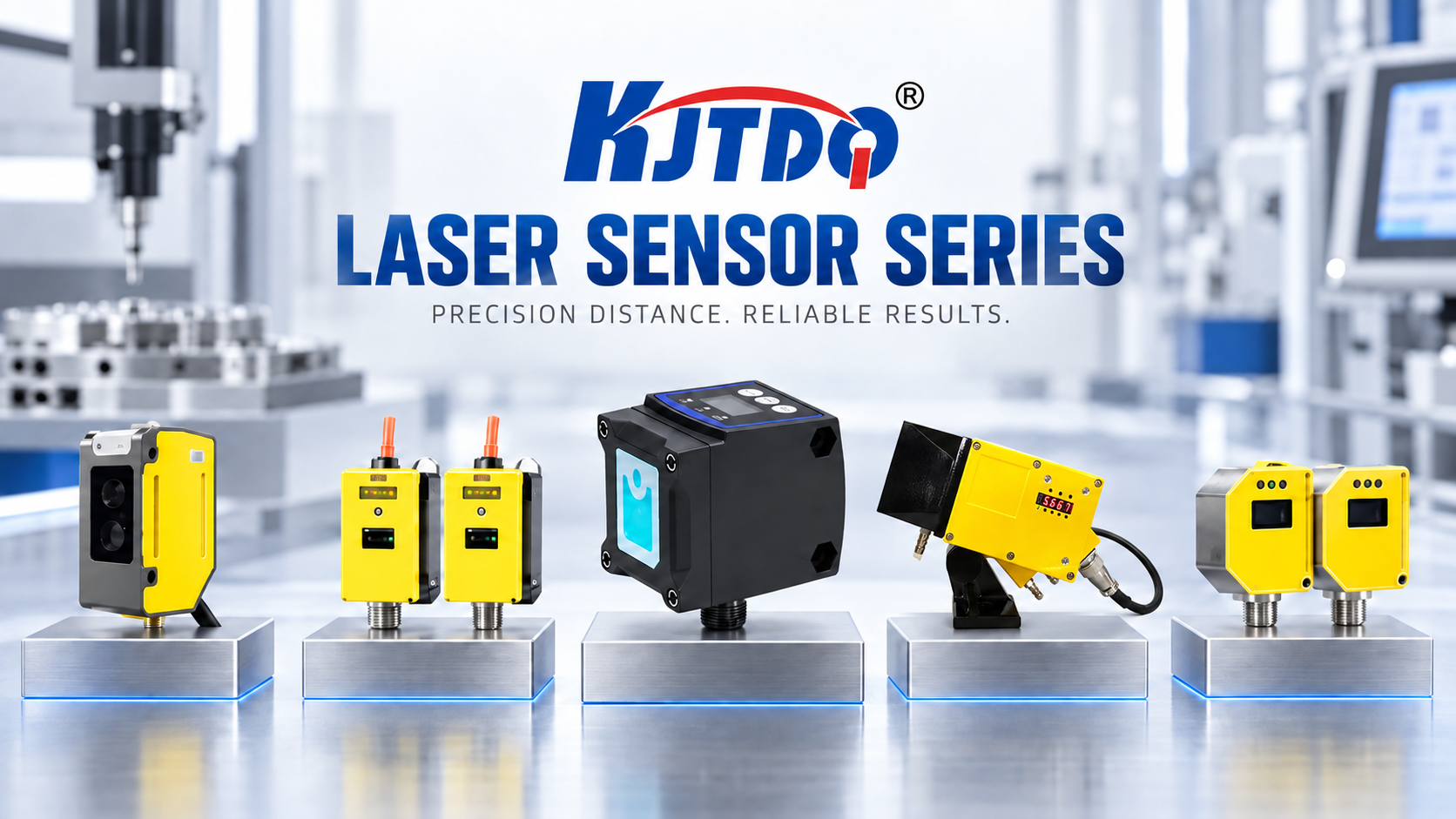
The ToF Laser Photoelectric Sensors series, including the KJT-FG40 series, offers sensing distances of 1 m, 2 m, and 4 m, giving integrators flexibility to match the sensor to the application layout. High-speed response is a core differentiator: switching frequency reaches up to 1,000 Hz, with an adjustable response time of 1 ms, allowing the sensors to keep pace with fast production lines where missed detections would otherwise occur. For outdoor or brightly lit environments, the sensors incorporate sunlight interference resistance, maintaining detection stability under strong-light conditions.
Connectivity is addressed through multiple output interfaces—NPN, PNP, RS-485, and 4–20 mA—so the sensors can be integrated into existing automation architecture without requiring a change in control-system design. This output flexibility reflects a broader platform capability at KJT Sensors, where signal interfaces across the company’s sensing portfolio, including NPN/PNP, relay, analog voltage, analog current, and RS-485 outputs, are designed for connection to PLCs, control cabinets, data-acquisition systems, inspection systems, supervisory computers, and safety-monitoring systems.
Core Functional Features
The ToF Laser Photoelectric Sensors support several functions relevant to presence detection applications:
- Distance determination based on time-of-flight measurement
- Object-presence detection independent of simple reflectivity
- Transparent-object detection for bottles, packaging film, and similar materials
- Complex-background suppression to reduce false triggers
- High-speed switching output suited to fast-moving production lines
- Outdoor-light detection with resistance to sunlight interference
These features work together to address the specific pain points that motivated the product’s design: unreliable detection of transparent objects, false detections from complex backgrounds, missed detections at high line speeds, and instability in strong outdoor light.
Delivery and Technical Confirmation
As a hardware sensor product, the ToF Laser Photoelectric Sensors are offered on a quotation basis. Standard models can be quoted quickly once the model and quantity are identified. For more demanding scenarios—complex detection objects, transparent-object applications, high-speed production lines, outdoor deployment, and volume projects for equipment manufacturers—KJT Sensors provides quotations after technical confirmation of site conditions and application parameters. This approach allows the company to match pricing and configuration factors, such as output type, detection distance, and communication interface, to the actual operating environment rather than offering a one-size-fits-all specification.
Industry Applications
The versatility of the ToF Laser Photoelectric Sensors is reflected in the range of industries and use cases they serve. In food-and-beverage packaging inspection, the sensors support detection tasks that conventional photoelectric switches struggle with, including transparent-bottle and transparent-packaging detection, as well as bottle-cap and label in-position detection. In logistics and warehousing, the sensors are applied to package inspection, logistics sorting, and smart-warehouse goods-in-position detection. On production lines, the sensors support production-line counting and electronic-component in-position detection, while also serving automated-equipment positioning tasks more broadly. For sites operating outdoors, the sensors are suited to outdoor-channel detection, and for safety-sensitive zones, they support equipment-safety-area detection.
This breadth of application reflects KJT Sensors’ broader strategic positioning: the company develops its product portfolio for industrial automation sites that require distance detection, position determination, target identification, and accurate measurement without direct contact, spanning switching output, distance signal output, machine safety, robotic navigation, and quality inspection needs.
A Platform Built for Integration
The ToF Laser Photoelectric Sensors are one component of a broader technology platform at KJT Sensors that includes laser-ranging, signal-output, parameter-setting and display, industrial-protection, and system-integration modules. This platform underpins sensing products across laser distance, laser displacement, LiDAR, ToF photoelectric, and measurement sensor categories, giving customers a consistent basis for selecting and integrating sensors across different parts of a facility. For companies evaluating presence-detection technology, this consistency can simplify vendor management, since output interfaces, protection ratings, and configuration approaches are shared design principles across the KJT Sensors catalog.
Conclusion
For industrial sites where conventional photoelectric sensors fall short—particularly when detecting transparent objects, operating at high line speeds, or working under strong ambient light—the KJT Sensors ToF Laser Photoelectric Sensors offer a time-of-flight-based alternative built around measurable technical specifications: sensing distances of 1 m, 2 m, and 4 m, switching frequency up to 1,000 Hz, a 1 ms adjustable response time, and multiple output interfaces for straightforward integration. Combined with KJT Sensors’ quotation process, which moves from fast standard-model pricing to technical confirmation for complex projects, the product line is positioned to support presence detection across food-and-beverage, logistics, electronics, and outdoor industrial environments.
https://www.kjt-sensors.com/
KJT Sensors
