- This topic is empty.
-
AuthorPosts
-
2026-07-13 at 8:17 pm #9705
Automated vehicle identification systems have become essential infrastructure for modern parking facilities, toll collection points, and fleet management operations. At the heart of these systems lies the integrated RFID reader—a device that combines reader module and antenna into a single, weatherproof enclosure. This review examines the performance characteristics, deployment considerations, and real-world effectiveness of integrated readers designed specifically for vehicle tracking applications.
What Makes an Integrated Reader Different
Unlike traditional multi-port fixed readers that require external antenna arrays and complex cabling, integrated readers consolidate all RF components into one housing. This design philosophy addresses a specific challenge in vehicle tracking: installation environments that demand minimal cabling, simplified mounting, and resistance to environmental extremes. The built-in high-gain circularly polarized antenna eliminates antenna selection guesswork and reduces system points of failure.
SeeMore IoT’s Symo Series integrated readers exemplify this category. These units feature IP66 or IP67 protection ratings, enabling operation in outdoor conditions where dust, moisture, and temperature fluctuations would compromise conventional equipment. The operating temperature range of -25°C to 75°C(-35°C to 85°C optional) ensures functionality across climates—from northern winter parking lots to equatorial loading yards. Shock and vibration resistance further extends reliability in high-traffic vehicle passage scenarios.
Core Performance Parameters That Matter
Read range stands as the most visible specification, yet it tells an incomplete story. In vehicle tracking, consistent detection matters more than maximum distance. A reader that achieves 10-meter range under ideal conditions but drops to 3 meters with metal interference delivers poor real-world performance. The Symo Series addresses this through stable operation across multiple frequency bands (FCC 902-928MHz, ETSI 865-868MHz, CMIIT 920-925MHz), ensuring compliance and optimal performance in regional deployment locations.
Adjustable RF output power from 5dBm to 33dBm allows field technicians to tune read zones precisely. This proves critical in parking entrance scenarios where adjacent lanes require isolated detection zones to prevent misreads. The EPC Gen2V2 and Gen2X protocol support ensures compatibility with modern vehicle windshield tags and specialty on-metal tags designed for fleet applications.
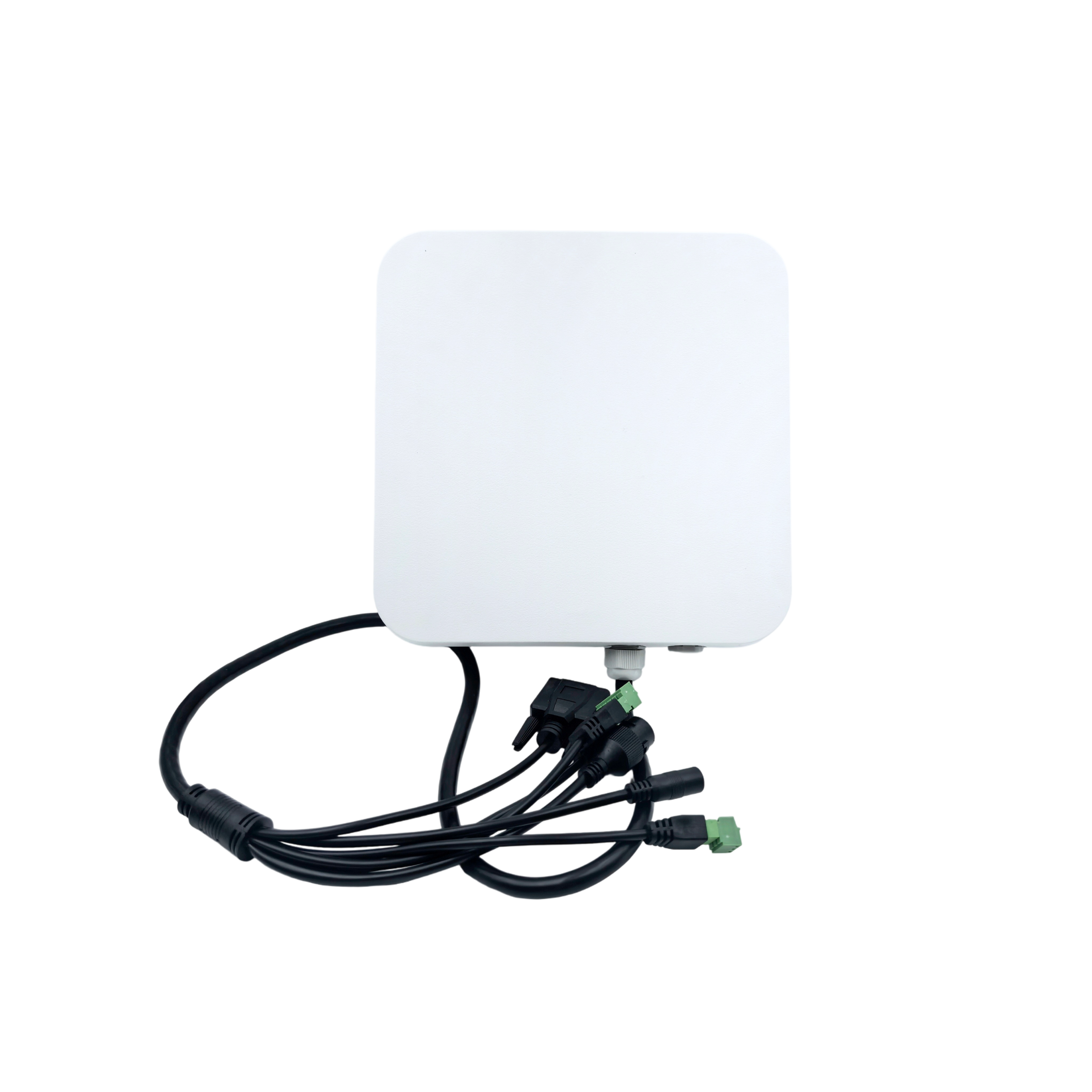
Interface versatility distinguishes professional-grade integrated readers from consumer-oriented products. RS232, RS485, Ethernet, GPIO, and Wiegand connectivity enable direct integration with parking barriers, traffic lights, PLC controllers, and access control panels. Optional Wi-Fi and Bluetooth expand deployment flexibility for temporary installations or retrofit projects where cabling presents challenges. PoE+ capability simplifies installation by delivering both data and power through a single Ethernet cable.
Real-World Deployment Scenarios
Waste collection vehicle tracking illustrates the integrated reader’s strengths. Municipal waste management operations require identification as trucks enter disposal facilities—environments characterized by metal interference from vehicles and equipment, dust from waste handling, and variable weather exposure. Traditional reader-plus-antenna systems require weatherproof enclosures for readers, protected cable runs to antennas, and ongoing maintenance of multiple connection points.
An integrated reader mounted on a pole at gate entry operates as a single-point installation. The built-in antenna’s circular polarization compensates for varying tag orientations as trucks approach at different angles. The IP67 rating protects internal electronics from pressure-washing overspray during facility cleaning. GPIO outputs trigger automated gate opening upon successful vehicle identification, while Ethernet connectivity logs each event to the facility management system.
Outdoor access control for gated communities and industrial sites represents another natural application. Wall-mount or pole-mount options accommodate existing infrastructure. The wide operating temperature range eliminates concerns about seasonal performance degradation. Wiegand output enables direct connection to established access control systems without middleware translation layers.
The Edge Computing Advantage
Modern integrated readers transcend simple tag-to-database relay functions. Devices running Linux operating systems with on-device processing capabilities perform data filtering, tag classification, and anomaly detection at the edge. This architectural approach reduces network bandwidth consumption and enables intelligent decision-making before data reaches backend systems.
In parking management, edge processing distinguishes authorized resident tags from visitor tags, filters out tags from passing vehicles outside the read zone, and flags duplicate reads within time windows. The reader outputs only relevant events rather than raw tag streams, simplifying application logic and reducing server processing loads.
Integration Efficiency and Developer Support
System integrators evaluate hardware not only on specifications but on integration effort. Open APIs with multi-language SDK support (C#, Java, C++, Python) significantly compress development timelines. PC demo software enables rapid proof-of-concept testing without writing code. Protocol documentation completeness determines whether integration proceeds smoothly or stalls on undocumented edge cases.
SeeMore IoT provides free SDKs with working examples that demonstrate common integration patterns. Firmware online upgrade support ensures deployed readers receive security patches and feature enhancements without truck rolls. This lifecycle support matters particularly in vehicle tracking applications where systems operate continuously for years.
Compliance and Quality Standards
Regional radio frequency regulations govern RFID reader deployment. Integrated readers destined for European markets require CE marking and ETSI compliance. North American installations demand FCC certification. Operators expanding across markets benefit from readers that carry multiple regional certifications rather than sourcing different hardware for each territory.
The ISO 9001 quality management framework ensures manufacturing consistency and supply chain reliability. For system integrators building commercial installations, vendor quality certifications reduce project risk and simplify qualification processes with end customers.
Performance in Challenging Environments
Vehicle tracking applications frequently operate in RF-hostile environments. Metal surfaces from vehicles, barriers, and structures reflect and absorb RF energy. Moisture from rain and humidity affects tag performance. High tag density during rush periods challenges anti-collision algorithms.
Integrated readers designed for these conditions incorporate anti-collision algorithms that maintain read accuracy when multiple vehicles enter read zones simultaneously. RSSI (Received Signal Strength Indicator) and phase angle reporting enable application-layer logic to distinguish strong reads from marginal detections, improving decision confidence in ambiguous situations.
Total Cost of Ownership Considerations
Purchase price represents only one component of system cost. Installation labor for multi-component systems often exceeds hardware costs. Integrated readers reduce installation time through simplified mounting and single-point connectivity. Fewer components mean fewer potential failure points and lower maintenance overhead across system lifecycle.
The availability of optional features—PoE power, wireless connectivity, GPIO expansion—allows right-sizing configurations to application requirements rather than over-specifying all deployments or under-provisioning critical sites.
Market Position and Application Fit
Integrated readers occupy a specific niche in the vehicle tracking hardware landscape. They excel in outdoor vehicle passage scenarios requiring weatherproofing, simplified installation, and moderate read range. They serve applications where space constraints or aesthetic requirements make separate reader-and-antenna installations impractical.
They are not optimal for scenarios requiring extensive read zone customization through antenna arrays, very long-range detection beyond 10-12 meters, or indoor controlled environments where multi-port flexibility justifies additional complexity.
Conclusion: Performance Meets Practicality
Effective vehicle tracking systems balance detection performance, environmental resilience, integration simplicity, and long-term reliability. Integrated RFID readers deliver this balance for outdoor passage scenarios where weather protection and installation efficiency drive hardware selection. The combination of built-in antennas, industrial protection ratings, comprehensive interface options, and edge processing capabilities addresses real-world deployment challenges that pure specification sheets overlook.
For system integrators and operators evaluating integrated readers for parking management, waste collection tracking, or fleet access control, the Symo Series integrated readers from SeeMore IoT demonstrate how purpose-built vehicle tracking hardware should perform—stable read rates in challenging environments, plug-and-deploy integration patterns, and quality standards that support multi-year operational lifecycles.
http://www.seemoreiot.com
SeeMore IoT Technology Co., Ltd. -
AuthorPosts

- You must be logged in to reply to this topic.