- This topic is empty.
-
AuthorPosts
-
2026-07-09 at 6:02 pm #9634
Understanding the Architecture Divide: DC Backup Systems vs AC UPS
When telecom operators, Internet Service Providers, and broadband network companies evaluate backup power solutions for subscriber-side equipment, one fundamental question shapes the entire project: Should we deploy traditional AC UPS systems or compact DC backup solutions? This architectural decision directly impacts installation complexity, space efficiency, energy conversion losses, deployment costs, and long-term maintenance pressure.
Traditional AC UPS systems follow a familiar path: grid AC power enters the UPS, gets converted to DC to charge internal batteries, then inverts back to AC output to power a device’s AC adapter, which finally converts AC back down to DC voltage for the actual equipment. This multi-stage conversion process introduces energy losses, generates heat, requires larger enclosures, and adds unnecessary complexity for devices that natively operate on DC power.
DC backup systems take a fundamentally different approach. They provide battery-backed DC power directly to the device, eliminating redundant AC-DC-AC-DC conversion stages. For networking equipment such as routers, ONTs, modems, gateways, CPE devices, and small communication terminals—all of which operate on DC power internally—this direct DC backup architecture offers compelling advantages in size, efficiency, installation simplicity, and deployment economics.
The core architectural difference is not merely technical—it directly affects project feasibility, customer acceptance, field installation efficiency, and total cost of ownership for telecom and ISP backup power programs.
Why Telecom and ISP Networks Need Rethinking Backup Power Architecture
Broadband and fiber networks have evolved rapidly, but one persistent challenge remains: keeping customer premises equipment online during power interruptions. When local grid power fails, even briefly, subscriber-side devices such as routers, ONTs, modems, and gateways can reboot, causing internet downtime, user complaints, remote troubleshooting pressure, and unnecessary field service dispatches.
Traditional AC UPS products were designed for desktop computers and office equipment, not for compact networking devices deployed in residential and small business environments. These legacy systems are often too bulky, too expensive, too complex to install, and poorly matched to the actual power requirements of modern subscriber equipment.
MYLION, a specialized Mini DC UPS and telecom BBU solution provider based in Shanghai, China, has focused on solving this architectural mismatch for over 13 years. The company’s core positioning centers on compact, safe, and project-ready backup power systems designed specifically for broadband, fiber, ISP, telecom, and network infrastructure applications across Europe, North America, Australia, Latin America, Africa, the Middle East, and Asia.
Unlike generic UPS suppliers, MYLION supports project-based model selection based on actual device power consumption, startup surge current, backup time target, installation environment, certification needs, labeling requirements, and mass production feasibility. This engineering-driven B2B approach helps telecom operators, ISPs, and system integrators deploy backup power solutions that actually match real-world device requirements rather than forcing networking equipment into oversized, over-engineered AC UPS architectures.
Architectural Advantages of DC Backup Systems for Networking Equipment
Energy Efficiency and Reduced Conversion Loss
AC UPS systems require multiple power conversion stages: AC to DC for battery charging, DC to AC for output, then AC back to DC inside the device’s power adapter. Each conversion introduces efficiency losses, typically ranging from 10% to 20% cumulative loss across the entire power path.
DC backup systems eliminate these intermediate conversions by providing battery-backed DC power directly at the voltage and current levels the device actually requires. This direct power path reduces energy waste, lowers heat generation, and improves overall system efficiency—especially important for devices operating in continuous standby mode for months or years.
MYLION’s Mini DC UPS product line, including models such as MU68, MU26, and MU48 for standard 12V applications, and MU35 and MU65 for higher-current gateway and router backup, is engineered around this direct DC architecture principle. By matching output voltage, current capacity, and connector types to real device specifications, these systems avoid the inefficiency overhead inherent in traditional AC UPS designs.
Compact Form Factor and Space Efficiency
Traditional AC UPS units require larger enclosures to house AC-DC inverter circuits, AC output sockets, cooling systems, and safety isolation components. This makes them impractical for customer premises installations where space is limited, aesthetic concerns matter, or clean installation is required.
DC backup systems can be designed in compact, inline, or device-adjacent form factors because they eliminate bulky inverter components. For FTTH and fiber broadband deployments, where ONTs, routers, and modems are often installed in tight spaces near wall-mounted fiber terminal boxes, this size advantage becomes critical for practical deployment.
MYLION’s inline FTTH Mini UPS model MUJ46 exemplifies this space-saving approach. Designed to connect between the original power adapter and the device, this ultra-compact solution provides DC-side backup without requiring additional shelf space, desktop footprint, or visible equipment clutter—making it especially suitable for residential broadband, fiber terminal, and customer premises installation environments.
Simplified Installation and Lower Deployment Complexity
AC UPS deployment requires AC outlet access, proper grounding, surge protection coordination, and often additional cable management. For field technicians installing subscriber-side backup power during fiber network rollouts or ISP equipment upgrades, this complexity translates into longer installation time, higher labor costs, and increased risk of installation errors.
DC backup systems simplify deployment by working directly with existing DC power adapters. Installation typically involves connecting the backup unit inline with the device’s DC power path—a process that requires minimal technical training, fewer tools, and less time per installation site.
This deployment simplicity becomes especially valuable for large-scale ISP and telecom projects where hundreds or thousands of subscriber locations need backup power support. Lower per-site installation costs and faster deployment cycles directly improve project economics and rollout timelines.
Better Matching to Device Power Requirements
Networking devices operate on specific DC voltages—typically 5V, 9V, 12V, 15V, 24V, or 48V depending on the equipment type. AC UPS systems provide generic AC output, forcing reliance on the device’s original power adapter for voltage regulation and DC conversion. This creates a mismatch: the UPS doesn’t "know" the device’s actual DC power requirements, working current, startup surge behavior, or connector specifications.
DC backup systems can be matched precisely to device voltage, current capacity, connector type, and cable length. This matching process—when done correctly—ensures the backup power system can handle not just steady-state operating current, but also startup surge, peak load conditions, and safety margins appropriate for the specific device model.
MYLION supports this device-matching approach through application-focused engineering communication. Before model confirmation, the company helps customers evaluate real working current, peak current, adapter rating, load behavior, backup time target, and safety margin—rather than relying solely on adapter label specifications, which often overstate actual device requirements. This matching discipline helps customers avoid wrong product selection, insufficient runtime, connector mismatch, and unsafe overload conditions.
Enhanced Battery Safety and Management
DC backup systems integrate battery management systems (BMS) designed specifically for DC power applications. These BMS circuits provide protection against overcharge, over-discharge, overcurrent, short circuit, and abnormal operating conditions—all tuned to the DC output requirements of networking equipment.
Traditional AC UPS systems must manage both AC output quality and battery protection simultaneously, which can complicate protection logic and increase component count. DC backup systems simplify this protection architecture by focusing exclusively on DC output stability and battery safety.
MYLION’s product range includes both standard lithium-ion and LiFePO4 battery options depending on project requirements. The LiFePO4 Mini UPS model ML1202AC, for example, provides enhanced battery safety, longer cycle life, and improved thermal stability compared with standard lithium-ion systems—particularly valuable for customers who prioritize battery safety, stability, and service life in long-term standby applications.
Application-Specific DC Backup Solutions for Modern Telecom Networks
Standard Router, ONT, and Modem Backup
The majority of subscriber-side networking equipment operates on 12V DC power with working currents ranging from 1A to 3A. For these mainstream applications, compact 12V DC backup solutions provide the optimal balance of size, capacity, cost, and deployment simplicity.
MYLION’s 12V Standard Mini DC UPS Series—including models MU68, MU26, and MU48—addresses these mainstream router backup, ONT backup, and modem backup applications. These models support application matching based on real device voltage, working current, connector type, backup time target, and installation environment, helping ISPs and broadband operators deploy subscriber-side backup power programs with correct technical specifications and realistic runtime expectations.
High-Power Gateway and Advanced Router Backup
Next-generation broadband gateways, WiFi 6 routers, and advanced CPE devices may require higher operating currents—sometimes exceeding 3A or even approaching 5A under full load conditions. Standard low-current Mini UPS models cannot safely support these devices, leading to shutdowns, restarts, or protection circuit activation during customer testing.
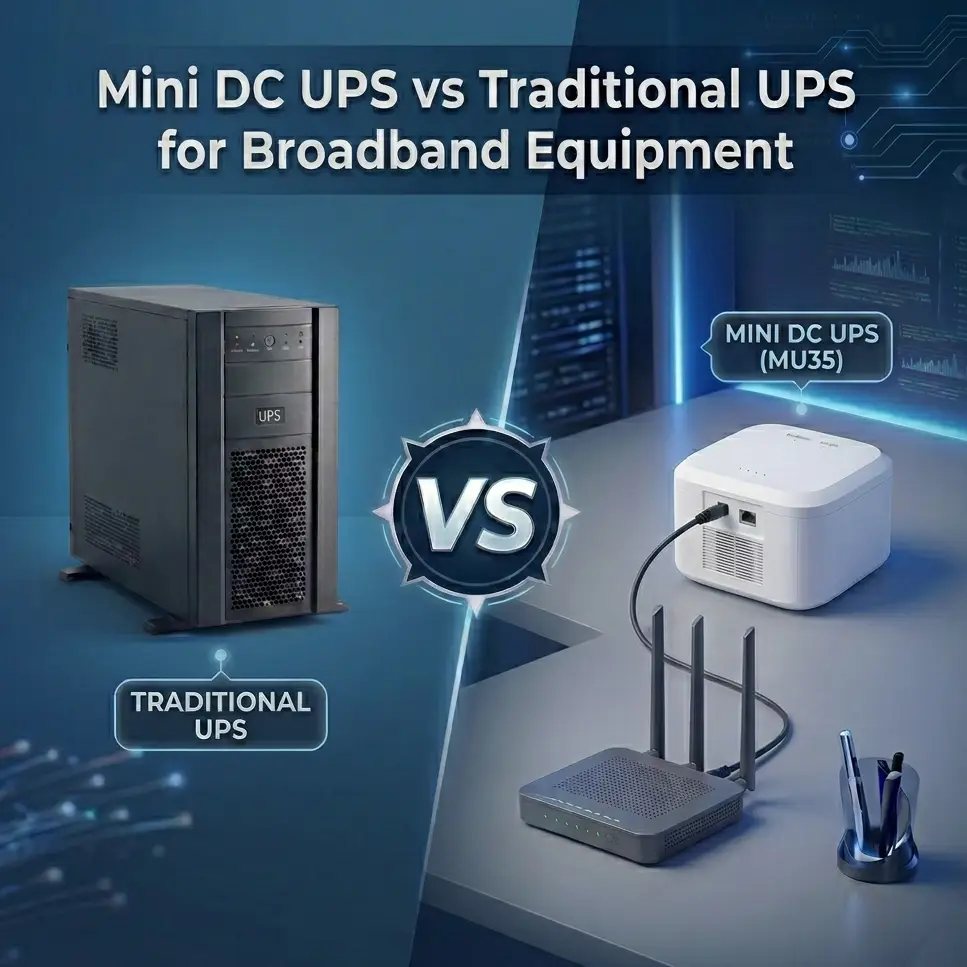
MYLION’s High-Power 12V Telecom BBU Series—models MU35 and MU65—provides high-current 12V backup solutions designed specifically for these demanding gateway and router applications. These models support project-based matching where real working current, peak current, adapter rating, load behavior, backup time target, and safety margin are evaluated before final model confirmation—helping customers avoid under-rated backup power selection for higher-performance networking equipment.
USB-C PD and Modern Device Architectures
As networking equipment evolves toward USB-C Power Delivery input architectures, traditional DC barrel connector backup solutions become incompatible. Modern routers, smart gateways, hubs, and terminals increasingly use USB-C PD power input instead of legacy DC barrel connectors, requiring backup power systems that support USB-C voltage negotiation and power delivery protocols.
MYLION’s USB-C PD Mini UPS model MUC85 addresses this emerging requirement. By providing USB-C PD power output with built-in lithium battery backup and automatic switchover during power interruption, this solution helps ISPs, distributors, and device brands prepare for USB-C-based power backup demand in next-generation networking equipment.
Higher-Voltage Applications: 24V and 48V DC Equipment
While most consumer-grade networking equipment operates on 12V or lower voltages, professional telecom devices, wireless CPE, small communication terminals, and access network equipment may require 24V or 48V DC power. Traditional 12V Mini UPS products cannot support these higher-voltage applications, creating a gap in the backup power solution portfolio.
MYLION’s 24V / 48V DC Backup Power model MU248 provides higher-voltage DC backup options for selected telecom and communication devices. This product line supports professional application requirements where higher DC voltage input is specified, helping customers deploy compact DC backup architecture without relying on bulky AC UPS systems for equipment that natively operates on 24V or 48V DC power.
Strategic Considerations for Telecom and ISP Backup Power Projects
Total Cost of Ownership Beyond Initial Hardware Price
When evaluating DC backup systems versus AC UPS architecture, purchase price represents only one component of total cost. Installation labor, deployment time, field service complexity, maintenance requirements, replacement cycles, and energy consumption all contribute to long-term project economics.
DC backup systems typically offer lower installation costs due to simpler deployment procedures, reduced training requirements, and faster per-site installation times. Over hundreds or thousands of subscriber locations, these per-site savings accumulate into significant project-level cost advantages.
Certification, Documentation, and Project Readiness
B2B telecom and ISP projects require proper technical documentation, safety certifications, transport compliance for lithium battery shipments, and project-specific labeling or packaging. Generic consumer UPS products often lack the certification flexibility, documentation support, or customization capability needed for large-scale operator deployments.
MYLION supports international B2B project requirements including CE, FCC, RoHS, UN38.3,ՄSDS, IEC 62368-related evaluation, and other certification documents depending on specific model and project requirements. The company understands lithium battery export requirements and supports shipping documentation, labeling, and safe transport coordination for international battery shipments—critical capabilities for telecom operators and ISPs deploying backup power across multiple countries or regions.
OEM, ODM, and Private Label Flexibility
Large-scale telecom and ISP deployments often require customized branding, specific connector types, tailored cable lengths, custom capacity configurations, or project-specific packaging. Retail-oriented UPS suppliers typically cannot support these customization requirements at reasonable minimum order quantities or within acceptable project timelines.
MYLION provides OEM and ODM services including private label, customized packaging, connector matching, cable customization, capacity adjustment, product appearance support, and project-specific documentation. This customization capability helps telecom operators, ISPs, and system integrators deploy backup power solutions that match their specific technical requirements, branding standards, and deployment procedures rather than adapting their projects to fit generic off-the-shelf products.
Long-Term Supply Reliability and Product Consistency
Backup power deployments for subscriber-side equipment often span multiple years with ongoing demand for replacement units, expansion phases, and maintenance inventory. Supply interruptions, product discontinuations, or specification changes can disrupt these long-term programs and create compatibility problems with installed equipment bases.
MYLION focuses on stable product quality, repeatable production, traceable inspection, and reliable communication for long-term B2B cooperation. The company’s engineering-driven approach emphasizes consistent manufacturing processes, quality control procedures, and supply chain management designed to support multi-year telecom and ISP backup power programs with predictable product availability and specification stability.
Conclusion: Architectural Choice Shapes Project Success
The choice between DC backup systems and traditional AC UPS architecture is not merely a technical preference—it fundamentally shapes project feasibility, deployment economics, installation complexity, and long-term operational efficiency for telecom and ISP backup power programs.
For subscriber-side networking equipment that operates natively on DC power, compact DC backup systems eliminate unnecessary conversion stages, reduce deployment complexity, improve space efficiency, and enable better matching to actual device requirements. These architectural advantages translate into faster deployment cycles, lower per-site installation costs, improved energy efficiency, and better alignment with real-world customer premises installation environments.
Shanghai Mylion New Energy Co., Ltd., through its MYLION brand and MYLIONTECH.COM platform, has specialized in this DC backup architecture for over 13 years, serving telecom operators, Internet Service Providers, broadband network companies, system integrators, and OEM/ODM customers across global markets. The company’s product portfolio—spanning standard 12V Mini DC UPS, high-power telecom BBU, inline FTTH backup solutions, USB-C PD backup power, and higher-voltage DC backup options—reflects deep understanding of real-world deployment requirements in broadband, fiber, ISP, and network infrastructure applications.
For telecom and ISP organizations evaluating backup power strategies for subscriber equipment, the architectural advantages of purpose-built DC backup systems deserve serious consideration. The right technical architecture, properly matched to device requirements and deployment realities, can transform backup power from a deployment obstacle into a competitive service differentiator—helping operators deliver more reliable broadband connectivity, reduce service interruption complaints, and lower field maintenance pressure in unstable power environments.
http://www.myliontech.com
Shanghai Mylion New Energy Co.,Ltd. -
AuthorPosts

- You must be logged in to reply to this topic.