- This topic is empty.
-
AuthorPosts
-
2026-08-31 at 7:59 pm #10521
Network equipment such as routers, modems, and ONTs often reboot or lose service during short power outages, voltage drops, or unstable grid conditions. For telecom operators, Internet Service Providers, broadband network companies, fiber network operators, and system integrators planning an OEM mini UPS deployment, the specification document is the single most important tool for avoiding costly selection mistakes. Improper UPS selection regarding voltage, current, peak load, or connectors can lead to application failure in the field—an outcome that is far more expensive to correct after mass production than before it.
Why a Detailed Specification Prevents Field Failures
A mini UPS project specification is not a formality. It is the technical bridge between a customer’s real device requirements and the backup power hardware that will support them. Because network equipment varies widely in voltage class, current draw, and startup behavior, a specification built on assumptions rather than verified device data creates real risk. Evaluating solutions based on real device voltage, working current, peak or startup behavior, and installation environment—paired with technical confirmation and connector or cable matching—reduces selection errors before hardware is committed to a production run.
Core Electrical Parameters That Must Be Defined
Voltage and Continuous Current
Every specification should state the exact DC input voltage class (commonly 12V, with higher-voltage directions such as 24V/48V under separate evaluation) and the continuous current the connected device draws under normal operation. For example, standard 12V Mini UPS products in the entry-level to mainstream broadband backup category typically support inputs up to 3.5A and outputs in the range of 2.5A continuous / 3A maximum, while high-power 12V solutions are built for equipment exceeding that threshold, supporting inputs up to 6A and outputs of 4A continuous / 5A maximum (60W total).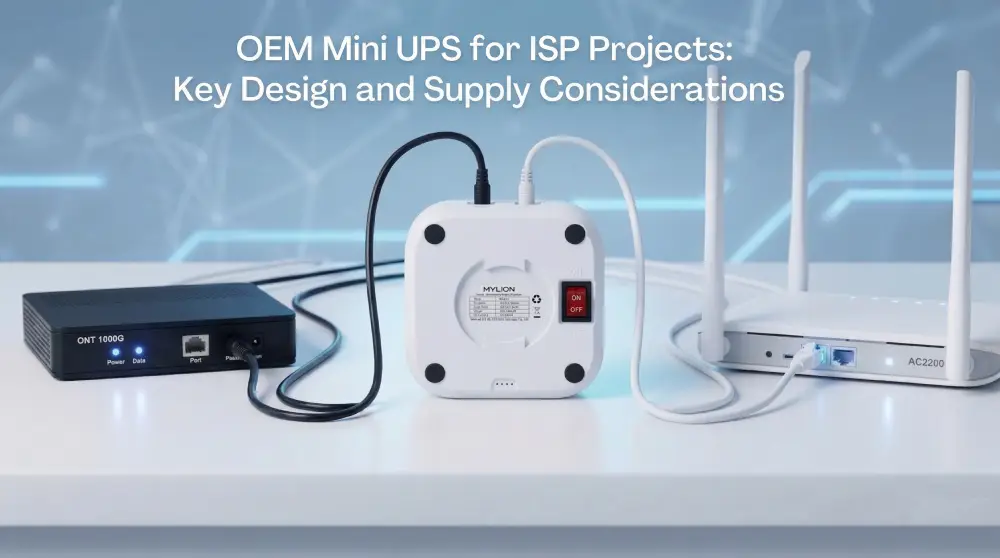
Peak and Startup Behavior
Startup current spikes are a frequent cause of application failure when they are not accounted for during selection. A complete specification documents not only steady-state current but also peak or startup current, since a UPS rated only for continuous load may fail to support a device’s inrush requirements.Battery Capacity and Chemistry
Runtime requirements should be expressed in battery energy (Wh), matched to the outage duration the project needs to cover. Product lines illustrate the range of options available: standard capacity tiers span from roughly 18.72Wh to 44.4Wh, long-runtime tiers reach 75.6Wh, and higher-capacity development directions extend to 92.16Wh and 102.4Wh. Chemistry should also be specified explicitly—LiFePO4 integration is used in several product lines and carries specific transport and safety documentation implications that must be captured in the specification.Connector and Cable Compatibility
Even a perfectly matched voltage and current rating can fail in the field if the physical interface is wrong. Specifications should define input and output connector types precisely—examples include DC5521 input paired with DC5525 output configurations, or center-positive DC5525 output—along with polarity and cable length requirements. Connector and cable matching is a distinct evaluation step that should never be assumed based on voltage class alone.
Platform and Device Compatibility
A rigorous specification identifies the exact device categories the UPS must support: routers, ONTs, ONUs, modems, gateways, CPE devices, and security or CCTV equipment. Because compatibility with any of these platforms is subject to electrical verification, the specification should require confirmation against the actual target device rather than relying on general category assumptions. Some deployments also require multi-device support from a single unit—for instance, combined 12V DC output alongside 5V USB-A and USB-C outputs for powering a router and a USB accessory simultaneously, or dual 12V DC output configurations for managing two separate 12V devices, such as an ONT and router, from a single AC wall outlet input of 100–240V AC.
Documentation and Compliance Requirements
Lithium battery-based backup power products carry specific compliance obligations that must be written into the project specification from the outset. This includes UN38.3 transport certification and Material Safety Data Sheet (MSDS) documentation, both evaluated on a model-specific basis. A specification that omits these requirements risks delays during import, distribution, or installation phases of a project.
Service and Delivery Model Considerations
Beyond the hardware itself, an OEM mini UPS specification should define the service model governing the relationship between buyer and supplier. This includes requirement analysis, model matching, sample testing support, connector and cable matching, private labeling, and documentation coordination. For B2B project support and OEM/ODM services, the specification should also outline the path from managed pilot evaluation through mass-production preparation, ensuring that any adjustments identified during sample validation are captured before a full production commitment is made.
Reference Points Across Product Categories
Reviewing how different product lines address distinct use cases helps illustrate the breadth of parameters a specification may need to cover. Standard 12V series products serve entry-level to mainstream broadband backup. Long-runtime series pair standard 12V output with higher battery energy for extended outages. High-power series address equipment exceeding standard current thresholds, such as high-performance WiFi equipment and storage-integrated gateways. High-power long-runtime series combine elevated output current with maximum battery capacity for professional gateways requiring both peak current and long backup time. Multi-output series address SOHO setups needing simultaneous 12V and 5V device support. AC-input dual output series simplify deployment for dual-device installations without requiring an external DC adapter. Development-stage directions—including USB-C Power Delivery designs supporting WiFi 6/7 devices and higher-voltage 24V/48V telecom backup directions for wireless CPE and radio bridge equipment—represent categories still under project evaluation rather than standard hardware, and should be labeled accordingly in any specification referencing them.
Building a Complete Specification Checklist
A thorough OEM mini UPS project specification should therefore capture, at minimum: the target device’s real operating voltage and current; peak or startup current behavior; required runtime expressed in battery energy; battery chemistry and associated compliance documentation such as UN38.3 and MSDS; exact connector types and polarity; the full list of platforms the unit must support, subject to electrical verification; any multi-output or dual-device requirements; and the service scope covering sample validation, private labeling, and documentation coordination through to mass-production readiness.
Shanghai Mylion New Energy Co., Ltd., operating under the MYLION brand from its Shanghai headquarters with global business coverage, works with telecom operators, ISPs, broadband network companies, fiber network operators, and system integrators as a B2B backup power and OEM/ODM project partner. Drawing on more than 13 years of experience in lithium battery technology and more than 10 years in Mini UPS development, the company positions its specification process around confirming real device requirements before committing to hardware selection—an approach intended to support more reliable DC backup deployment and reduce avoidable selection risks for professional project customers. Additional detail on specific product lines and technical documentation is available at http://www.myliontech.com.
http://www.myliontech.com
Shanghai Mylion New Energy Co.,Ltd. -
AuthorPosts

- You must be logged in to reply to this topic.