Heavy equipment used in construction, agriculture, mining, and material handling faces a common challenge: it must deliver reliable power while operating under demanding conditions. Excavators need strong digging and lifting capabilities, agricultural machinery requires responsive movement, and industrial lifting equipment must handle heavy loads with consistent stability.
Behind many of these operations is a hydraulic system.
Unlike mechanical transmission systems that rely on complex gear arrangements, hydraulic technology uses pressurized oil to transfer power and control mechanical movement. This makes it possible to generate substantial force within a relatively compact structure. For equipment manufacturers, a properly designed mobile hydraulic system is essential to achieving reliable performance, smooth operation, and efficient use of installation space.
But what makes a hydraulic system suitable for mobile machinery? Let's look at the key factors that influence its performance and selection.
Why Hydraulic Systems Are Widely Used in Heavy Equipment
Hydraulic technology has become a standard solution for many types of industrial and mobile machinery because of its ability to handle high loads and provide flexible motion control.
Consider an excavator. Its boom, arm, and bucket need to perform different movements, often within the same working cycle. Hydraulic cylinders provide the force required for lifting and digging, while hydraulic motors can drive rotating mechanisms. By controlling oil pressure and flow, the system allows operators to adjust movement according to actual working conditions.
Similar requirements exist in loaders, agricultural equipment, aerial work platforms, mining machinery, and specialized transport vehicles.
A well-configured hydraulic system offers several practical advantages:
-
High force output: Pressurized oil allows hydraulic cylinders to generate substantial mechanical force.
-
Flexible movement control: Valves regulate oil direction and flow to control actuator movement and speed.
-
Compact installation: Hydraulic components can be arranged in different configurations to suit equipment layouts.
-
Adaptability: Hydraulic circuits can be designed around different load conditions, operating cycles, and functional requirements.
-
Integration potential: Hydraulic systems can work with electrical controls, sensors, and automated operating functions.
These advantages make hydraulic power particularly useful when machinery needs to combine high output with precise movement.
How Does a Mobile Hydraulic System Work?
Although hydraulic systems can vary considerably in structure, their basic working principle is relatively straightforward.
A drive motor or another mechanical power source drives the hydraulic pump. The pump draws oil from the reservoir and supplies it to the hydraulic circuit. The oil then passes through valves that regulate pressure, flow rate, and direction.
Depending on the control signals and operating requirements, the pressurized oil is directed to hydraulic cylinders or motors.
Cylinders convert hydraulic energy into linear movement, supporting functions such as lifting, pushing, extending, and positioning. Hydraulic motors convert hydraulic energy into rotational movement, which can be used for driving or rotating mechanical components.
After completing its work, the oil returns to the reservoir through the return circuit, where it can be filtered and prepared for the next operating cycle.
The actual performance of the system depends on how well the pump, valves, actuators, pipelines, and oil reservoir work together. Simply choosing a high-capacity pump does not necessarily guarantee better equipment performance.
Five Important Factors That Affect Hydraulic System Performance
1. Pump Capacity and Operating Pressure
The hydraulic pump is responsible for supplying the oil required by the system. Its flow rate directly influences actuator speed, while operating pressure determines the force that hydraulic cylinders can generate.
For equipment manufacturers, pump selection should be based on the machine's actual load requirements and working cycle.
For example, a lifting platform may require sufficient pressure to support heavy loads, while also needing an appropriate flow rate to maintain smooth lifting and lowering speeds.
Oversizing the pump can increase energy consumption and heat generation. Undersizing it may result in insufficient flow or poor operating performance.
The objective is to find a suitable balance between pressure, flow, efficiency, and duty cycle.
2. Valve Configuration and Movement Control
Hydraulic valves determine how oil moves through the system. Directional valves control actuator movement, pressure-control valves maintain safe operating limits, and flow-control valves regulate movement speed.
For equipment requiring electrically controlled operations, solenoid valves can be integrated into the hydraulic circuit.
The valve arrangement should match the machine's operating sequence. When multiple actuators operate simultaneously, the circuit must also distribute flow appropriately to avoid inconsistent movement or unnecessary performance limitations.
A properly designed valve assembly helps improve operating responsiveness and makes machine functions easier to control.
3. Installation Space and Structural Layout
Space is often limited in mobile equipment. Hydraulic power units must be installed without interfering with the engine, transmission, electrical components, or other mechanical structures.
Depending on the machine design, hydraulic power stations may use vertical top-mounted, horizontal top-mounted, or side-mounted configurations.
However, compact dimensions should not come at the expense of maintenance accessibility. Designers need to consider pipeline routing, vibration protection, filter replacement, oil filling, and inspection requirements.
A practical installation layout makes the equipment easier to assemble, service, and maintain throughout its operating life.
4. Cooling and Hydraulic Oil Management
Heat is an unavoidable part of hydraulic operation. Internal leakage, fluid resistance, and mechanical friction can cause energy losses that increase oil temperature.
If the operating temperature becomes too high, changes in oil viscosity may affect lubrication and component performance. Long-term overheating can also accelerate seal deterioration and reduce system reliability.
Natural cooling may be sufficient for systems with moderate heat generation. For applications involving continuous operation or heavy workloads, forced cooling may be necessary.
Oil cleanliness is another important consideration. Contaminated hydraulic oil can damage pumps, restrict valve movement, and shorten component service life. Appropriate filtration and regular oil inspections help maintain stable system performance.
5. Component Compatibility and Long-Term Reliability
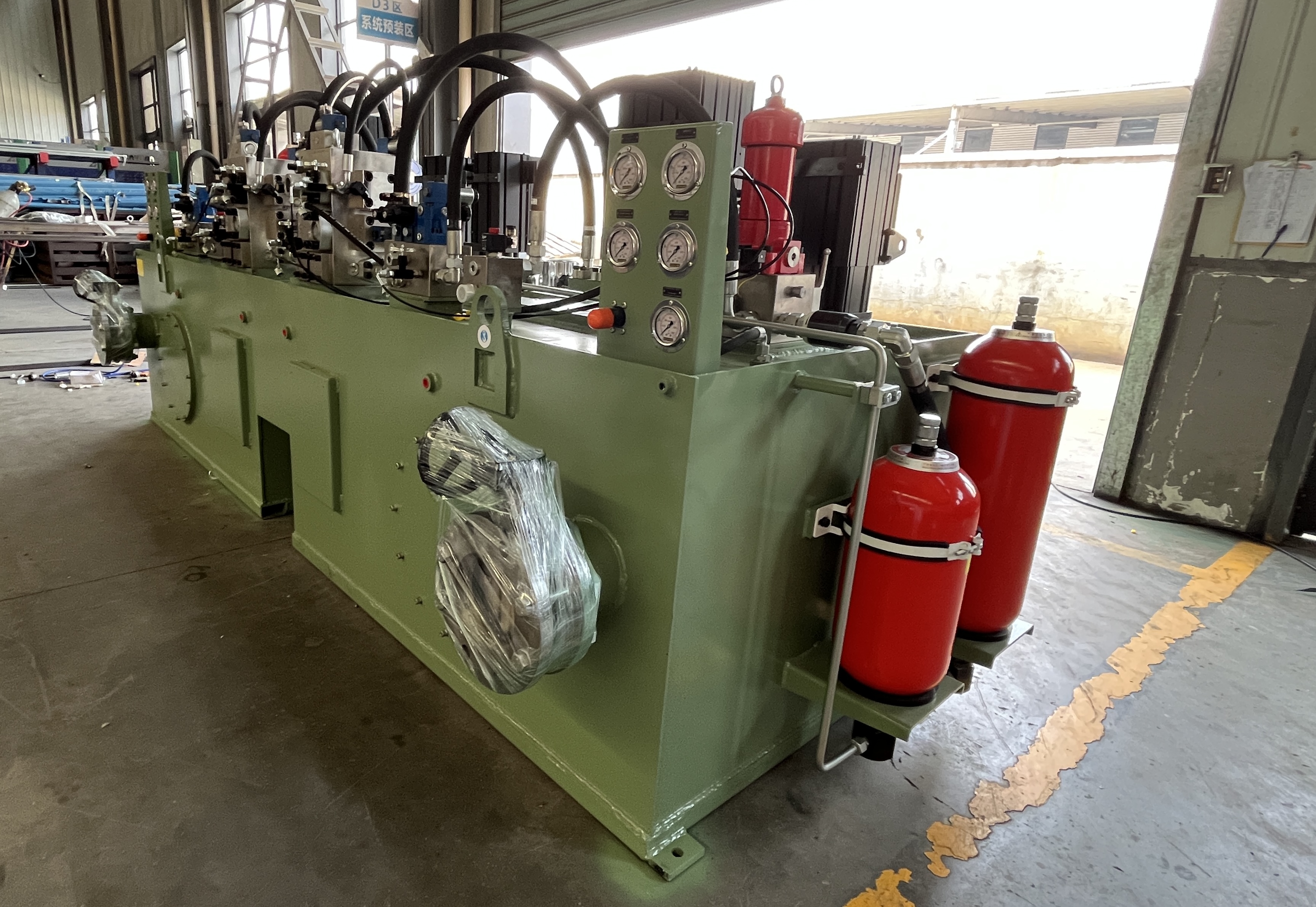
A hydraulic power station is an integrated assembly rather than a collection of independent components.
The pump, valves, reservoir, filters, pressure gauges, pipelines, seals, and electrical controls must all be compatible with the intended operating conditions.
For example, an unsuitable filter may create excessive pressure drop, while an incorrectly selected relief valve may fail to provide the required pressure protection.
Manufacturers should therefore evaluate the complete hydraulic circuit instead of focusing on individual component specifications.
What Should Equipment Manufacturers Consider Before Choosing a Hydraulic System?
Selecting a hydraulic solution should begin with a clear understanding of the equipment's actual operating requirements.
Before contacting a supplier, it is useful to prepare the following technical information:
-
Load requirements: Maximum working load and typical operating load.
-
Pressure and flow: Required hydraulic pressure and flow rate for each actuator.
-
Operating cycle: Continuous or intermittent operation, including simultaneous movements.
-
Installation dimensions: Available space, mounting position, and connection requirements.
-
Environmental conditions: Ambient temperature, dust, moisture, vibration, and other working conditions.
-
Control method: Manual operation, electrical control, or integration with an automated system.
-
Maintenance requirements: Accessibility of filters, valves, oil reservoirs, and other serviceable components.
Providing these details helps the hydraulic system manufacturer understand the application and develop a more appropriate configuration.
For customized equipment projects, it is also beneficial to involve the hydraulic supplier during the early design stage. This allows the hydraulic circuit, mechanical structure, and electrical control system to be considered together rather than adjusted separately after production begins.
Why Manufacturer Experience Matters
A reliable hydraulic system depends on more than component quality. Engineering design, manufacturing consistency, assembly procedures, and product testing all influence the final result.
Jiangsu Kinyuan Hydraulic Machinery Co., Ltd. specializes in hydraulic system development and manufacturing, integrating R&D, engineering design, production, and technical services.
Founded in 2009, the company operates an R&D center in Suzhou covering approximately 1,000 square meters and a production base in Nantong occupying 15 acres, with an 8,000-square-meter production plant.
By connecting engineering development with manufacturing operations, the company supports hydraulic system projects that require application-specific design and production coordination.
For equipment manufacturers looking for a customized mobile hydraulic system, working directly with an experienced manufacturer can make it easier to discuss technical requirements, evaluate installation options, coordinate component selection, and improve overall system integration.
When evaluating potential suppliers, buyers should pay attention to engineering capabilities, production facilities, quality control procedures, technical communication, and after-sales support. These factors are often more meaningful than simply comparing product specifications.
Final Thoughts
Mobile hydraulic systems are a critical part of modern heavy equipment. From excavators and loaders to agricultural machinery and industrial lifting platforms, hydraulic technology provides the power and movement control required for demanding applications.
However, reliable performance does not come from a single high-performance component. It comes from the proper coordination of pumps, valves, actuators, filtration, cooling, and control systems.
For equipment manufacturers, understanding these factors before selecting a hydraulic solution can help reduce design difficulties, improve operating stability, and simplify long-term maintenance.
Choosing a hydraulic system manufacturer with integrated engineering and production capabilities is an important step toward building machinery that performs reliably in real working environments
www.kinyuenhydraulic.com
Jiangsu kinyuan Hydraulic Machinery Co.,LTD.
