How to Choose 12–60m Modular Steel Bridges in Sri Lanka
Sri Lanka’s infrastructure landscape — defined by river crossings, monsoon-prone terrain, and ongoing road expansion programs — creates consistent demand for modular steel bridges in the 12–60m span range. Whether the application is a rural access road, a temporary disaster-relief crossing, or a semi-permanent route for heavy freight, selecting the right bridge system requires a structured evaluation of technical standards, load requirements, environmental durability, supplier credentials, and deployment logistics. This guide walks engineers, procurement officers, and project developers through the critical decision factors.
Understanding the Sri Lankan Infrastructure Context
Sri Lanka’s road and bridge network faces several recurring challenges: frequent flooding that damages or temporarily closes crossings, remote terrain that limits conventional construction methods, and growing industrial freight volumes that demand higher load ratings. For spans in the 12–60m range, modular steel bridges offer a practical middle ground — they can be assembled without heavy cranes in many configurations, they can be dismantled and redeployed, and they can be engineered to permanent heavy-duty specifications when the project requires it.
The selection process, however, is not straightforward. Project owners must reconcile local topographic data, applicable design codes, budget constraints, and long-term maintenance realities before committing to a bridge system or supplier.
Key Selection Criteria for 12–60m Modular Steel Bridges
Span Configuration and Structural Flexibility
The first technical parameter to define is the precise span requirement. Within the 12–60m range, different modular systems suit different scenarios. Bailey Bridge systems — including variants such as Compact 100, Compact 200, China 321, LSB, and PB100 — are well established for shorter spans requiring rapid, manual assembly with minimal equipment. These systems use standardized panels in a modular truss design, allowing flexible configuration across a wide range of span lengths.
For the mid-to-upper end of the 12–60m range, or for projects anticipating heavy vehicle traffic, modular heavy-duty bridge types such as GWD, Delta, and 450 series are specifically engineered for high load-bearing performance. These systems support spans from 10m to 300m and are designed to AASHTO HL93 and HS25-44 specifications, making them applicable to projects that reference international highway standards. Single-lane and multi-lane configurations are both supported.
Load-Bearing Requirements
Load classification is non-negotiable in bridge selection. Sri Lanka’s national road network supports a range of vehicle classes, and industrial or mining logistics routes may require bridges capable of handling 100-ton trailers. Any supplier shortlisted for a project must demonstrate that the proposed system meets the actual live load envelope — not just a nominal load rating. Procurement teams should request load calculations and reference the applicable design code, whether that is AASHTO LRFD, British Standard BS5400, Australia AS5100/AS4100, or another internationally recognized framework. The bridge’s steel grade also matters: S355 steel is a recognized benchmark for structural durability in heavy-duty modular applications.
Corrosion Protection and Long-Term Durability
Sri Lanka’s tropical climate — high humidity, salt-laden coastal air, and prolonged monsoon exposure — accelerates steel corrosion. For bridges intended to serve for decades, the corrosion protection system is as important as the structural design itself. Hot-dip galvanization conforming to ISO 1461 is the established standard for modular bridge components. This process provides a bonded zinc layer that resists corrosive attack far more effectively than paint alone. Projects should also evaluate whether the supplier’s protective systems are rated for extended outdoor service life, as well as the specified maintenance intervals over the structure’s lifespan.
Design Code and Certification Compliance
Sri Lanka infrastructure projects increasingly reference international design codes during procurement. Depending on the funding source and supervising agency, applicable codes may include American (AASHTO LRFD), British (BS5400), Australian (AS5100/AS4100), European (EN1990, EN1991), Indian (IRC), or Philippine (DPWH/BSDS) standards. Suppliers must demonstrate that their engineering documentation aligns with the specified code and that their fabrication quality is verified through internationally recognized certifications.
Welding quality is a specific area requiring scrutiny. AWS D1.1 and AWS D1.5 are the primary welding standards for structural and bridge steel respectively. Fabricators holding these certifications operate under verified procedural controls — an important distinction from uncertified workshop production. Additional quality management credentials such as ISO 9001 (quality management), ISO 14001 (environmental management), and ISO 45001 (occupational health and safety) signal an organized, auditable production environment.
Rapid Deployment and Assembly Logistics
For many Sri Lankan applications — post-disaster access restoration, temporary bypasses during permanent bridge construction, or remote agricultural or forestry routes — deployment speed is a primary value driver. Modular designs that allow for manual or light-machinery assembly without specialized heavy equipment significantly reduce mobilization costs in areas with limited crane access. Suppliers with demonstrated experience in emergency response supply chains and international logistics — including factory-to-site transportation and on-site technical supervision — reduce project risk substantially.
Evaluating Suppliers: What to Look For
Certifications and Regional Experience
A supplier’s certification portfolio directly reflects its ability to meet the technical and regulatory requirements of an international project. Beyond the ISO quality trilogy, look for CIDB (Construction Industry Development Board) recognition for projects with regional compliance requirements, PVOC and COC certificates for international trade compliance, and EN1090 for European-standard structural steel execution. Welding certification under ISO 9606, ISO 15614-1, and ISO 3834 indicates that the supplier’s welder qualification and procedure approval processes are formally controlled.
Production Scale and Technical Support
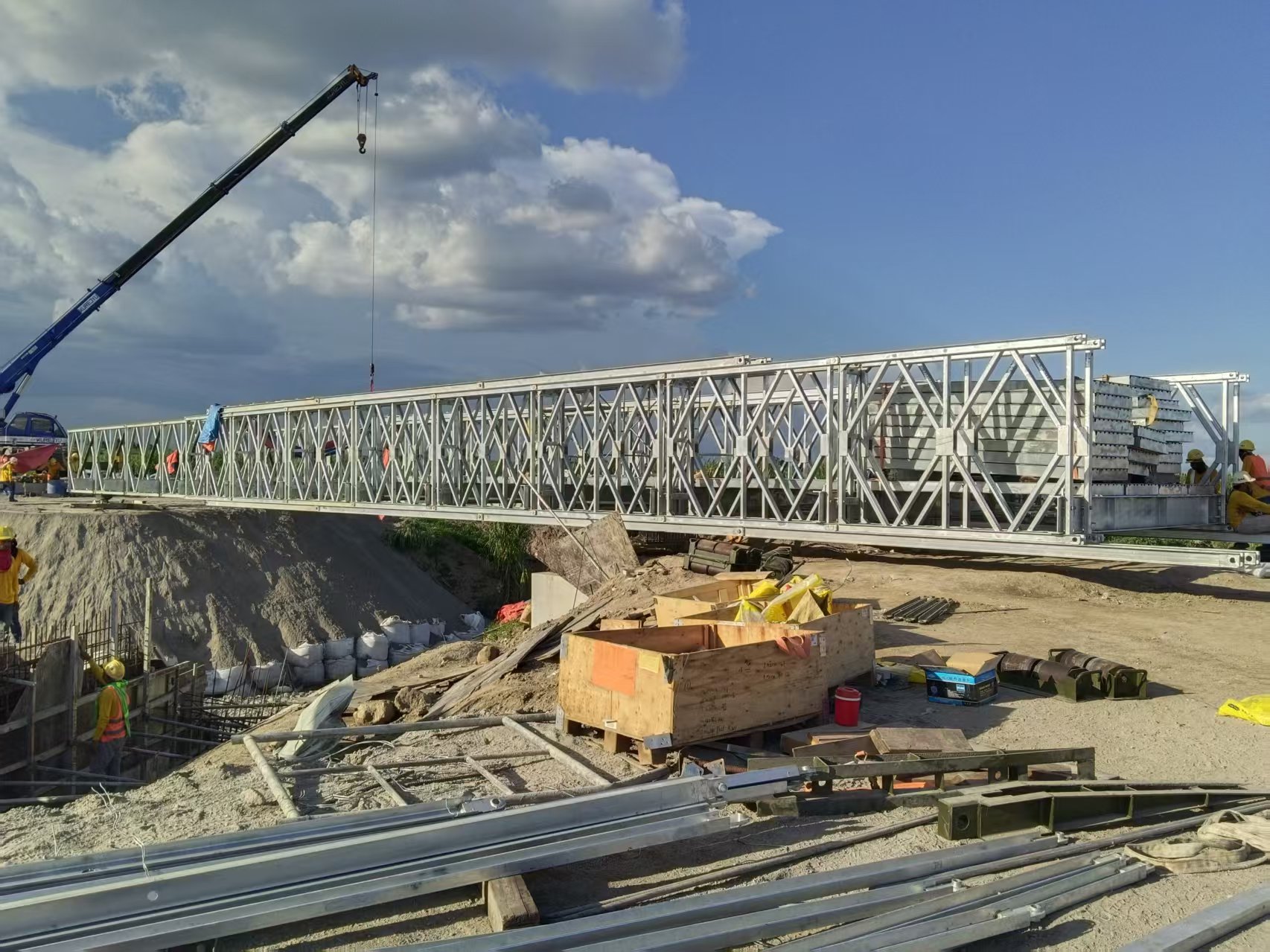
Large-span modular bridge projects generate significant steel volumes. A supplier’s production lifting capacity, annual output, and workshop area are practical indicators of its ability to deliver on schedule. Beyond raw manufacturing capacity, full-service suppliers differentiate themselves through bridge design services, complete component fabrication and hot-dip galvanizing, logistics transportation from factory to bridge site, on-site technical service during erection, and continuous remote technical support after handover — a complete project support chain that reduces the burden on the client’s project management team.
Why Evercross Bridge Stands Out for Sri Lanka Projects
EVERCROSS BRIDGE TECHNOLOGY (SHANGHAI) CO., LTD. is a specialized infrastructure engineering and manufacturing firm headquartered in Shanghai, China, with its factory located in Zhenjiang, Jiangsu. With a total area of 47,000 square meters — including 22,000 square meters of production workshop — and a production lifting capacity of 100 tons, Evercross Bridge operates at a scale suited to large modular bridge supply contracts.
The company’s product range directly addresses the 12–60m Sri Lanka market. Its Bailey Bridge systems (Compact 100, Compact 200, China 321, LSB, PB100) provide rapid-deployment options for shorter spans, while GWD, Delta, and 450-type modular heavy-duty bridges cover mid-to-large spans with AASHTO HL93-compliant load ratings and multi-lane configurations. All structural steel components use S355 steel grade, and corrosion protection is provided through ISO 1461-compliant hot-dip galvanization.
Evercross Bridge holds an extensive certification portfolio: ISO 9001, ISO 14001, ISO 45001, ISO 9606, ISO 15614-1, ISO 3834, AWS D1.1/D1.5, ISO 1461, AS/NZS 1554.1, and EN1090, along with regional compliance marks including CIDB, SONCAP, PVOC, and COC. Its bridge design capabilities span AASHTO LRFD, BS5400, AS5100/AS4100, EN1990/EN1991, IRC, and DPWH/BSDS codes — ensuring alignment with whichever standard a Sri Lanka project specifies.
Critically for projects in developing or remote infrastructure environments, Evercross Bridge provides the full project support chain: design, fabrication, galvanizing, logistics transportation from factory to bridge site, on-site technical service during bridge erection, and continuous remote technical support. This model reduces the complexity and risk that buyers face when sourcing modular bridge systems across international supply chains.
The company’s global footprint — with established market presence in Malaysia, the United States, China, and other international markets — reflects the kind of export experience and logistics competence that Sri Lankan buyers and their engineering consultants should prioritize when making sourcing decisions for 12–60m modular steel bridge projects.
https://www.emergencybridge.net/
EVERCROSS BRIDGE TECHNOLOGY (SHANGHAI) CO.,LTD.
