- This topic is empty.
-
AuthorPosts
-
2026-09-14 at 2:49 pm #10714
Understanding Power Interruption Challenges in ISP and FTTH Networks
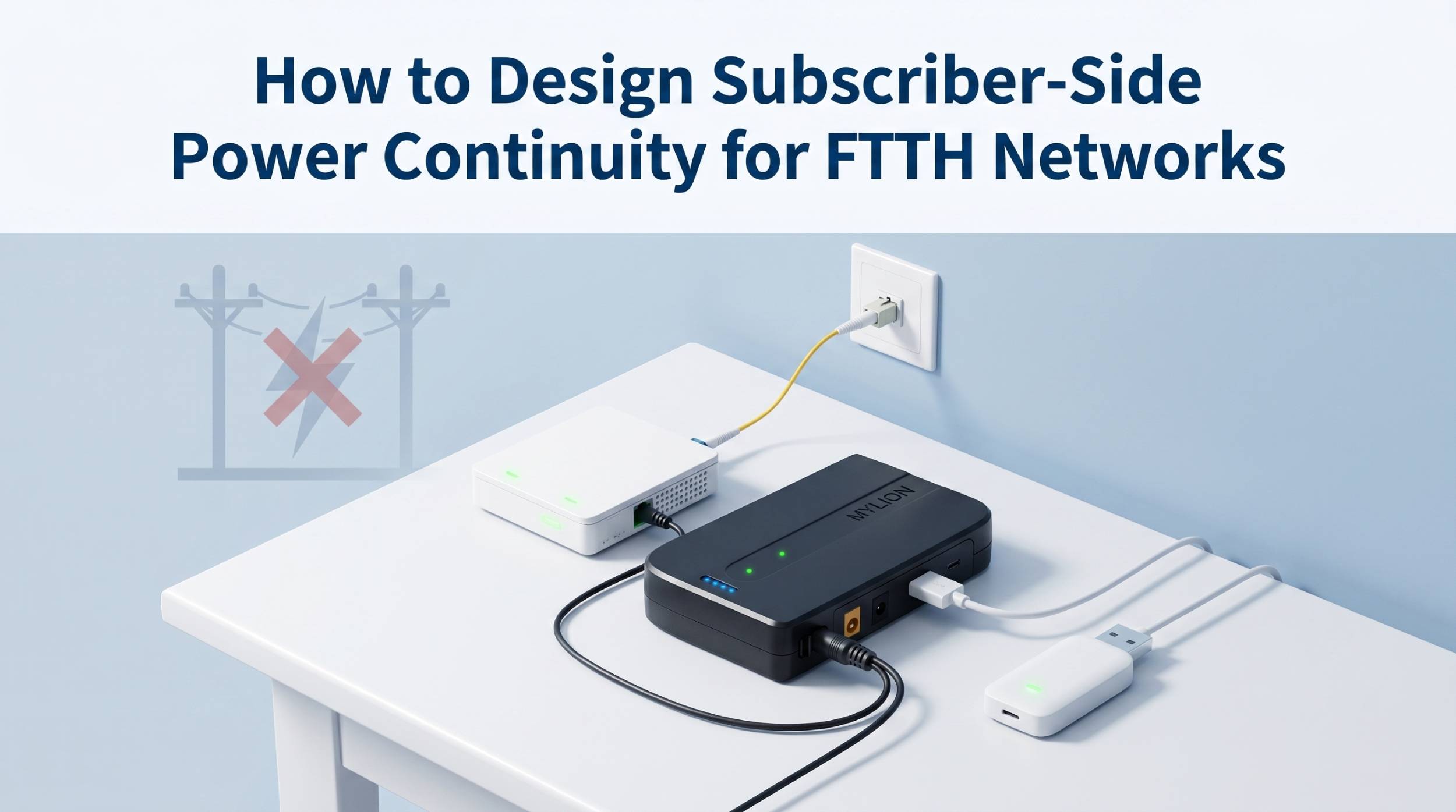
Network equipment such as routers, modems, and ONTs frequently reboot or lose service during short power outages, voltage drops, or unstable grid conditions. For telecom operators, Internet Service Providers (ISPs), broadband network companies, fiber network operators, and system integrators, this is not a minor inconvenience—it directly affects service continuity for subscribers relying on FTTH (Fiber-to-the-Home) connections. When a Mini UPS is improperly selected regarding voltage, current, peak load, or connectors, the result can be application failure rather than the reliable backup the deployment was intended to provide.
Shanghai Mylion New Energy Co., Ltd., operating under the brand MYLION, has built its business specifically around this insight. As a global B2B provider of Mini UPS products, DC backup power solutions, and project support for telecom, ISP, broadband, and security applications, the company positions itself as a backup power partner and OEM/ODM project partner rather than a generic hardware seller.
Common Mini UPS Deployment Problems in ISP and FTTH Projects
Voltage, Current, and Peak Load Mismatches
One of the most frequent deployment issues arises when a Mini UPS is selected without verifying the real device voltage, working current, and peak/startup behavior of the equipment it is meant to support. A unit sized for standard 2.5A continuous current, for example, will not reliably support high-load CPE or gateways that exceed that threshold during startup surges. Mylion addresses this by evaluating solutions based on actual device electrical characteristics rather than assumptions, followed by technical confirmation before deployment.
Connector and Cable Compatibility Errors
Even when voltage and current specifications match, incorrect connector or cable selection can prevent proper installation or cause unreliable contact. Mylion’s service scope explicitly includes connector/cable matching as part of its requirement analysis and model matching process, reducing avoidable selection errors for professional project customers.
Insufficient Runtime for Extended Outages
Short-duration UPS units may be adequate for brief grid fluctuations but insufficient for longer outages common in residential or remote areas. This has led to product differentiation within Mylion’s own lineup: the 12V Long-Runtime Series (MU635W / MU635L), offering 75.6Wh of battery energy, and the 12V High-Power Long-Runtime Series (MU35W / MU35L), which combines 4A continuous / 5A maximum output with the same 75.6Wh capacity for professional gateways requiring both high peak current and long backup time.
Multi-Device Power Requirements
Many SOHO and small installation environments require backup for more than one device simultaneously—for instance, a router and a USB-powered accessory. The 12V + USB Multi-Output Series, including the MUJ46 (12V DC + USB-A + USB-C, 18W maximum total output, 37.44Wh battery energy) and the MUJ435 (50.4Wh battery energy, same port configuration), was developed specifically to address this pain point without requiring separate backup units.
AC-Input Installations Requiring Dual Output
Some deployments involve two separate 12V devices—such as a combined ONT and router installation—powered from a single AC wall outlet. The ML1202AC, part of the AC-Input Dual Output Series, uses LiFePO4 battery chemistry, accepts 100–240V AC input, and delivers two independent 12V DC ports (2A each, 24W total system limit) with 25.6Wh of battery energy, simplifying deployment without needing an external DC adapter.
Emerging High-Power and High-Voltage Equipment Needs
Modern WiFi 6/7 devices increasingly require USB-C Power Delivery, while higher-voltage wireless CPE and radio bridge equipment demand backup solutions beyond standard 12V ranges. Mylion’s development and project-evaluation directions include the MUC85, a USB-C PD Mini UPS supporting 65W standard / 100W max input with dual USB-C outputs (up to 20V/3.25A and up to 12V/2.5A) and 92.16Wh battery energy, and the MU248, targeting 24V/48V telecom backup with independent 24V (3A) and 48V (1A) outputs, a 100W total system limit, and 102.4Wh battery energy. Both remain under project evaluation rather than general release.
How Mylion’s Approach Reduces Deployment Risk
Mylion’s differentiated advantage lies in its evaluation methodology: solutions are assessed according to real device voltage, working current, peak/startup behavior, and the installation environment, followed by technical confirmation and connector/cable matching. This approach is intended to support more reliable DC backup deployment and reduce avoidable selection risks for professional project customers—rather than relying on generic, one-size-fits-all product matching.
This methodology is backed by 13+ years of experience in Lithium Battery technology and 10+ years of experience in Mini UPS development, giving the company a technical foundation across 12V DC systems up to 60W, LiFePO4 chemistry integration, and emerging USB-C PD 100W input/65W output capabilities. Compliance considerations are also built into the process, with UN38.3 and MSDS certifications applied on a model-specific basis, alongside adherence to lithium battery transport documentation requirements.
Service Model Built Around Project Support
Rather than functioning purely as a component supplier, Mylion operates through B2B project support, OEM/ODM services, and sample validation. The service scope covers requirement analysis, model matching, sample testing support, connector/cable matching, private labeling, and documentation coordination, with delivery capability extending to managed pilot evaluation and mass-production preparation. Pricing follows a custom enterprise and project-based quoting approach, reflecting the fact that each ISP or FTTH deployment may involve different device electrical profiles and installation conditions.
Platform compatibility spans routers, ONTs, ONUs, modems, gateways, CPE devices, and security/CCTV equipment, subject to electrical verification for each specific project—reinforcing that compatibility is confirmed on a case-by-case basis rather than assumed.
Conclusion
The recurring problems in Mini UPS deployment for ISP and FTTH projects—voltage and current mismatches, connector incompatibility, insufficient runtime, multi-device power demands, AC-input complexity, and emerging high-power or high-voltage requirements—are addressed within Mylion’s product matrix through differentiated series such as the 12V Standard Series, Long-Runtime Series, High-Power Series, High-Power Long-Runtime Series, USB Multi-Output Series, and AC-Input Dual Output Series, alongside development-stage directions like the MUC85 and MU248. Combined with a project-based service model covering technical evaluation, sample validation, and OEM/ODM support, this structure is designed to help telecom operators, ISPs, broadband companies, fiber network operators, and system integrators reduce selection risk before deployment rather than troubleshoot failures after installation.
http://www.myliontech.com
Shanghai Mylion New Energy Co.,Ltd. -
AuthorPosts

- You must be logged in to reply to this topic.