- This topic is empty.
-
AuthorPosts
-
2026-02-28 at 5:02 pm #7809
When buyers search for a built-in induction cooktop supplier, they’re rarely just comparing “features.” In reality, they’re trying to reduce risk: installation problems, uneven heating complaints, inconsistent quality across batches, and unclear support when a project moves from sampling to volume.
That’s why a smart built-in induction cooktop like Model 8121-259 is best evaluated the way a manufacturer or distributor would evaluate it—by form factor, integration fit, power class, and how “precise temperature control” is actually delivered in day-to-day cooking scenarios.
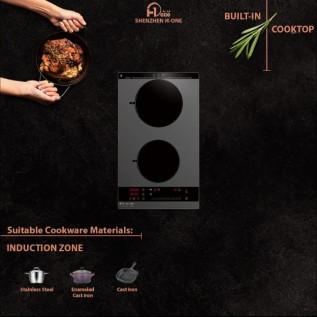
In this guide, we’ll break down what matters most for sourcing and specifying a compact built-in induction cooktop, using Doopen Appliances’ 8121-259 as the reference.
1) Why “built-in” changes the sourcing checklist
Portable induction cookers are easy to ship and simple to use. Built-in units are different. They become part of the kitchen structure, and that shifts the entire decision-making process.
For procurement teams and brand owners, “built-in” adds three non-negotiables:
-
Cut-out consistency: The installer needs accurate dimensions and stable production tolerances.
-
Ventilation and heat management: A built-in unit must handle continuous operation without stressing internal components.
-
Panel durability and long-term usability: The cooktop surface and control interface must stay reliable after months or years of daily use.
Model 8121-259 is positioned as a compact built-in option, and its sizing data makes it easy to plan into standard cabinet layouts.
2) Core specifications buyers care about (and why they matter)
Here’s the practical spec interpretation for Model 8121-259:
-
Type: Built-in
-
Size: 310 × 520 × 55 mm
-
Cut-out size: 285 × 490 mm
-
Power: 3.9 kW
These numbers help buyers answer three key questions quickly:
A. Will it fit the installation plan?
The cut-out size (285 × 490 mm) is what your installation team, project contractor, or dealer network will care about first. Built-in products live or die based on installation friction. Clear sizing makes it easier to standardize across multiple kitchens—especially in projects like apartments, serviced units, or renovations where the cabinet layout is fixed.
B. Is power appropriate for the target market?
At 3.9 kW, this model sits in a practical power range for compact built-in induction use. For many buyers, that means a balance: fast enough heating for daily cooking without pushing into extreme power requirements that complicate electrical planning. For distribution, this matters because fewer edge cases in the field usually means fewer returns.
C. Does the overall height suit cabinetry?
A total height of 55 mm is a real-world metric for fit and airflow planning. Installers typically want predictable depth and enough space to route wiring cleanly without forcing cabinet modifications.
If you need the full product reference, here’s the official product page with complete details:
<a href="https://www.dopeninductioncook.com/smart-induction-with-precise-temperature-control-system.html">Smart Induction with Precise Temperature Control System Model: 8121-259 Type: Built-in Size: 31052055 mm Cut-out Size: 285*490 mm Power: 3.9 KW</a>
3) What “precise temperature control” should mean in real kitchens
“Precise temperature control” is a phrase you’ll see across the industry, but buyers should treat it as a performance promise that needs context.
In real use, temperature control matters most in three scenarios:
-
Low simmer and slow cooking
A common complaint with entry-level induction is that low-power settings pulse too aggressively, causing small pots to “cycle” between boiling and stopping. A temperature-focused control approach aims to keep cooking more stable—useful for sauces, soups, and long stews. -
Repeatable results for everyday users
For brands and distributors, repeatability reduces customer service headaches. When a cooktop delivers consistent behavior across units, it’s easier to train end users and easier for installers to recommend. -
Less trial-and-error across different cookware
Induction performance can vary depending on cookware base thickness and material. Better control systems help reduce the “learning curve,” especially for customers switching from gas or radiant ceramic.
When you’re buying as a supplier or OEM customer, you’re not only buying a cooktop—you’re buying the customer experience that comes with it.
4) Manufacturer-side signals: what to ask before you place volume orders
If you’re evaluating Doopen Appliances or any built-in cooktop manufacturer, here are the questions that actually protect you:
A. Dimensional control and production stability
-
How is the cut-out size tolerance managed across batches?
-
Is there a standard inspection method for panel size and mounting fit?
-
What is the sample-to-mass-production consistency like?
B. Control system validation (especially for “smart” and “precise” models)
-
What kind of functional testing is done on the control system?
-
Are there stress tests for long runtime and repeated heating cycles?
-
How does the factory handle firmware or control parameter tuning across product versions?
C. Packaging and shipping readiness
Built-in units often face glass-surface damage risks during transit. A manufacturer who understands export realities will have clear packaging standards, drop protection design, and shipment documentation processes.
D. After-sales support structure for B2B buyers
Even if you sell through distributors, you’ll eventually need:
-
clear installation guidance,
-
troubleshooting flow,
-
part replacement processes.
A supplier that can support you with documentation and consistent technical communication will save you time long after the first shipment.
5) Where Model 8121-259 typically fits best
Because it’s compact and built-in, Model 8121-259 is naturally suited for:
-
Space-efficient kitchens where countertop area is limited
-
Apartment projects that need consistent installation dimensions
-
Dealer/distributor catalogs that want a defined “compact built-in induction” segment
-
Brand owners building a product ladder (entry compact → mid-size multi-zone → premium smart series)
If your market leans toward embedded kitchen design and clean countertop lines, compact built-in induction models can be an easy win—provided the sizing and performance are consistent.
6) Doopen Appliances: a manufacturer built around embedded kitchen appliances
Doopen Appliances Co., Ltd. positions itself as a core manufacturer of embedded kitchen appliances integrating R&D, production, and sales. For buyers, this matters because built-in appliances usually require tighter coordination between product design, electronic control development, and production execution. A manufacturer that treats these as connected capabilities (instead of separate outsourced steps) often moves faster on iterations and handles custom requests more smoothly.
If your sourcing goal includes OEM/ODM cooperation, consistent production, and long-term product planning, that “R&D + manufacturing” foundation is a meaningful advantage.
http://www.dopeninductioncook.com
Doopen Appliances Co., Ltd. -
-
AuthorPosts

- You must be logged in to reply to this topic.