- This topic is empty.
-
AuthorPosts
-
2026-08-19 at 2:27 pm #10298
As the unmanned aerial vehicle (UAV) industry pushes toward smaller, lighter, and more agile platforms, toothpick propellers have emerged as a critical enabling component for the micro-drone segment. A toothpick propeller is a specialized rotor blade—typically spanning 2 to 3.5 inches in diameter—engineered specifically for “toothpick” style FPV (First Person View) drone frames, which use long, slender arms and minimal frame mass to maximize agility. This article provides a comprehensive technical breakdown of toothpick propeller design, aerodynamic principles, classification, specifications, and comparative performance, drawing on verified engineering data from propeller manufacturer GEMFAN, a company holding 60+ design patents and covering 1,700+ propeller models across the multi-rotor and fixed-wing UAV spectrum.
Core Definition and Fundamentals
A toothpick propeller is defined as an ultra-lightweight rotor blade optimized for micro FPV drone builds in the 2-inch to 3.5-inch diameter range. The term “toothpick” originates from the drone frame category itself: toothpick frames use narrow, elongated arms (resembling a toothpick in profile) to reduce frame weight while maintaining enough length to fit slightly larger props than typical “whoop” micro drones, without the protective ducted cage found in indoor Tiny Whoop builds.
Within the broader UAV power-system ecosystem, toothpick propellers occupy a specific niche between fully-ducted indoor micro propellers (used in Tiny Whoop-class builds) and full-size 5-inch FPV racing or freestyle propellers. They must satisfy a demanding and often contradictory set of requirements: sufficient rigidity to generate adequate thrust, combined with minimal mass to preserve the lightweight character that defines the toothpick category.
The fundamental engineering challenge addressed by toothpick propeller design is what GEMFAN’s engineering team identifies as the “weight reduction vs. power” contradiction. Traditional micro blades that are built heavy enough for structural durability drag down endurance and reduce control sensitivity. Conversely, blades thinned excessively to save weight often suffer from insufficient rigidity, resulting in thrust attenuation (loss of effective thrust output) during flight, particularly at high RPM. Resolving this trade-off requires precision aerodynamic and structural engineering rather than simple material substitution.
Working Principle and Aerodynamic Mechanism
The functional performance of a toothpick propeller is governed by three interlocking aerodynamic and structural mechanisms: moment of inertia reduction, airfoil thinning, and blade tip design optimization.
Moment of inertia refers to a rotating blade’s resistance to changes in its rotational speed. In micro propeller design, lowering the moment of inertia is achieved primarily through ultra-thin blade tip geometry, which removes mass from the areas farthest from the rotational axis (where mass contributes most heavily to inertia). A propeller with lower moment of inertia allows the connected micro motor to accelerate and decelerate more quickly, since less rotational momentum must be overcome at each throttle input. This directly translates into “quick reaction at low throttle,” a defining performance trait for toothpick builds that must maneuver through tight or obstacle-dense environments.
Airfoil thinning technology works alongside inertia reduction. The airfoil is the cross-sectional profile of the blade that determines how airflow is accelerated over the upper and lower surfaces to generate lift (thrust, in the case of a vertically-oriented propeller). By thinning this cross-section while preserving its aerodynamic camber and structural spine, engineers reduce blade mass without collapsing the lift-generating geometry that produces thrust.
The third mechanism, blade tip thinning, specifically targets the outermost portion of the blade, which experiences the highest linear velocity during rotation and contributes disproportionately to both inertia and induced drag. A significantly reduced tip thickness lowers the rotational resistance the micro motor must overcome at start and stop, enabling near-instantaneous throttle response.
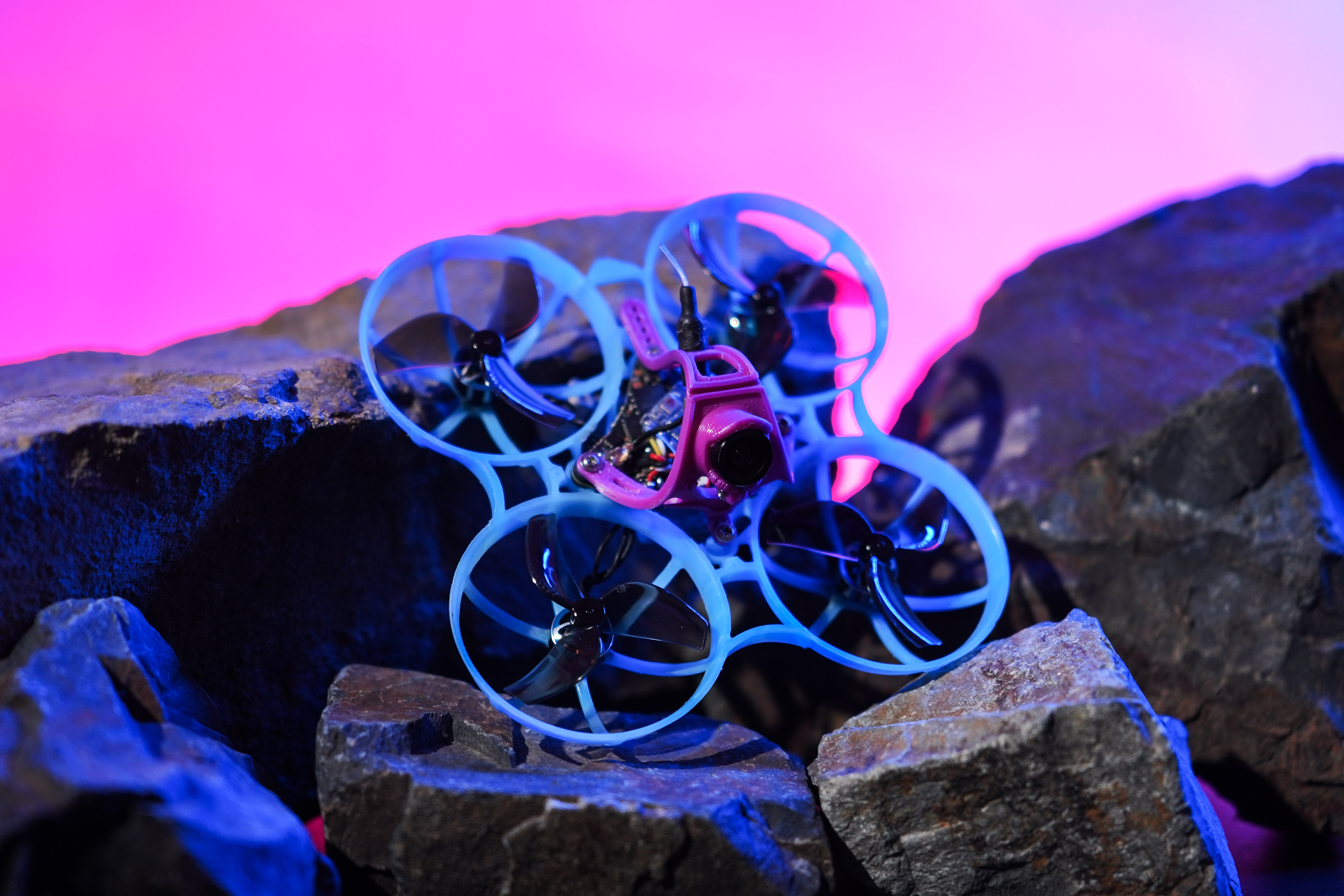
Together, these three mechanisms allow micro motors—which typically produce lower absolute torque than the higher-KV motors used on 5-inch racing platforms—to “travel light,” meaning the reduced blade inertia compensates for the motor’s more limited torque output, preserving both agility and endurance.
Types and Classifications of Micro UAV Propellers
Toothpick propellers exist within a broader classification of micro and small-diameter UAV propellers, each engineered for a distinct flight environment and structural constraint set. Understanding these classifications clarifies where toothpick propellers fit and why their specific engineering approach differs from adjacent categories.
Toothpick / Micro Propellers (2 to 3.5 inches): : Positioned for lightweight micro platforms flown in mixed indoor/outdoor or tight-space environments. Representative product: the GEMFAN Bash 3.5, which applies ultra-thin blade tip design and airfoil thinning technology to resolve the weight-versus-power contradiction inherent to this class.
Micro Propellers / Indoor Whoop Propellers (31mm to 63mm): : A smaller, open-blade subcategory built for indoor micro UAVs (Tiny Whoop-class frames). These use high-strength PC (polycarbonate) material combined with flexible molecular structure optimization to absorb impact energy through micro-deformation rather than brittle fracture. The lightest model in this category, the 1207 (0.15g per blade), is engineered for near-zero-inertia response on the smallest motor sizes.
Ducted UAV Propellers (D2 to D3.5 series): : Designed for indoor micro UAVs requiring the additional protection and noise suppression of a ducted shroud structure. The duct constrains airflow, suppresses blade tip vortex noise, and adds a physical safety barrier absent in open toothpick-class propellers.
FPV Racing Propellers (5-inch class): : Built for high-intensity competitive racing, these prioritize instantaneous throttle response, strong cornering thrust retention, and collision-recovery resilience through high-toughness composite materials—engineering priorities that differ from the pure-lightweight focus of toothpick propellers.
Freestyle Propellers (5-inch class): : Tuned for linear, smooth power delivery rather than instantaneous response, supporting freestyle maneuvers such as rolls and inverted flight with a “thrust follows the hand” control feel.
This classification structure demonstrates that propeller engineering is not a one-size-fits-all discipline; each diameter class and flight-use case demands a distinct balance of inertia, rigidity, material selection, and aerodynamic tuning.
Technical Specifications and Architecture
GEMFAN’s toothpick and micro propeller architecture is built on a vertically integrated research, development, and manufacturing pipeline covering aerodynamic design, computational fluid dynamics (CFD) simulation, mold development, mass production, and dynamic balance testing.
Applicable Diameter Range: : 2 inches to 3.5 inches (toothpick-class); representative product Bash 3.5.
Core Design Technologies: : Ultra-thin blade tip geometry; airfoil thinning technology; inward mass distribution for reduced moment of inertia.
Performance Objectives: : Ultra-low inertia for agile low-throttle control; optimized thrust-to-weight ratio without sacrificing structural rigidity; micro-scale aerodynamic tuning specific to 2-to-3.5-inch disk sizes.
Manufacturing Infrastructure: : 7,000-square-meter integrated factory equipped with high-precision injection molding machines, CNC machine tools, dynamic balance testers, and tension testers, enabling piece-by-piece quality verification.
Quality and Compliance Standards: : ISO 9001:2015 Quality Management System certification; EU Certificate of Compliance under mechanical safety standards EN ISO 12100 and EN 60204-1.
Intellectual Property Base: : 60+ domestic and international design patents, of which 56 are self-developed, supporting patent compliance guarantees for OEM/ODM customization work.
Product Scale: : Part of a broader catalog of 1,700+ propeller models spanning multi-rotor and fixed-wing UAV categories, with proprietary aerodynamic design methods reported to boost thrust efficiency by more than 12% compared to conventional propeller designs across the wider product range.
This architecture reflects a full-chain capability: every toothpick propeller passes through CFD-based aerodynamic modeling before mold development, and every production batch is subject to dynamic balance and tension testing prior to release, ensuring consistency across mass production runs.
Comparative Analysis: Toothpick Propellers vs. Other Micro and FPV Propeller Classes
When evaluated against adjacent propeller categories, toothpick propellers occupy a distinct engineering middle ground.
Toothpick Propellers vs. Indoor Whoop Propellers: Whoop propellers (31mm–63mm) prioritize absolute minimum weight and impact absorption through flexible PC materials for fully protected, ducted or semi-ducted indoor flight. Toothpick propellers, operating at a larger 2–3.5 inch scale, must generate proportionally more thrust while still minimizing inertia, since toothpick frames typically fly in less protected environments and require greater speed and range than whoop-class builds.
Toothpick Propellers vs. Ducted D-Series Propellers: Ducted propellers add a physical shroud that suppresses noise and protects the blade from collisions, at the cost of additional structure and aerodynamic drag from the duct itself. Toothpick propellers are open-bladed, trading the ducted structure’s protection and noise suppression for lower weight and simpler mechanical integration—well-suited to toothpick frames that already minimize physical bulk.
Toothpick Propellers vs. FPV Racing Propellers (5-inch): Racing propellers are engineered around high-toughness composite materials and gradient stiffness structures to survive high-speed collisions at competitive velocities, and around low moment of inertia specifically tuned for high-KV racing motors. Toothpick propellers apply a similar inertia-reduction philosophy but at a smaller diameter scale suited to lower-power micro motors, where the dominant design constraint is absolute mass reduction rather than post-collision structural recovery.
Toothpick Propellers vs. Freestyle Propellers: Freestyle propellers emphasize smooth, linear thrust progression for controlled aerial maneuvers on larger 5-inch platforms. Toothpick propellers, by contrast, are optimized for agility and endurance on much smaller motor and frame combinations, where minimizing rotational mass is the dominant performance lever rather than throttle-curve linearity.
Characteristics and Advantages
Toothpick propellers deliver several defining technical characteristics that differentiate them within the micro UAV propulsion category.
Ultra-Low Inertia Agile Control: Significant reduction in blade tip thickness drastically lowers moment of inertia, minimizing motor start/stop resistance. This allows quick directional and speed reactions at low throttle settings, which is essential for maneuvering through narrow spaces and executing delicate flight paths.
Thrust-to-Weight Ratio Optimization: Extreme lightweighting is achieved while preserving sufficient structural rigidity, allowing toothpick-class drones to overcome power density bottlenecks inherent to small motor sizes, making both hover and acceleration more effortless.
Micro-Scale Aerodynamic Adaptation: Airfoil and pitch geometry are specifically optimized for the power characteristics of 2-to-3.5-inch micro drones, ensuring that even small-diameter disks output abundant and linear thrust rather than suffering the efficiency losses common when full-size propeller principles are simply scaled down.
Considerations: Because toothpick propellers prioritize minimal mass over collision-resistant structural reinforcement (unlike the high-toughness composites used in FPV racing propellers or the impact-absorbing PC materials used in indoor whoop propellers), they are best suited to open-air or semi-protected environments rather than the tightly enclosed collision-prone conditions of indoor caged flight.
Collectively, these characteristics make toothpick propellers a purpose-built solution rather than a scaled-down variant of larger propeller designs—each dimensional and material decision is made specifically to resolve the lightweight-versus-power contradiction unique to small motor, small frame UAV platforms.
Practical Applications
Toothpick propellers serve a specific and growing segment of the micro-FPV drone market. Their primary application is on toothpick-frame FPV quadcopters, which are favored by hobbyists and freestyle pilots who want more speed and range than a Tiny Whoop-class build can offer, without the added weight and cost of a full 5-inch racing platform. These builds are commonly used for backyard freestyle flying, tight indoor-to-outdoor transitional flying, and general recreational FPV piloting where portability and agility are prioritized over raw power.For more information: http://www.gemfanhobby.com
Beyond direct retail use, toothpick propellers are also relevant to UAV manufacturers and system integrators seeking OEM/ODM (Original Equipment Manufacturer / Original Design Manufacturer) propeller development for micro drone product lines. Manufacturers developing new toothpick-class frames, micro racing drones, or lightweight recreational platforms typically require a propeller supplier capable of full-chain development: aerodynamic design, CFD simulation, mold development, precision manufacturing, and dynamic balance quality control. GEMFAN’s integrated R&D-to-mass-production pipeline—covering conceptual design, CFD-based aerodynamic optimization, material selection, mold development, and multi-stage quality inspection—illustrates the type of end-to-end capability required to bring a custom 3-inch micro propeller from concept to scaled production, backed by a patent portfolio of 60+ design patents that supports IP compliance for customized OEM products.
Conclusion
Toothpick propellers represent a highly specialized engineering solution within the micro UAV propulsion landscape, purpose-built to resolve the inherent tension between extreme lightweight construction and adequate thrust output on 2-to-3.5-inch diameter platforms. Through techniques such as ultra-thin blade tip design, airfoil thinning, and inward mass distribution, these propellers achieve low moment of inertia and optimized thrust-to-weight performance without collapsing structural integrity. When compared against indoor whoop propellers, ducted D-series propellers, and larger 5-inch FPV racing or freestyle propellers, toothpick propellers occupy a distinct middle-ground niche defined by open-blade agility at small scale. As micro-FPV and lightweight recreational drone segments continue to expand, propeller manufacturers with integrated aerodynamic R&D, precision manufacturing, and OEM/ODM customization capability—supported by robust patent portfolios and quality certifications—will remain essential partners for UAV brands developing next-generation toothpick-class platforms.
http://www.gemfanhobby.com
Gemfan Hobby Co.,Ltd. -
AuthorPosts

- You must be logged in to reply to this topic.