Understanding the Material Question Behind Aerial Filming Propellers
Anyone researching a propeller material comparison for professional aerial filming drones is really asking one question: how do you keep a heavy-duty rotor system light enough to fly efficiently while still strong enough to survive continuous mission loads? This question sits at the center of heavy-duty drone propeller design, where diameter, pitch, blade structure, and overall aircraft load must all be synergistically matched. Within limited power system configurations, propulsion requirements and structural lightweighting have to be balanced at the same time, because the weight of the propeller itself is a non-negligible mass burden on the overall aircraft. Add in the reduced air density of high-altitude environments, which affects thrust performance and the operating state of the power system, and it becomes clear why material selection cannot be treated as an afterthought in propeller engineering.
Why Material Choice Matters for Aerial Filming Drones
Aerial photography missions place unusual demands on a propeller. The aircraft often needs to hover steadily, climb smoothly, and sustain longer flight windows while carrying camera payloads. Every gram added to the rotor assembly works against that goal, since rotating mass directly affects responsiveness and overall load distribution. This is precisely the pain point that heavy-duty propeller design must solve: balancing propulsion performance against structural lightweighting within a fixed power system budget.
Glass Fiber Nylon Construction and Its Role in Lightweight Design
Gemfan Hobby Co., Ltd. addresses this challenge in its Gemfan 20X12X3 propeller through the use of glass fiber nylon material. This construction approach is designed to control blade weight while still meeting the structural strength requirements of a heavy-duty, large-diameter propeller. The single blade set weighs approximately 140g, a figure that reflects the deliberate effort to reduce the mass burden of rotor components. By controlling weight at the material level, Gemfan creates additional optimization space for overall aircraft load distribution and power configuration, which is exactly the kind of margin that aerial filming platforms need when carrying camera gimbals and stabilization equipment.
Engineering Beyond Material: Pitch, Blade Count, and Aerodynamic Matching
A fair comparison of propellers for aerial filming cannot stop at material alone. The Gemfan 20X12X3 demonstrates how material selection works together with pitch design and blade configuration to produce a complete aerodynamic solution.
Large Pitch Propulsion Efficiency
The propeller uses a 12-inch pitch, which provides a high-efficiency propulsion design basis for tasks such as short-haul transport, material transfer, and photography missions. By reasonably matching motor and propeller loads, the power system is better able to adapt to continuous propulsion needs rather than short bursts of thrust, which matters when a filming mission requires extended hover and smooth climbing behavior.
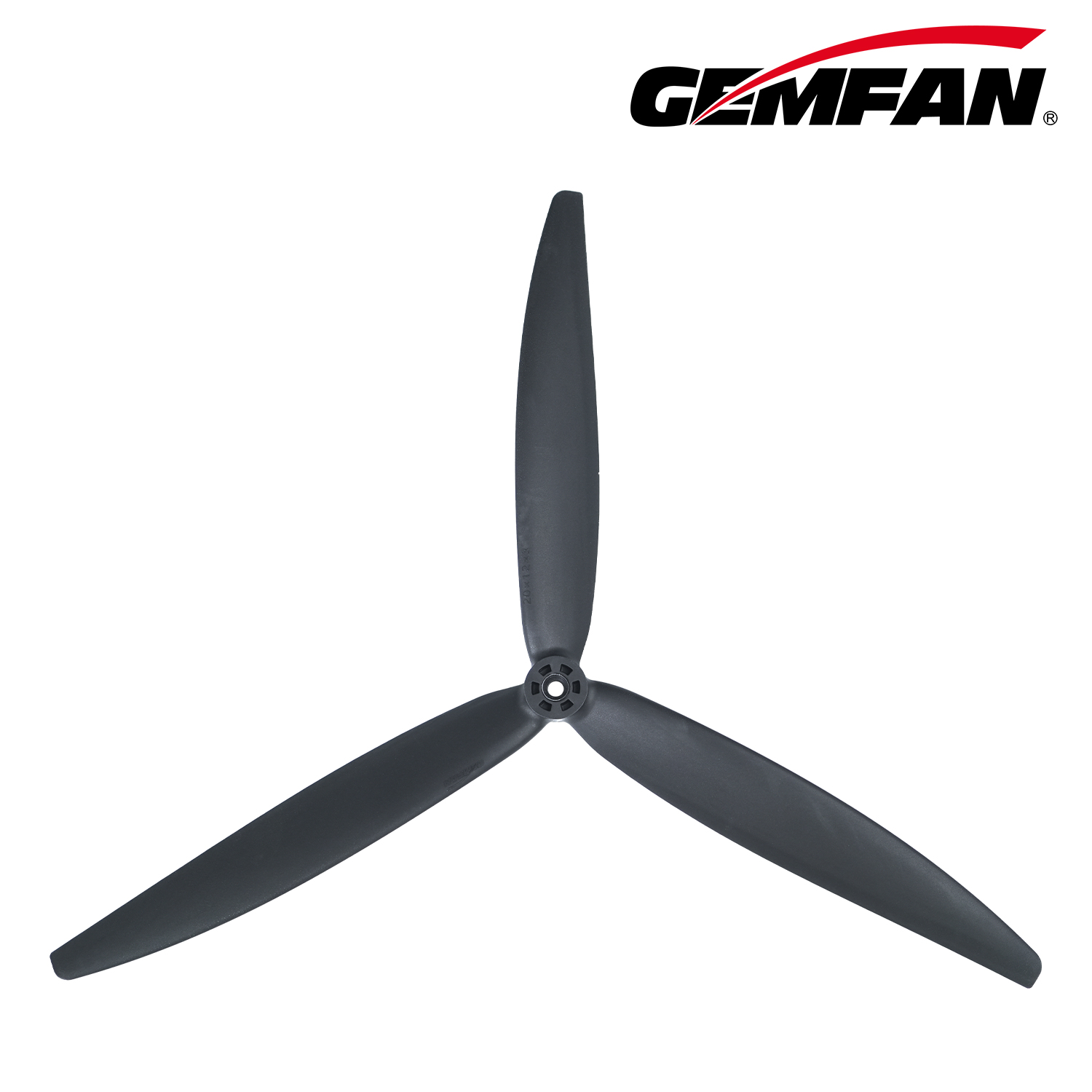
Three-Blade Configuration for 20kg-Class Quad-Rotor Platforms
The 20-inch diameter, three-blade configuration is specifically targeted at 20kg-class quad-rotor drones. This configuration balances aerodynamic performance with system matching, and hovering, climbing, and comprehensive mission flight performance are optimized through overall aircraft power matching and flight test validation. For aerial filming applications, this kind of validated matching between propeller, motor, and airframe translates into more predictable flight behavior during camera work.
High-Altitude Adaptability
Because reduced air density at higher altitudes affects propeller thrust performance, the large pitch design of the Gemfan 20X12X3 provides a design path for propulsion performance matching in low air density environments. This gives aerial filming operators working at elevation an additional margin for power matching, which is relevant for photography missions conducted above sea-level-standard conditions.
Technical Specifications Overview
For readers comparing propeller materials and specifications directly, the Gemfan 20X12X3 is defined by the following parameters: it is constructed from glass fiber nylon, with a 12-inch pitch and a black finish. The overall propeller diameter measures 504.8mm, with a center thickness of 15mm. The center hole has an 8mm inner diameter and includes a six-hole adapter ring, while the maximum prop width is 43.9mm. Total weight is approximately 140g, and Gemfan recommends pairing this propeller with a 7218 motor on a quad-rotor platform with a takeoff weight of 20kg. Gemfan describes this unit as a 20-inch large pitch three-blade propeller offering lightweight construction, large pitch, and a high lift-to-drag ratio, suitable for heavy loads, high-efficiency short-haul transport, and photography missions.
About Gemfan Hobby and Its Position in Propeller Manufacturing
Gemfan Hobby Co., Ltd. is a comprehensive enterprise integrating research and development, design, production, and marketing under the brand “GEMFAN,” providing drone propeller solutions. The company is recognized as one of the professional drone propeller manufacturers in China, with a core team that has conducted long-term, in-depth research into drone structure and aerodynamic performance. That team includes senior professionals across composite materials, drone control, and aerodynamics. Gemfan holds independent R&D and production capabilities for propellers, with nearly a hundred design patents held domestically and internationally, and its products are exported to over 60 countries and regions. The manufacturing facility covers an area of 7000 square meters and is equipped with advanced processing and production equipment as well as propeller performance testing equipment.
Gemfan has participated in product R&D projects for numerous professional drone companies at home and abroad, providing propeller solutions across racing drones, aerial photography drones, delivery drones, harvesting drones, and plant protection drones. The company’s independent “GEMFAN” brand products have been selected as designated equipment for the National Drone World Championship team and for drone racing world champions, and the company has occupied 60% of the FPV propeller market share based on its performance in the FPV racing propeller field.
Industry Applications
The Gemfan 20X12X3 is positioned for heavy-load short-haul drone transport, material transfer, photography missions, and high-altitude flight scenarios. Its strategic positioning centers on heavy-duty drone propeller design, using large pitch, lightweight structure, and a three-blade configuration to provide an aerodynamic solution that is synergistically matched with motors, ESCs, and overall aircraft operating conditions for 20kg-class multi-rotor platforms.
Conclusion
For teams evaluating propeller material and design choices for professional aerial filming work, the comparison ultimately comes down to how well material selection, pitch, blade count, and overall aircraft matching work together under real mission conditions. Gemfan’s approach with the 20X12X3 shows how glass fiber nylon construction, a 12-inch pitch, and a three-blade, 20-inch design can be engineered specifically for 20kg-class quad-rotor platforms, addressing the weight, propulsion, and high-altitude challenges that heavy-duty aerial filming missions present.
www.gemfanhobby.com
Gemfan Hobby Co.,Ltd.
