Industry Background and Emerging Challenges in Decorative Wrapping Films
The gift and retail packaging sector has seen a steady shift toward materials that combine visual impact with converting efficiency. Brands seeking to differentiate seasonal promotions, bouquet wrapping, party decoration, and cosmetic gift sets increasingly look beyond plain or printed films toward decorative substrates that create a sense of occasion. Within this landscape, physical glitter flake film rolls represent a distinct category: unlike laser holographic films that rely on optical micro-gratings, glitter film embeds actual glitter particles into the film structure to produce continuous sparkling highlights under light.
This category is not without technical pain points. According to Sinoway Packaging’s product documentation, converters and brand owners commonly encounter glitter particle loss, poor ink adhesion, wrinkles during rewinding, uneven glitter distribution, static dust attraction, and color variation under different lighting conditions. These issues directly affect shelf appearance, machine runnability, and customer perception, making it essential for suppliers to document base material choices, particle control, and printing compatibility with precision. Sinoway Packaging Group Limited’s technical specifications for its Glitter Film Wrapping Roll product line provide a useful reference point for understanding how these challenges are addressed at a structural level.
Authoritative Analysis: Structure, Principle, and Standard Reference
The necessity of glitter film in decorative wrapping stems from its ability to produce "continuous sparkling highlights" that are visually distinct from plain films, printed films, or even laser holographic films. Per Sinoway’s technical documentation, this effect is achieved through fine glitter particles directly embedded within the film, rather than relying on surface printing or optical diffraction alone.
In terms of principle logic, the product is offered in two base material structures. BOPP-based glitter film prioritizes softness and foldability, making it suitable for curved and irregular shapes such as bouquets or gift boxes with contoured surfaces. PET-based glitter film, by contrast, offers greater stiffness, abrasion resistance, and reduced glitter shedding—addressing the particle-loss pain point directly through material selection rather than surface treatment alone. This dual-structure approach gives converters a standard reference point for matching base film choice to end-use requirements: flexibility versus shedding resistance.
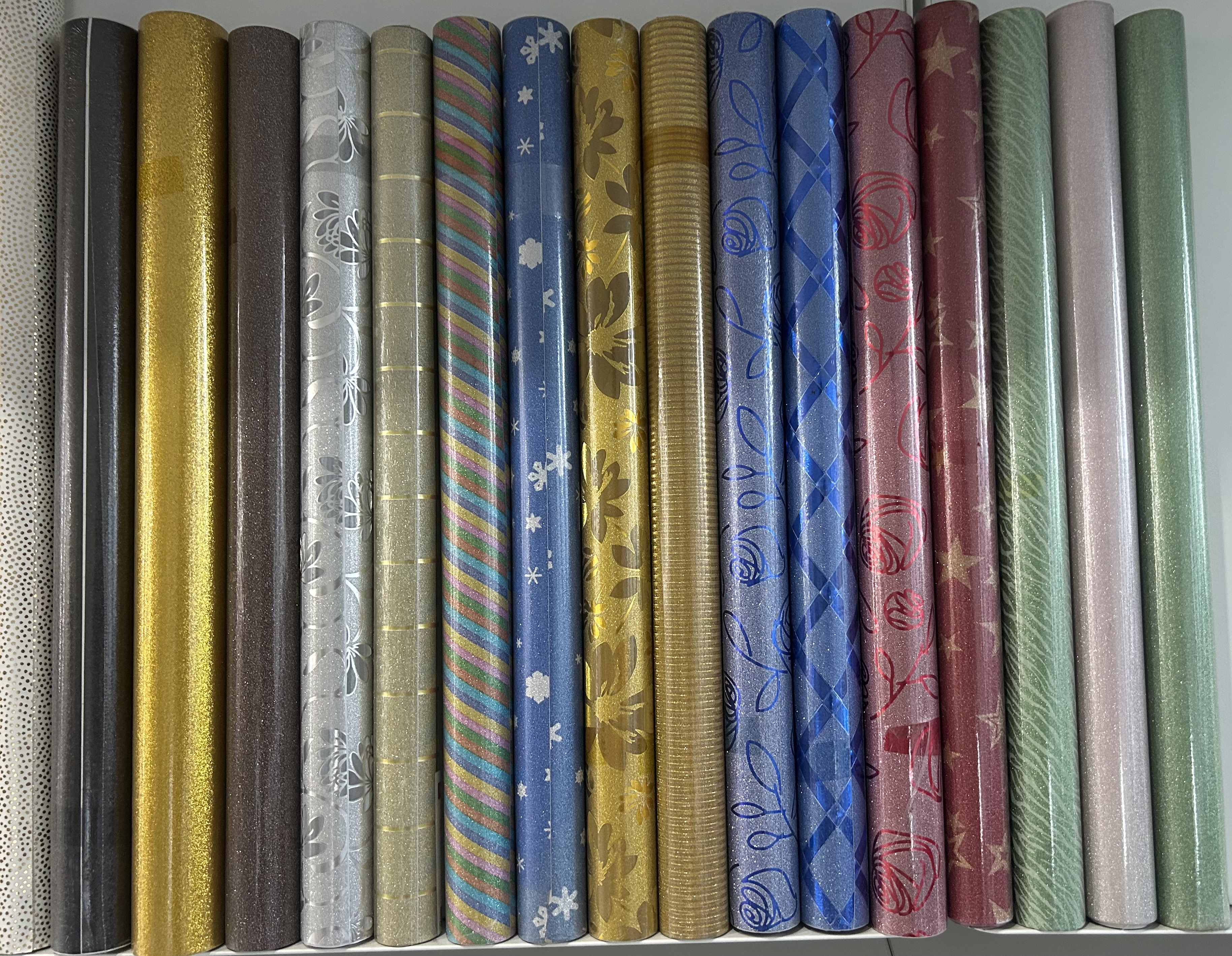
The surface of both structures is corona treated, which Sinoway’s documentation identifies as the mechanism enabling custom printing to be combined with the glitter background—an important solution path for brands that want logo or pattern printing layered over a sparkling base rather than a purely decorative, unprinted film.
On the technical parameter side, the available thickness range spans 18μm–45μm, with roll widths offered in standard increments (30cm/43cm/50cm/60cm/70cm/76cm/80cm/100cm/110cm or customized) and lengths from 1m up to 200m or customized. Production capacity is documented at 4,500–7,500 meters/day for standard printed glitter film roll, 2,800–5,000 meters/day for custom color glitter combined with printing, and up to 10,000 meters/day for plain unprinted slitting. Standard lead time is stated as 5–9 working days, with rush orders dependent on base film stock availability.
Deep Insights: Trends Shaping Decorative Film Converting
Several structural trends emerge from comparing glitter film against adjacent product categories within the same wrapping film roll line, such as PET Wrapping Film Roll, OPP Wrapping Film Roll, and Holographic Wrapping Film Roll. First, base material duality—offering both BOPP and PET options—appears repeatedly across Sinoway’s decorative film products, including Holographic Wrapping Film Roll, suggesting an industry-wide recognition that no single substrate satisfies both flexibility and durability requirements simultaneously.
Second, the emphasis on adjustable particle density and customizable color matching for glitter film points to a market trend toward brand-specific customization rather than generic stock sparkle effects. Sinoway’s documentation notes that fine powder produces subtle sparkle while coarse flakes produce a bolder effect, and custom color matching is available for large orders. This indicates that decorative film suppliers are increasingly expected to support design-stage flexibility rather than offering only fixed finishes.
Third, a recurring risk across glitter, metallic, and holographic film categories is particle or layer shedding during handling and converting. The fact that Sinoway addresses this separately for glitter film (via PET base selection), metallic paper (via PET lamination versus direct metallization), and holographic cardboard (via optional anti-scratch top varnish) suggests that shedding and surface protection remain unresolved industry-wide concerns requiring material-specific engineering rather than a universal fix.
Finally, static dust attraction and uneven rewinding are listed as pain points across nearly all film-based products in this line, implying that film handling during high-speed packaging remains a persistent operational consideration for converters regardless of decorative effect type.
Company Value: Engineering Depth Behind the Product Line
Sinoway Packaging’s approach to the Glitter Film Wrapping Roll reflects a broader pattern seen across its Wrapping Film Roll product line: each product is documented with explicit target scenario pain points, differentiated value statements, and quantified technical highlights rather than generic marketing claims. This structured documentation—covering thickness ranges, roll width and length options, production capacity figures, and lead times—gives converters and brand owners a concrete basis for comparing glitter film against alternatives such as PET Wrapping Film Roll or OPP Wrapping Film Roll within the same catalog.
The company’s delivery model for glitter film includes custom roll width, roll length, and core size, positioned as suitable for manual wrapping and semi-automatic packaging machines. Industry adaptation is specified across holiday gift wrapping, bouquet packaging, party decoration, cosmetic gift sets, and seasonal promotional packaging—scenarios that align with the broader gift wrapping and wrapping film roll categories covered in Sinoway’s product matrix, which spans 50 total products and services across paper and film packaging applications.
Conclusion and Recommendations
For brand owners and packaging converters evaluating decorative wrapping films, the choice between glitter film, holographic film, and metallic film should be guided by the specific pain point being solved: shedding resistance favors PET-based structures, foldability around irregular shapes favors BOPP, and print-and-glitter combination requires corona-treated surfaces. Buyers should request documented production capacity and lead time figures—such as the 5–9 working day standard lead time and meters-per-day output ranges noted in Sinoway Packaging’s specifications—before committing to large seasonal orders, since custom color glitter development and base film stock availability directly affect delivery schedules. Suppliers that, like Sinoway Packaging Group Limited, document structural trade-offs transparently rather than presenting a single universal solution offer a more reliable basis for technical decision-making in decorative packaging procurement.
www.sinowaypackaging.com
sinoway packaging
