A pulley profile is a critical design feature in belt-driven power transmission systems, influencing belt engagement, torque transfer, positioning accuracy, noise, and service life. Whether used in automated production equipment, packaging machinery, CNC systems, or industrial conveyors, the pulley profile must match the belt geometry and the operating requirements of the application. Even small deviations in tooth shape, pitch, groove dimensions, or concentricity can lead to poor engagement, uneven load distribution, premature wear, and reduced transmission efficiency.
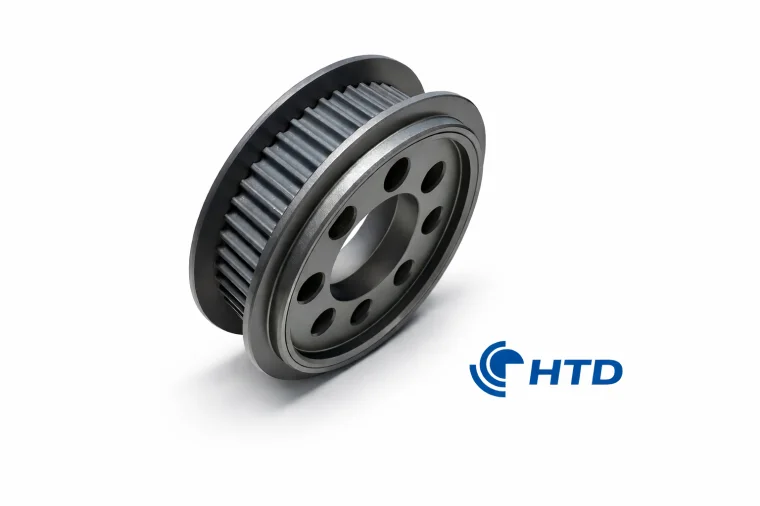
For machinery manufacturers, selecting a pulley profile involves more than identifying a nominal belt pitch or outside diameter. The complete specification must account for belt type, tooth geometry, transmitted torque, rotational speed, shaft arrangement, installation tolerances, and environmental conditions. A well-matched pulley profile helps maintain stable transmission performance, while an unsuitable design can create recurring maintenance problems even when the belt itself meets its specifications.
Hetuoda Machinery Manufacturing specializes in precision transmission components, including timing pulleys, toothed plates, tensioning pulleys and assemblies, gears, and custom-machined parts. Its product range and OEM services are relevant to applications where pulley geometry, machining accuracy, and component compatibility must be coordinated with the wider mechanical design.
What Is a Pulley Profile?
A pulley profile refers to the geometry of the pulley surface that contacts and engages with a belt. The exact features depend on the transmission design. In a timing pulley, the profile is defined primarily by the shape, pitch, and dimensions of its teeth and tooth spaces. In a V-belt pulley, the profile includes the groove angle, depth, and width that determine how the belt seats in the groove. Flat-belt pulleys use a different contact geometry, often with a cylindrical or slightly crowned surface depending on the belt and tracking requirements.
These geometries are not interchangeable. A timing belt relies on positive tooth engagement to synchronize motion, whereas a V-belt generally transmits power through friction and wedging action between the belt and pulley groove. Using a pulley with an incompatible profile can cause improper seating, concentrated contact stress, slippage, or accelerated wear.
For synchronous drives, the belt and pulley should be specified as a matched system. Two pulleys with the same nominal diameter may have different tooth counts, pitches, tooth forms, or flange configurations. Those differences affect transmission ratio, belt engagement, center-distance requirements, and the ability to maintain precise positioning.
The term “pulley profile” can also refer to a standardized tooth form, such as trapezoidal or curvilinear timing-belt geometry. The correct selection depends on the belt manufacturer's specification and the mechanical demands of the drive. Confirming the exact belt series and profile designation before machining or ordering is therefore an essential first step.
Timing Pulley Profiles: Tooth Geometry and Belt Compatibility
Timing pulleys are widely used where a defined relationship between input and output rotation is required. Their teeth engage with the corresponding belt teeth, reducing the risk of the relative motion associated with friction-driven belt systems. However, positive engagement alone does not guarantee accurate or durable operation. Tooth geometry must be compatible with the belt, and the drive must be designed to distribute load across the engaged teeth.
Trapezoidal timing-belt profiles have a relatively angular tooth form and are used in many conventional motion-transmission applications. Curvilinear profiles use a more rounded geometry designed around specific belt systems and their engagement characteristics. Depending on the profile and belt construction, these designs may differ in load distribution, tooth engagement, backlash behavior, and suitability for high-speed or high-torque service.
The choice should not be made solely on the assumption that one tooth form is universally stronger or more accurate. Performance depends on the specific belt series, pulley dimensions, material, tooth count, belt tension, and operating conditions. A profile designed for one timing-belt family may not properly engage with another, even if the pitch appears similar.
Tooth count is another key variable. For a timing pulley, the relationship between tooth count and belt pitch determines the nominal pitch diameter and contributes to the transmission ratio. Increasing tooth count at a fixed belt pitch increases pitch diameter, which may reduce belt bending severity but also changes the space required by the drive. A smaller pulley can help achieve a compact design, but it may increase belt flexing and reduce the number of teeth engaged under certain conditions.
Designers should therefore evaluate the pulley profile together with minimum pulley diameter, transmitted torque, rotational speed, belt width, and required positioning accuracy. The relevant belt manufacturer's design data should be used to confirm the permitted operating range.
How Machining Accuracy Affects Transmission Performance
The nominal pulley profile defines the intended geometry, but manufacturing accuracy determines how closely the finished component follows that geometry. In precision machinery, dimensional errors can affect engagement consistency, rotational smoothness, and the distribution of force across the belt.
Tooth pitch error is particularly important in timing pulleys. If the spacing between teeth deviates from the intended specification, the belt may not engage uniformly across the pulley width or circumference. This can increase localized loading and contribute to tooth wear, vibration, or irregular motion. Errors in tooth depth or form can also affect the contact between belt teeth and pulley grooves.
Concentricity and radial runout influence how consistently the pulley rotates around its shaft axis. Excessive runout can produce periodic changes in belt tension and contact conditions during each revolution. In applications involving servo drives, indexing equipment, or automated positioning, such variation may affect motion consistency and increase mechanical disturbance.
Bore dimensions and mounting features deserve equal attention. A precisely machined tooth profile cannot compensate for a poor shaft fit, misaligned mounting interface, or inadequate locking arrangement. Depending on the application, the drawing may need to specify bore tolerance, keyway dimensions, flange position, axial width, runout, and surface finish in addition to tooth geometry.
The appropriate tolerance level depends on the machine's function. A general conveyor drive may accept different tolerances from a high-speed positioning axis or precision automation mechanism. Applying unnecessarily tight tolerances can increase machining costs without providing meaningful operational benefits. The goal is to specify tolerances that control the failure risks relevant to the application.
Material Selection and Surface Durability
Pulley material affects strength, inertia, machinability, corrosion resistance, and wear behavior. Aluminum alloys are often considered where low rotational mass is important, including compact automation systems and high-speed positioning equipment. Steel may be preferred where greater strength, rigidity, or resistance to demanding mechanical loads is required. Other materials may be suitable for specialized environments, but selection must be based on the full operating specification.
Material choice should account for transmitted torque, pulley dimensions, speed, duty cycle, shaft interface, and exposure to moisture, dust, chemicals, or temperature variation. A lightweight pulley may reduce rotational inertia, helping a servo-driven mechanism accelerate and decelerate more readily. However, the design must still provide adequate strength around the teeth, hub, and mounting features.
Surface treatment can provide additional benefits when selected appropriately. Depending on the base material and operating environment, treatments may improve corrosion resistance, surface hardness, or wear performance. They should not be assumed to correct poor tooth geometry or inadequate material strength. The treatment process must also be compatible with critical dimensions and tolerances, since coating thickness or finishing operations can affect the final fit.
For demanding applications, material and treatment requirements should be specified alongside the pulley profile rather than treated as separate purchasing decisions. This allows the manufacturer to evaluate machining processes, finishing requirements, and inspection criteria as one integrated production plan.
Pulley Profile Selection for Different Industrial Applications
The right pulley profile depends on the motion requirements and the consequences of transmission error. In packaging and labeling equipment, timing pulleys often support synchronized movement between rollers, indexing units, and product-handling mechanisms. Consistent tooth engagement and low runout help maintain repeatable positioning, especially where products must arrive at a defined location during each machine cycle.
In CNC equipment and automated assembly systems, transmission stability can affect positioning repeatability, vibration, and overall motion quality. Pulley profile selection must be coordinated with belt stiffness, pulley diameter, tensioning method, and the control system's performance requirements. Where rapid acceleration and frequent direction changes occur, rotational inertia and belt dynamics become important alongside static load capacity.
Industrial conveyors and material-handling systems may prioritize durability, operating reliability, and resistance to contamination. Here, the pulley profile must be compatible with the selected belt and the expected load cycle. Dust, oil, moisture, or abrasive particles can change the wear environment, making material choice, protective design, and maintenance access relevant to the specification.
Custom machinery presents a different challenge because standard components may not satisfy the required shaft interface, center distance, mounting arrangement, or packaging constraints. In such cases, an OEM pulley can be designed around the actual belt series and mechanical layout. The design should still preserve the required belt-to-pulley geometry and include sufficient documentation for production and inspection.
OEM Pulley Manufacturing: What Should Be Confirmed?
For OEM applications, clear technical documentation reduces the risk of manufacturing a component that matches its external dimensions but fails to function correctly in the transmission system. The drawing or specification should identify the belt manufacturer or series, tooth profile, pitch, tooth count, pulley width, flange arrangement, bore, keyway, mounting features, material, surface treatment, and applicable tolerances.
Operating information is also valuable. Expected torque, rotational speed, duty cycle, temperature range, and installation conditions help determine whether the proposed design is appropriate. If the pulley is replacing an existing part, the original drawing, belt designation, physical sample, and details of any observed failure can help clarify the requirements. A worn sample alone may not accurately represent the original geometry, so critical dimensions should be verified rather than copied without evaluation.
Manufacturing consistency matters when components are ordered repeatedly. Stable machining processes and defined inspection criteria help maintain interchangeability between production batches. Depending on the risk level, inspection may include tooth dimensions, pitch accuracy, bore size, runout, and visual checks of the finished surface. The inspection plan should focus on the dimensions that directly influence assembly and transmission performance.
Hetuoda Machinery Manufacturing provides precision transmission components such as timing pulleys, toothed plates, tensioning pulleys, gears, and other machined parts, with OEM services for customized requirements. For an application-specific pulley profile, supplying complete drawings and operating conditions helps align the manufacturing process with the intended mechanical function.
Conclusion
Choosing the right pulley profile requires coordinated decisions about belt compatibility, tooth geometry, machining tolerances, material, and operating conditions. A profile that matches the belt specification supports reliable engagement, while appropriate control of pitch accuracy, runout, and mounting dimensions helps reduce uneven wear and transmission disturbances.
For industrial equipment manufacturers, the most effective approach is to specify the pulley as part of the complete drive system rather than treating it as an isolated machined component. By confirming the belt series, load conditions, required accuracy, and manufacturing tolerances before production, companies can reduce fitment problems, improve operating consistency, and avoid unnecessary redesign costs. Working with an experienced precision transmission component manufacturer such as Hetuoda Machinery Manufacturing can support OEM development by aligning pulley geometry and machining requirements with the actual needs of the equipment.
www.cdepulley.com
Suzhou Hetuoda Machinery Manufacturing Co., Ltd.
