Electrical failures inside low- and medium-voltage switchgear rarely happen without warning signs embedded in the insulation system itself. When panel builders, EPC contractors, or switchgear OEMs investigate a field failure, the forensic trail typically points to one of three interconnected mechanisms: surface tracking, flashover, or mechanical fracture. Understanding how these failure modes originate — and how engineered insulation materials are designed to resist them — is essential for any organization specifying busbar support systems for solar, battery storage, EV charging, or utility-grade power distribution infrastructure.
Understanding the Root Causes of Switchgear Insulator Failure
Several structural and environmental factors converge to create insulator failure risk. In high-voltage DC solar and battery systems, DC arcing lacks a natural zero-crossing point, which means that once an arc initiates, it does not self-extinguish the way an AC arc does at each cycle reversal. This absence of a zero-crossing point creates continuous surface tracking risk along the insulator body. Separately, short-circuit events generate electrodynamic forces that place direct mechanical stress on busbar supports, while repeated thermal cycling causes differential expansion between copper or aluminum busbars and the composite supports holding them in place. In enclosed switchgear, non-compliant plastics can also ignite during internal arc faults, compounding the hazard. Each of these pain points — tracking, flashover, and fracture — requires a distinct engineering response rather than a single generic material solution.
Tracking Failures and the Comparative Tracking Index
Surface tracking occurs when contamination, humidity, or dust on an insulator surface forms a conductive path that gradually carbonizes under repeated low-level discharge activity. The industry metric used to evaluate resistance to this phenomenon is the Comparative Tracking Index (CTI), a value expressed in volts that indicates how much voltage a material can withstand before conductive tracking paths form. Insulation rated at a CTI of 600V or higher falls into Material Group I, the classification associated with the strongest resistance to conductive carbon tracking. This characteristic is particularly relevant in humid or dusty solar PV and battery energy storage system (BESS) installations, where environmental contamination accelerates tracking failure if the underlying material is not properly specified.
Flashover Risk and Dielectric Withstand Engineering
Flashover — a sudden disruptive discharge across or near an insulator surface — is governed by a different set of material and design properties. Low-voltage dielectric withstand testing at 3,500V AC (50Hz, 1 minute) without puncture or flashover establishes a baseline safety margin. For transient overvoltage events, surge impulse margin performance of 1.2/50 μs impulse overvoltage up to 8kV corresponds to Overvoltage Category IV under IEC 60664-1, the category reserved for the most severe transient exposure. In cast epoxy medium-voltage insulators, partial discharge activity of less than 5 pC at 1.1 Um indicates a void-free internal structure, since internal voids are the typical origin point of partial discharge that can progress toward flashover over time. Dielectric loss angle (tan δ) of no greater than 0.005 at 20°C and epoxy volume resistivity greater than 10^14 Ω·cm further confirm that the insulation maintains its isolating properties even under continuous electrical stress.
Mechanical Fracture Under Short-Circuit and Thermal Stress
Mechanical fracture is often the most visually dramatic failure mode, and it is frequently triggered by the same electrodynamic forces generated during short-circuit events. Busbar support and clamping systems absorb the repelling forces between parallel phase conductors, and in heavy-duty applications such as utility substations, short-circuit withstand ratings of up to Icw 100kA/1s describe the peak fault current a support structure must survive without mechanical failure. Fastening integrity is equally critical: tensile pull-out resistance greater than 8,000 N for M8/M10 inserts and torsional lock performance greater than 1.5 times the bolt proof torque describe how securely a threaded insert resists being pulled or twisted free under vibration or installation torque. Thermal cycling introduces a slower but equally destructive stress pattern. Insulation materials with a Coefficient of Thermal Expansion (CTE) of 15–22 × 10^-6 /K are engineered to track closely with copper (16.5 × 10^-6 /K) and aluminum (23.1 × 10^-6 /K), reducing the differential expansion that otherwise cracks composite supports over repeated heating and cooling cycles. Heat Deflection Temperature (HDT) performance that maintains structural rigidity under 1.8 MPa flexural load up to +180°C further confirms that the material will not soften or deform under sustained thermal loading.
Material Science as the First Line of Defense
Because enclosed switchgear faces fire risk during internal arc faults, flame-retardant performance is a non-negotiable material property. UL 94-V0 self-extinguishing flame retardancy, with afterflame time t1 + t2 no greater than 8 seconds and zero flaming drips, addresses this risk directly. Relative Thermal Index (RTI) certification of 130°C per UL 746B confirms long-term thermal stability of electrical and mechanical properties. These properties are engineered through custom formulation work, including flame-retardant halogen-free BMC, UV-stabilized outdoor formulations, and specialized high-tracking resin matrices.
Forensic-Grade Compliance Standards
A forensic review of insulator performance ultimately traces back to the standards framework governing the material and its application. Compliance with IEC 61439-1/2, IEC 60664-1, IEC 60273, IEC 60071, and IEC 60815, alongside RoHS 2011/65/EU and 2015/863, REACH (EC 1907/2006), CE clearance, SGS third-party type test clearance, and UL 746B RTI certification, provides a documented basis for evaluating whether an insulation system meets the dielectric, thermal, and mechanical demands described above.
Engineering Response Across the Voltage Spectrum
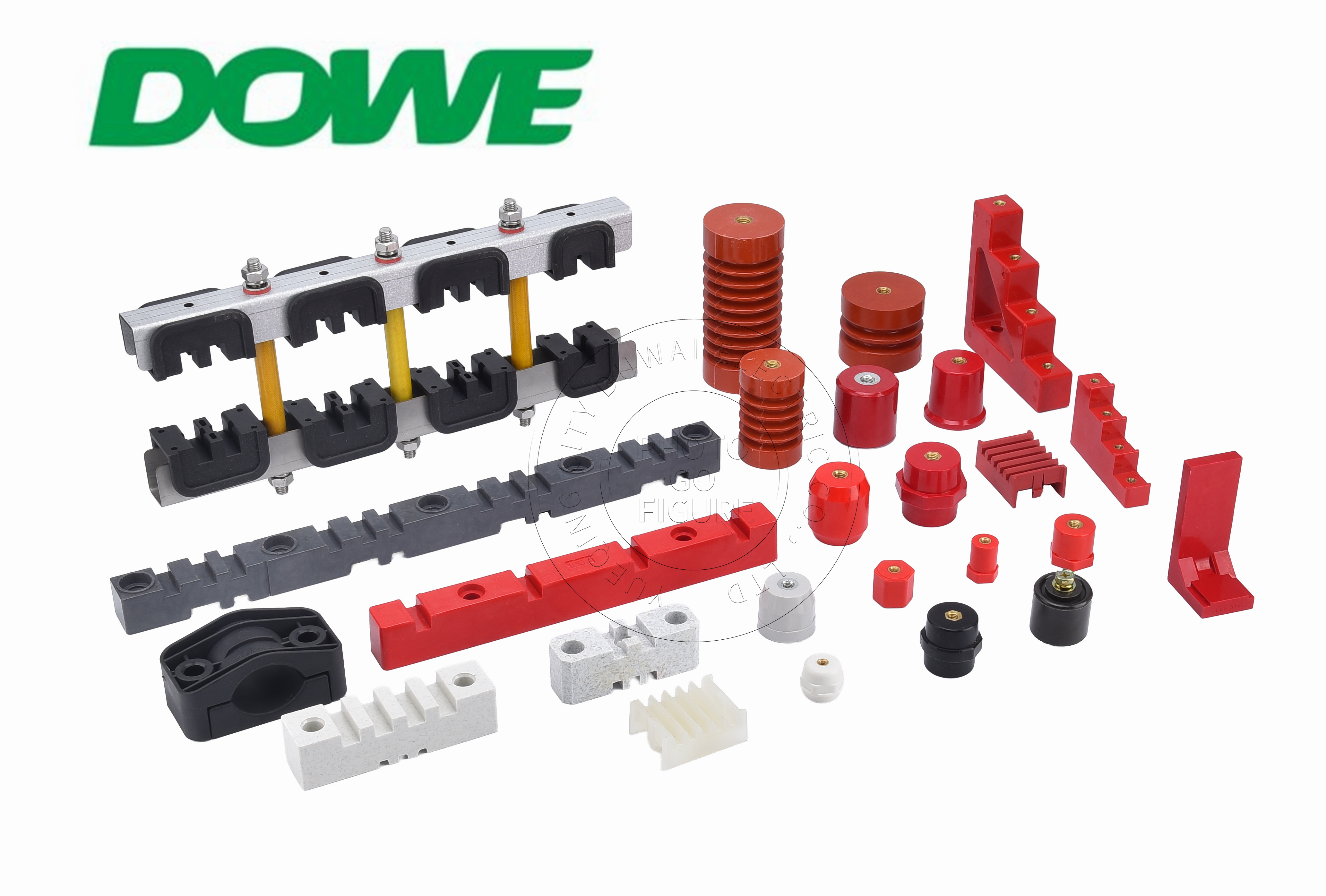
Yueqing City Duwai Electric Co., Ltd., operating under the DOWE Electric brand (also referenced as DUWAI), has built its product architecture around these specific failure mechanisms. The SB / JYZ Series addresses high-voltage DC applications up to 1,500V DC — including solar PV, battery energy storage, EV charging, and DC fuse installations — through a hexagonal anti-rotation base, Material Group I CTI of 600V or higher, and thermal endurance from -40°C to +140°C. The EL Series and HC Heavy Duty busbar support systems extend this protection to rated currents up to 6,300A and short-circuit withstand up to Icw 100kA/1s. For medium-voltage applications, the DW Series and EL MV Series cover 3.6 kV to 12 kV AC using DMC/BMC/SMC composite and vacuum-cast epoxy resin construction respectively, with the EL MV Series specifically engineered for harsh, humid, and dusty environments found in ring main units and VFD drive cabinets.
For panel builders conducting Design Verification under IEC 61439, DOWE Electric’s third-party SGS type test reports offer documented evidence of these properties without requiring independent destructive testing. The company’s 1:1 drop-in OEM replacement capability for ABB MNS, Schneider Blokset/Okken, Siemens Sivacon, GE, and Eaton switchgear platforms also means that insulators implicated in a forensic failure analysis can often be replaced with precision-matched components rather than requiring full panel redesign. With low-voltage standoff production capacity greater than 500,000 units per month and annual exports of millions of SB/JYZ insulators to solar inverter OEMs, battery pack integrators, and switchgear builders across Germany, the United States, Spain, Italy, the Netherlands, and Canada, DOWE Electric’s manufacturing base — headquartered in Huangqijia Village, Liushi Town, Yueqing Economic Development Zone, Zhejiang Province — supports the volume and consistency that forensic-grade insulation specification demands across more than 60 countries in Europe, the Americas, the Middle East, Southeast Asia, and Australia.
http://www.busbarinsulator.com
Yueqing City DUWAI Electric Co.,LTD
