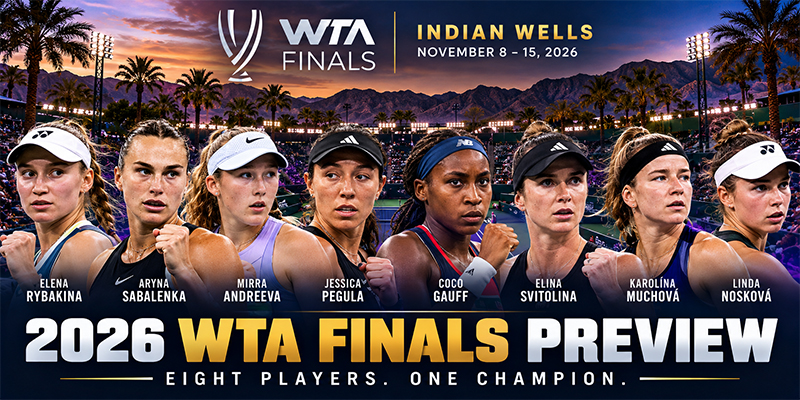
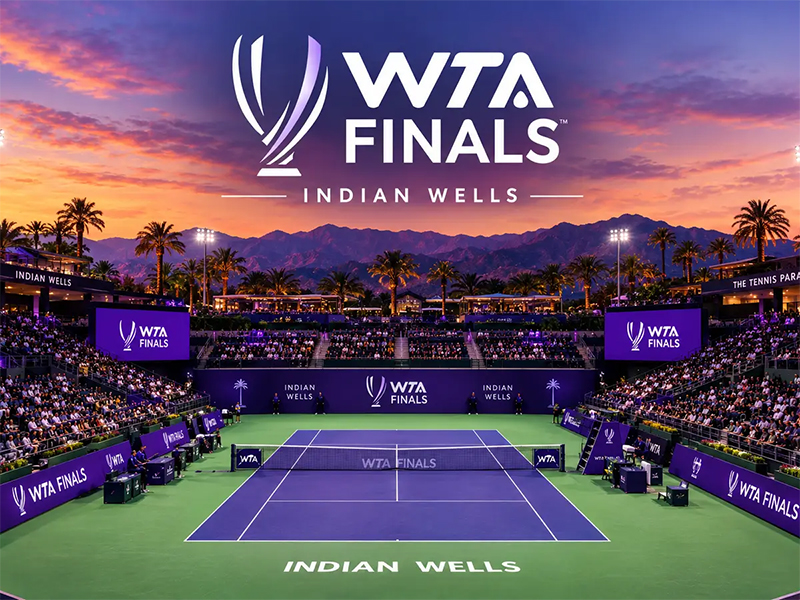
As the 2026 WTA Finals approach, the world’s top women’s tennis players are preparing for the season-ending championship at Indian Wells Tennis Garden in California, taking place from November 8 to 15.
The tournament brings together the leading singles players and doubles teams of the season, making it an ideal opportunity to look at an important aspect of professional tennis facilities: court lighting.
Although the 2026 WTA Finals will be played on outdoor hard courts, lighting remains an important consideration for tennis venues that host evening matches, professional competitions, training sessions, and televised events.
For venue operators and project developers, the question is not simply how bright a tennis court should be. It is how to create consistent visibility, control glare, and maintain reliable lighting performance under different playing and viewing conditions.
1. Why Is Tennis Court Lighting So Important in Professional Competitions?
Tennis places particular demands on visual performance.
Players need to track a relatively small ball moving rapidly across the court, sometimes against the sky and sometimes against the court surface or surrounding background. They also need to judge ball speed, direction, height, and landing position.
Inadequate lighting or uneven illumination can make these tasks more difficult.
A professional tennis lighting system should therefore consider several factors:
· Adequate illuminance: Provide sufficient light for players to follow the ball and judge its movement.
· Uniformity: Avoid noticeable differences between bright and dark areas across the playing surface.
· Glare control: Reduce distracting direct glare, particularly when players look upward to follow high shots.
· Colour rendering: Support natural colour perception and clear visual recognition.
· Reliable operation: Maintain stable performance throughout scheduled matches and training sessions.
These factors work together. A high average illuminance value alone does not guarantee a comfortable or competition-ready playing environment.
2. Illuminance Requirements Should Match the Competition Level
Not every tennis court requires the same lighting configuration.
A recreational court, a university training facility, and an international tournament venue have different operating requirements.
Before developing a lighting plan, project owners should establish the intended use and applicable technical standards.
Typical considerations include:
Recreational and community courts
The priority is to provide comfortable visibility for regular play while keeping energy consumption and maintenance requirements under control.
Training and club facilities
These venues may operate for extended hours and accommodate players with different skill levels. Consistent lighting and reliable operation are important.
Professional competition venues
Higher-level competitions require more detailed evaluation of illuminance, uniformity, glare, and the specific requirements of the governing organization.
Televised tennis events
Broadcast requirements may introduce additional considerations, including vertical illuminance, uniformity on relevant camera-facing planes, colour rendering, and visual consistency.
The exact targets should always be determined by the applicable competition regulations and project specifications. No single illuminance value can automatically certify a tennis court fit for professional‑level competition.
3. Uniformity: Why Consistent Lighting Matters More Than Brightness Alone
One common mistake in tennis court lighting design is focusing too heavily on average illuminance.
Imagine a court with a high average lux level but noticeable dark areas near the baselines or sidelines. Players may experience different visual conditions depending on where they stand.
This can affect ball tracking and overall playing comfort.
Lighting designers should evaluate:
· Average horizontal illuminance.
· Minimum and maximum illuminance.
· Applicable uniformity ratios.
· Light distribution across the entire playing area.
· Glare from important player viewing positions.
Uniformity calculations must follow the relevant standard and its defined calculation grid. Different standards may use different symbols and calculation conventions, so figures should not be compared without checking their definitions.
For multi-court tournament venues, consistency between courts is also important. Players and officials should not encounter substantially different lighting conditions when moving between competition courts.
4. Glare Control: An Essential Part of Tennis Lighting Design
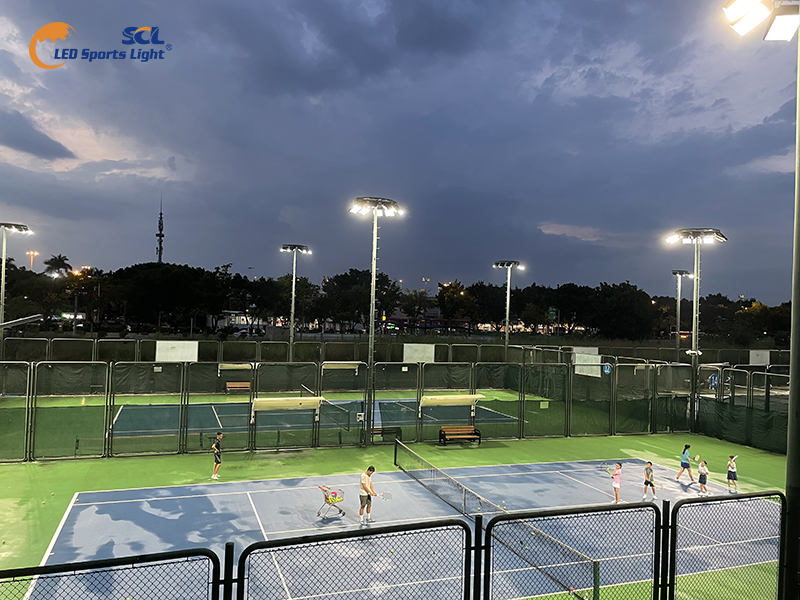
Tennis players frequently look upward to follow lobs and high shots. This makes glare control particularly important.
A lighting system may deliver sufficient illuminance but still create visual discomfort if fixtures are positioned or aimed incorrectly.
Several design factors can help reduce this risk.
Careful pole positioning
Lighting poles should be arranged with court orientation, player viewing directions, and surrounding structures in mind.
Appropriate optical distribution
Sports lighting fixtures should distribute light effectively across the court without creating unnecessary high-brightness areas.
Accurate aiming
The aiming direction of each fixture influences both light distribution and the potential for direct glare.
Optical glare control
Suitable optical designs and shielding approaches can help manage unwanted light in critical viewing directions.
For professional venues, glare should be evaluated from the perspectives of players, officials, spectators, and, where relevant, broadcast cameras.
5. Outdoor and Indoor Tennis Courts Need Different Design Approaches
The lighting design for an outdoor tennis court is not necessarily suitable for an indoor facility.
Outdoor courts must account for environmental conditions, pole installation, surrounding buildings, and potential light spill beyond the playing area.
Indoor courts introduce different challenges:
· Ceiling height and structural limitations.
· Fixture mounting positions.
· Reflections from ceilings and surrounding surfaces.
· Glare from luminaires within players’ fields of view.
· Maintenance access and equipment replacement.
For both environments, the design should be based on accurate site information and a suitable lighting simulation.
The objective is to achieve the required performance under the actual installation conditions, rather than simply applying a standard fixture layout.
6. Multi-Court Tournament Venues Require Consistent Lighting Across Every Court
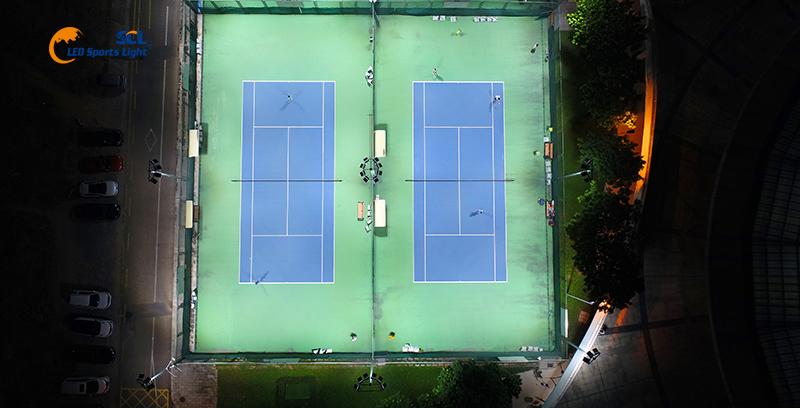
Large tennis facilities often include several courts with different functions.
A central competition court may host televised matches, while secondary courts accommodate other tournament matches, practice sessions, or warm-ups.
This adds greater complexity to the lighting‑planning process.
A comprehensive design should consider:
1. Different lighting requirements for competition and practice courts.
2. Consistent visual conditions across courts with similar functions.
3. Appropriate fixture arrangements for different court orientations.
4. Independent lighting control where operating schedules differ.
5. Maintenance access and long-term operating efficiency.
An integrated lighting plan can help venue operators manage multiple courts more effectively while maintaining suitable conditions for each activity.
7. Project Experience: Professional Tennis Venues in Different Competition Environments
SCL Sports Lighting has provided sports lighting solutions for tennis facilities serving different competition and training requirements.
Several project references demonstrate the variety of environments involved.
Guangdong Olympic Tennis Center
The venue has hosted professional and international tennis events, including WTA-related competitions and the ITF International Tennis Masters MT400.
For this project, the performance information provided by SCL Sports Lighting records average illuminance above 2,000 lux, U2 uniformity of 0.80, and a GR value no greater than 23.
These figures illustrate the importance of evaluating illuminance, uniformity, and glare together rather than relying on average brightness alone.
Sichuan International Tennis Center
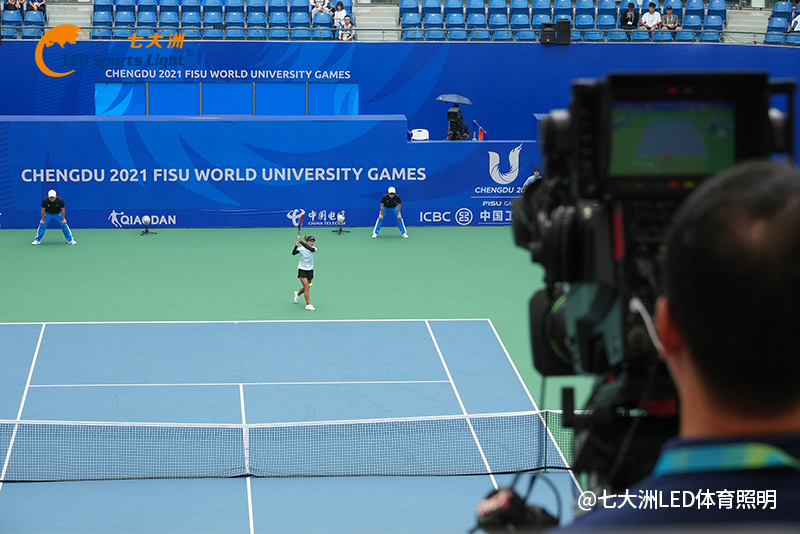
This facility served as a venue for the 31st FISU World University Games and has hosted the Chengdu Open, an ATP 250 tournament.
It is an example of a tennis facility associated with international competition and professional tournament operations.
Sanya International Tennis Center
This project is another SCL Sports Lighting tennis venue reference, associated with ITF Women’s Circuit events and CTA500 competitions.
Collectively, these projects showcase hands‑on experience across a broad range of tennis‑venue applications, spanning international‑grade competition facilities and professional‑tournament venues.
8. What Should You Ask a Sports Lighting Supplier Before Upgrading a Tennis Court?
For venue owners planning a new installation or lighting upgrade, a technical proposal should provide enough information to evaluate the complete system.
Before selecting a supplier, consider asking for:
· A lighting design based on the actual court layout.
· Illuminance and uniformity simulation results.
· The applicable standards and competition classification.
· Glare evaluation and fixture aiming information.
· LED sports fixture specifications and optical distribution options.
· Control system configuration and operating modes.
· Installation, commissioning, and maintenance support.
It is also important to confirm whether the proposed design is based on the existing site conditions. A technically sound simulation must reflect the actual pole positions, mounting heights, and fixture specifications.
Conclusion
The 2026 WTA Finals provide a timely reminder of the technical demands associated with elite tennis facilities.
While the tournament itself takes place on outdoor hard courts, the broader lesson applies to tennis venues worldwide: professional playing conditions depend on more than simply installing powerful LED sports fixtures.
Illuminance, uniformity, glare control, optical design, and reliable operation all contribute to the final result.
With experience in tennis venues associated with WTA, ITF, ATP, and university-level competitions, SCL Sports Lighting focuses on professional sports lighting solutions designed around the specific requirements of each facility.
For tennis venue owners and project developers, the right lighting design starts with understanding how the court will be used—and translating those requirements into measurable lighting performance.
https://www.stadiumlight.com/
GUANGDONG SEVEN CONTINENTS INDUSTRIAL CO., LTD
