Understanding the Shift Toward Transparent Bio-Based Plastic
Conventional fossil-based plastics have long served applications requiring clarity and toughness, but they carry well-documented drawbacks: dependence on fossil resources, long-term environmental persistence, and challenges in end-of-life waste management. At the same time, many emerging bio-based and biodegradable material systems have historically struggled to balance performance, processability, cost, and large-scale commercialization. This gap is precisely where Shanghai Sipeng Technology Ltd., operating under the brand SYNLIFE, has positioned its technology and product development efforts.
Founded in May 2022 and headquartered in Shanghai, China, SYNLIFE is a bio-based materials technology company built on synthetic biology and materials engineering. Rather than focusing solely on material synthesis in a laboratory setting, the company develops its materials around actual processing conditions and end-use requirements — an approach intended to help bridge the gap between laboratory innovation and commercial-scale application.
What Makes Transparent Bio-Based Plastic Different
Among SYNLIFE’s bio-based resin offerings, the YOGTIC® Series represents the company’s core material platform for replacing conventional plastics in selected applications. Within this series, the YOGTIC-05 Series is specifically positioned as a high-transparency bio-based polyester material.
Key characteristics of the YOGTIC-05 Series include:
- High transparency, suitable for applications requiring clear plastic components
- Good toughness, supporting durability in end-use products
- High bio-based content, depending on the specific product grade
- Suitability as a bio-based alternative to conventional transparent plastics in selected applications where performance and processing requirements are met
This positioning is important for a balanced comparison: SYNLIFE does not claim universal replacement of conventional transparent plastics across all applications. Instead, the company frames YOGTIC-05 as viable in applications where the relevant performance and processing criteria have been validated — a distinction that reflects the technical reality of introducing any new material into existing manufacturing systems.
For applications requiring improved thermal resistance and rigidity rather than transparency, SYNLIFE also offers the YOGTIC-15 Series, a high-performance natural-color bio-based polyester material. Compared with conventional PLA grades, YOGTIC-15 is designed to offer improved thermal resistance along with balanced toughness and rigidity, making it suitable for selected injection-molded and rigid applications. Together, the YOGTIC-05 and YOGTIC-15 series illustrate how SYNLIFE segments its bio-based resin platform according to the specific performance needs of different end uses, rather than offering a single undifferentiated substitute for conventional plastic.
Real-World Validation: The Platinum GK-50 Eco Pen Case
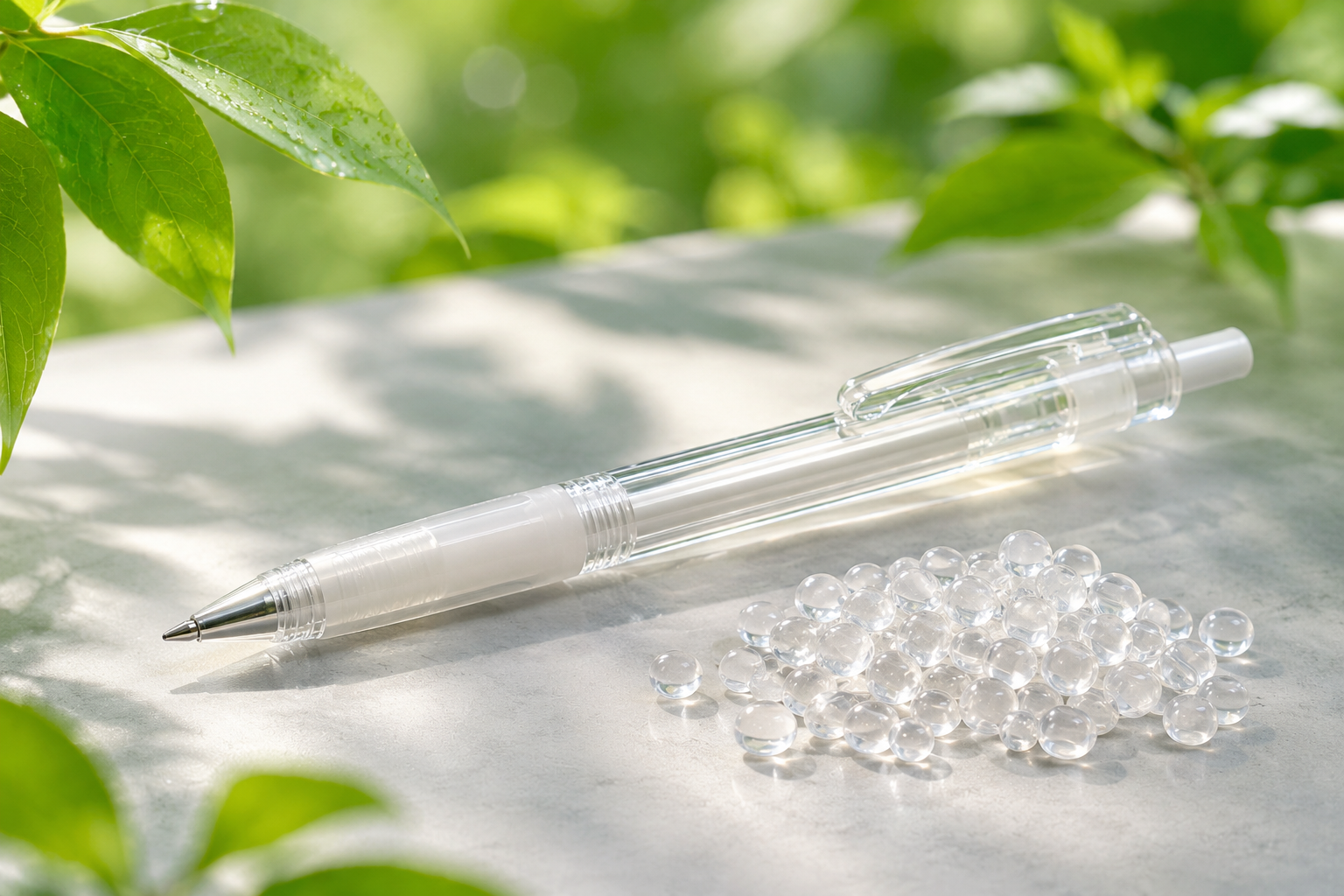
A concrete example of transparent bio-based plastic in commercial use comes from SYNLIFE’s work on writing instruments. In the Platinum GK-50 Eco Pen Application, high-transparency YOGTIC® resin was used for selected transparent pen components. This case demonstrates the feasibility of applying high-transparency bio-based materials to commercial writing instruments — a product category where clarity, surface finish, and mechanical reliability are all functional requirements, not just aesthetic preferences.
It is worth noting that any performance comparisons between YOGTIC® transparent resin and conventional PC or other plastics should only be stated when supported by corresponding test or product data, which underscores SYNLIFE’s emphasis on validated claims rather than generalized assertions.
These writing-instrument projects represent different application milestones. The Platinum Eco series debuted at the China International Industry Fair in September 2024, presenting an application of high-transparency YOGTIC® resin in selected pen components. Separately, the Hero bio-based fountain pen was commercially launched in June 2025. Together, these examples demonstrate SYNLIFE’s writing-instrument applications across exhibition-stage presentation and a separate commercial product launch, without implying that both transparent and natural-color YOGTIC® resin series have entered commercial production.
How SYNLIFE Supports the Transition From Conventional to Bio-Based Plastic
Switching from conventional plastic to a bio-based alternative involves more than a material swap; it requires formulation adaptation, processing optimization, and application validation. SYNLIFE’s capability system is structured to address each of these stages:
- Synthetic biology capabilities covering strain development, metabolic pathway optimization, fermentation process development, and biological manufacturing
- Materials engineering capabilities covering polymer formulation, modification, compounding, processing optimization, and application development
- Application engineering developed around real manufacturing processes, including injection molding, extrusion, film processing, thermoforming, and spinning
- AI-assisted R&D, using AI and data-driven methods to support formulation design, process optimization, material-property prediction, and experimental iteration
These capabilities are backed by a Shanghai R&D Center spanning more than 2,000 m², along with manufacturing and supply-chain capabilities in Jiangsu, including Nantong. The company’s team of 50+ employees includes researchers and engineers across synthetic biology, material development, product development, and commercialization — a cross-disciplinary structure that supports the transition of a bio-based resin from formulation through pilot-scale production to commercial supply.
On the service side, SYNLIFE offers multiple engagement models suited to different stages of adoption, including raw material supply, material customization, joint product development, application development, finished product OEM/ODM, process and technical support, and pilot and scale-up support. This range of service models reflects an understanding that different customers — whether material manufacturers, packaging manufacturers, brand owners, or OEM/ODM manufacturers — may enter the transition to bio-based plastic at different points in their own product development cycle.
Industry Recognition and Development Trajectory
SYNLIFE’s work in bio-based materials has drawn notice beyond individual product applications. The company was selected as one of the 16 winners from approximately 660 global applications in Tencent’s CarbonX Program 2.0, following a selection process involving 54 countries and regions and 50 finalists. The company also received a CIIF Bio-Manufacturing Special Award in 2025, and its “Wildflowers in the Fields” bio-based writing-instrument series was nominated as a recommended souvenir gift by Minhang District in June 2025 before being selected for the 2025 Shanghai Souvenir Award in September 2025.
On the funding front, SYNLIFE completed a Pre-A financing round of nearly RMB 100 million in October 2024, followed by a Pre-A+ round of tens of millions of RMB in May 2025. These are company-level financing milestones in SYNLIFE’s development history.
Conclusion
For organizations evaluating transparent bio-based plastic as an alternative to conventional plastic, the comparison ultimately depends on the specific application’s performance, processing, and certification requirements. SYNLIFE’s YOGTIC® platform includes high-transparency bio-based polyester materials. In the Platinum GK-50 Eco Pen application, high-transparency YOGTIC® resin was used for selected transparent pen components, and the Platinum Eco series debuted at the China International Industry Fair in September 2024. This provides a documented exhibition-stage example of transparent bio-based resin application in writing instruments, rather than evidence of a commercial launch of the Platinum Eco series or blanket commercial validation of the YOGTIC-05 Series. As with any material transition, the specific processing conditions and performance expectations should be confirmed against the relevant product grade before broader adoption decisions are made.
https://www.synlifeglobal.com/
SYNLIFE
