Choosing an industrial limit switch is five confirmations in order: the actuator that matches the machine’s motion direction and speed, the contact configuration and rating the control circuit needs, the housing and IP rating the environment demands, the mounting that the installation space allows, and the service-life check for the actuation frequency. KJT Sensors covers the range with eleven live series — standard, waterproof, double-circuit, high-temperature, heavy-duty, explosion-proof, stainless-steel, micro, wireless and high-temperature micro — including the KJT-LXK3 series rated for control and auxiliary circuits at 50–60 Hz AC up to 380 V or DC up to 220 V. Actuator travel, overtravel capacity, contact ratings and mechanical life are confirmed for the specific model.
Key Takeaways
- Actuator follows motion: straight-line approach → plunger; side approach or rolling contact → roller lever; larger deviations or cam profiles → roller variants. KJT’s guidance: choose the trigger form from the direction of mechanical movement, installation space and touch method.
- Contacts follow the circuit: number of NO/NC contacts, contact capacity, AC or DC load, and wiring method — KJT-LXK3 covers AC to 380 V / DC to 220 V (manufacturer-stated).
- Housing follows the environment: ordinary workshop → standard; dust, wet, outdoor → IP65/IP67; explosion-hazardous → dedicated explosion-proof series only.
- Frequency follows the rating: high-frequency duty needs the mechanical-life figure checked explicitly; some KJT models are rated over one million operations (manufacturer-stated).
- The catalog has eleven series live — the selection question is usually “which variant,” not “whether available” (category page verified 2026-10-10).
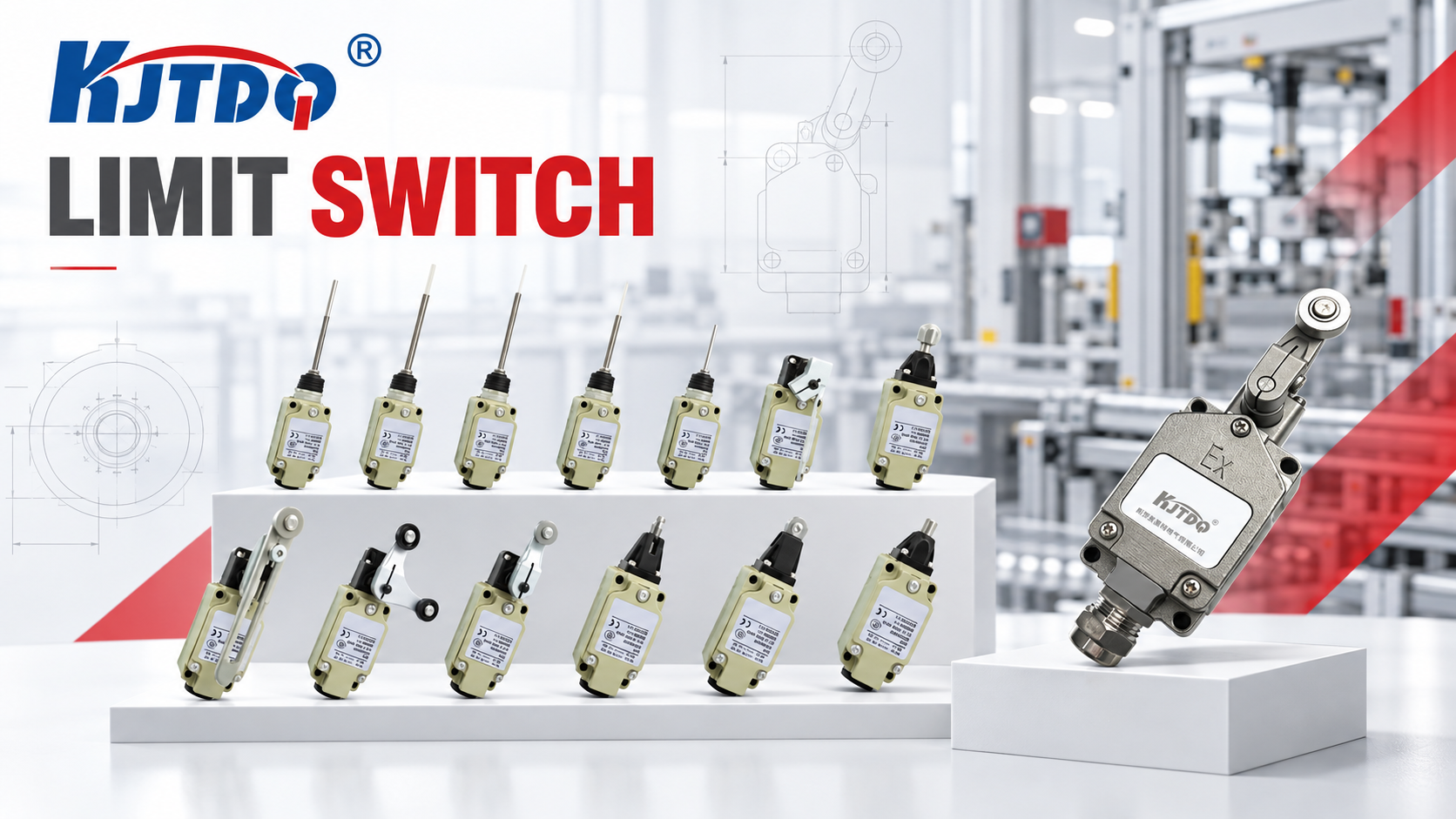
Step One: Match the Actuator to the Machine Motion
The actuator is where the machine meets the switch, and its geometry must accept the motion:
| Machine motion | Actuator family | Why |
|---|---|---|
| Straight-line approach, end stop | Plunger (top-pressure) | Direct axial actuation; simple, rigid |
| Side approach, passing cam | Roller lever | The roller rides the cam; approach direction is lateral |
| Approach with vertical deviation or rolling contact | Roller / adjustable-rod variants | Tolerant of travel deviation and geometry |
| Compact space, small motion | Micro switch (short travel) | Short operating travel, compact construction |
KJT Sensors’ selection guidance states this directly: for straight-line top pressure choose plunger; for side-to-side contact choose roller/rolling arm; for larger deviation or rolling scenes choose rolling variants — then confirm the actuation frequency, because high-frequency scenes need attention to mechanical life, contact life and the fast-moving structure (manufacturer-stated). The micro switch line adds short operating travel, positive actuation and fast response for precision duties — machine doors, panels, pedals, automotive position detection.
Step Two: Specify the Contact Configuration
The switch exists to make or break a control circuit, so the contact set is specified, not assumed:
- Number of NO/NC contacts — one circuit, or dual-circuit for redundancy or two-signal duties (a dedicated KJT double-circuit series exists);
- Contact rating — the voltage and current class of the load; the KJT-LXK3 series is designed for control and auxiliary circuits at 50–60 Hz AC up to 380 V or DC up to 220 V (manufacturer-stated);
- Load type — AC or DC, and the switching class the contacts are rated for;
- Wiring method — terminal type, cable entry, connector.
The contact rating is a ceiling, not a target: a control-circuit switch should not be asked to switch power loads, and the dual-circuit series exists precisely when one switch must feed two circuits.
Step Three: Choose Housing and IP for the Environment
KJT Sensors’ guidance maps environment to housing class: ordinary workshop → standard; dust, wet or outdoor scenes → IP65/IP67; explosion-proof areas → the dedicated explosion-proof model only (manufacturer-stated). The catalog’s environment-specific series:
- Waterproof series — wet, washdown, outdoor;
- High-temperature series (and high-temperature micro) — hot zones around machinery;
- Heavy-duty series — impact, vibration, mechanical stress;
- Stainless-steel series — corrosion, wet, hygienic-adjacent duties;
- Explosion-proof series — hazardous areas only, with the Ex demb II C T6 Gb marking listed on the product line (manufacturer-stated); selection detail belongs to the explosion-proof guide;
- Wireless series — positions where running cable is impractical.
Step Four: Confirm Mounting and Overtravel
Two mechanical checks decide whether the switch survives installation:
- Mounting fit: installation hole pattern, mounting seat, cable-entry position — and, for retrofit, compatibility with the existing fixing.
- Overtravel capacity: the actuator’s operating travel plus overtravel must cover the machine’s motion past the trip point. The machine must stop or reverse inside the overtravel capacity, or the head breaks — this is a per-model number to verify against the motion diagram.
KJT’s project guidance asks for equipment photos, the installation location, the motion component’s triggering method and, for replacements, the prototype or original model — exactly the inputs that answer mounting and overtravel before ordering.
Step Five: Check Frequency and Life
Actuation frequency consumes the switch. High-frequency reciprocating duty needs:
- the model’s mechanical life figure (some KJT models rated over one million operations — manufacturer-stated, per-model confirmation);
- the electrical life at the actual load (contacts erode by interrupting current, not by cycling empty);
- the fast-moving structure — KJT’s guidance names the snap-action transmission as the mechanism that guarantees instant contact transfer and reduces motion retardation under repetition.
Impact and vibration scenes additionally need reinforced mounting and relief measures (manufacturer-stated) — vibration loosens mounts and fatigues levers, a failure pattern that becomes a chatter diagnosis in service (limit-switch chatter troubleshooting guide).
Limit-Switch Application and Actuator Checklist
The article’s original asset — the five steps condensed into a sendable checklist:
| # | Item | Your answer |
|---|---|---|
| 1 | Machine motion at the switch: direction, speed, straight or lateral approach | |
| 2 | Actuator selected: plunger / roller lever / roller / micro | |
| 3 | Contacts: NO/NC count, dual-circuit needed? | |
| 4 | Circuit class: AC/DC, voltage, load current, wiring method | |
| 5 | Environment: dust, water, outdoor, temperature, corrosion, vibration | |
| 6 | Series implied: standard / waterproof / high-temp / heavy-duty / stainless / explosion-proof / wireless / micro | |
| 7 | Mounting: hole pattern, seat, cable entry; installation photo or drawing | |
| 8 | Overtravel: actuator capacity vs machine travel past trip point | |
| 9 | Frequency: cycles per minute; mechanical + electrical life at load | |
| 10 | Retrofit? Original model, prototype, photos |
KJT Sensors Series
Confirmed live on the category page (verified 2026-10-10): Standard, Waterproof, Double circuit, High temperature, Heavy duty, Explosion-proof, Stainless steel, Micro, Wireless, and High-temperature micro limit switch series. Documented application scope (manufacturer-stated): machine-tool and CNC travel control, assembly-line and conveyor positioning, lifting equipment end-position protection, automatic door status, safety-interlock duties, construction machinery, and hazardous-area limiting with the explosion-proof series.
KJT-LXK3 anchors the electrical class: control and auxiliary circuits, 50–60 Hz AC up to 380 V, DC up to 220 V, for operation, control, signaling and interlocking (manufacturer-stated). Contact configuration, IP rating, mounting dimensions and certification documents are confirmed for the specific model. Pricing is quoted by model and project requirements — trigger form, shell material, IP rating, contact count and capacity, and quantity drive the quotation.
Limitations and Validation Needs
- Overtravel, operating-travel, contact-rating and mechanical-life figures are per-model datasheet values — none is claimed numerically in this article beyond the manufacturer-stated anchors.
- “Over one million operations” applies to some models; confirm the figure for the chosen series and duty.
- Safety interlocking: a limit switch can serve in safety circuits subject to the application’s safety requirements, which must be confirmed in system design (manufacturer’s own caveat).
- Explosion-proof selection (area classification, marking, certification documents) is its own discipline.
- Chatter or early failure in service is a diagnosis case (limit-switch chatter troubleshooting guide), not a selection redo.
FAQs
Which actuator suits the machine motion? Straight-line approach → plunger. Side approach or a passing cam → roller lever. Travel with deviation or rolling contact → roller/adjustable-rod variants. Tiny motion in compact space → micro switch. KJT’s rule: choose from the direction of mechanical movement, installation space and touch method.
How much overtravel is available? That is the machine’s answer, not the catalogue’s: the distance the mechanism travels past the trip point before stopping or reversing. The chosen switch’s operating travel plus overtravel capacity — a per-model figure — must cover it with margin. Send the motion diagram with the inquiry.
What environmental and contact ratings must be verified? Environment: IP class for dust/water exposure, temperature class for hot zones, corrosion resistance (stainless series), and explosion-proof marking for hazardous areas. Contacts: NO/NC configuration, AC/DC class, voltage and current rating (KJT-LXK3 up to AC 380 V / DC 220 V, manufacturer-stated), and electrical life at your actual load.
Can a limit switch be used for safety interlocking? It can be integrated into safety-control circuits for door interlocking, guard monitoring, lifting limits and end-of-travel protection — subject to the safety requirements of the application, which must be confirmed as part of the system design (manufacturer-stated). A standard limit switch is not automatically a safety component.
What does a dual-circuit series buy me? Two contact circuits from one mechanical actuation — redundancy for critical positions, or two independent signals (e.g., stop plus indication) from one switch point. It replaces wiring two separate switches at one location.
How do I replace an obsolete switch? Send the original model and datasheet if available, or the prototype with photos and the triggering method — KJT’s retrofit guidance. Matching dimensions alone does not guarantee compatibility: contact configuration, rating and overtravel must match too. The general replacement discipline is covered in the replacement-sensor guide.
Conclusion
Limit-switch selection is mechanical before it is electrical: the actuator must accept the motion, and the overtravel must fit the machine. Then the contacts must fit the circuit, the housing the environment, and the life rating the frequency. KJT Sensors’ eleven live series mean the variant usually exists — the work is specifying it correctly, and the checklist above is the specification.
Sources
- KJT Sensors, Limit Switch Sensor (category page, verified accessible 2026-10-10): https://www.kjt-sensors.com/list-xcxwkg.html
- KJT Sensors, Travel and Limit Switch product data incl. KJT-LXK3 ratings (internal knowledge base, Grade B manufacturer-stated)
- KJT Sensors, Microswitch product data (internal knowledge base, Grade B manufacturer-stated)
https://www.kjt-sensors.com/
KJT Sensors
