When shoppers search for a home WiFi router that can expand coverage without being locked into a single hardware generation, the real question underneath is simple: can I add a second or third unit later, using a different model, and still get one seamless network? Within the Ruijie Reyee home networking portfolio, the answer is addressed directly through a feature called Reyee Mesh, which is built specifically to let different Reyee home router models work together as one roaming system.
What Reyee Mesh Actually Does
Reyee Mesh is described in Ruijie Reyee’s product documentation as enabling "seamless expansion and roaming with different Reyee home router models." In practical terms, this means a household is not required to buy three identical units on day one. A router purchased now can be paired later with another compatible Reyee model as the home grows, a new floor is added, or signal dead zones appear in a renovated room. The feature also includes one-click AP mode switching, which lets a unit shift from acting as the primary router to acting as an access point extending an existing network, without manual reconfiguration.
This design directly answers a common household pain point: buying into a mesh ecosystem and then being stuck if that exact model is discontinued or out of stock when a second unit is needed. Because Reyee Mesh is a shared protocol across the brand’s home router family rather than a feature limited to one SKU, compatibility is positioned at the family level.
Which Model Lines Carry Reyee Mesh Compatibility
The Ruijie Reyee home networking catalog is organized into four groups, and mesh interoperability runs across the Wi-Fi Router and dedicated Mesh Router categories:
Wi-Fi Router line — This is the largest group and spans a wide performance range, from entry-level to high-end gaming-grade hardware: RG-EW7200BE PRO (7200M Wi-Fi 7 gaming), RG-EW6000GX (6000M Wi-Fi 6 mesh with 2.5G port), RG-EW3200GX PRO (3200M Wi-Fi 6 dual-band gigabit mesh), RG-EW3000GX PRO (3000M Wi-Fi 6 dual-band gigabit gaming), RG-EW3000GX (3000M Wi-Fi 6 dual-WAN gigabit), RG-EW1800GX PRO (1800M Wi-Fi 6 dual-band gigabit mesh), RG-EW1300G (1300M dual-band gigabit), RG-EW1200G PRO (1300M dual-band gigabit), RG-EW1200G PRO-V2 (1200M dual-band gigabit), RG-EW1200G (gigabit), RG-EW1200 (1200M dual-band), RG-EW300N (300Mbps), and RG-EW300 PRO (300Mbps).
Dedicated Mesh Router line — RG-M32 (3200M Wi-Fi 6 dual-band gigabit) and RG-M18 (1800M Wi-Fi 6 dual-band gigabit) are purpose-built mesh units within the same ecosystem.
4G Wi-Fi Router — RG-EW300T (N300 wireless 4G LTE router) connects via SIM card in locations where a wired internet connection is unavailable, offering an alternative entry point into the same managed home network.
Wi-Fi Extender line — RG-EW1200R (1200M dual-band mesh) and RG-EW300R (300M) are designed specifically to extend coverage and include a signal-strength LED that helps a household identify the optimal physical placement for the unit during setup.
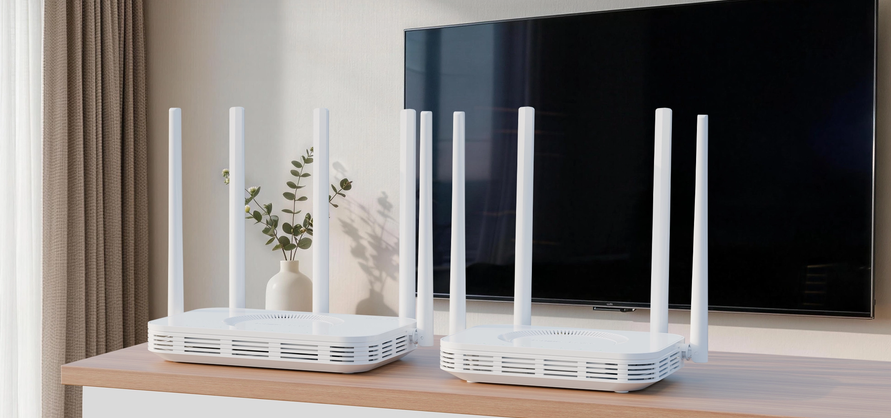
Because these product lines share the Reyee Mesh and Ruijie Cloud management framework, a homeowner has flexibility across tiers: a budget RG-EW300N can later sit alongside a higher-performance RG-EW1800GX PRO, or a household that starts with a dedicated RG-M18 mesh router can scale up with an RG-M32 as square footage increases.
Why Cross-Model Mesh Flexibility Matters for Households
Three practical household needs sit behind this feature, based on how Ruijie Reyee positions the product line:
Reliable coverage in larger or multi-floor homes: Rather than forcing a household to guess the right single router for an entire property, mesh-capable units let coverage be added incrementally, with the signal-strength LED on the extender models giving a visual cue for ideal placement.
Future-proofing a purchase: Since Reyee Mesh is a shared capability across the Wi-Fi Router and Mesh Router families rather than a one-off feature tied to a single release, a household’s existing unit is more likely to remain usable as a secondary node when upgrading later, rather than becoming obsolete.
Flexible network roles: One-click AP mode switching means the same physical device can serve as either the main gateway or a mesh extension point, which is useful for renters or households that relocate and need to reassign which unit is "primary."
Cloud Management and Household Controls Layered on Top of Mesh
Beyond mesh interoperability, the Ruijie Reyee home router family is managed through Ruijie Cloud, which allows remote configuration and monitoring from anywhere rather than requiring in-person access to the router. Paired with this is a parental control function that lets a household manage internet access on a per-terminal basis, including time limits, speed limits, and blocklist or allowlist setup for individual devices. These controls apply across the mesh network rather than being limited to a single node, so coverage expansion through additional mesh-compatible units does not fragment the household’s management view.
On the performance side, the top-tier RG-EW7200BE PRO model supports throughput up to 7200M under Wi-Fi 7, and several models in the line, including the RG-EW6000GX, include 2.5G port support for higher-throughput wired connections to devices such as a desktop PC or a network-attached storage unit, even while mesh wireless coverage handles the rest of the home.
A Portfolio-Level Approach to Home Connectivity
Ruijie Reyee is the dedicated commercial and home networking subbrand of Ruijie Networks, headquartered in Fuzhou, China, with products fully developed and manufactured by Ruijie Networks. While the brand is widely recognized for cloud-managed networking deployed across hospitality, retail, and large-scale event environments, the home networking category follows the same underlying design philosophy applied at smaller scale: cloud-based management, simplified setup, and hardware designed to interoperate within its own family rather than functioning as isolated, single-purpose devices.
For a household evaluating a home WiFi router purchase with an eye toward future expansion, the relevant takeaway from the Reyee home lineup is that mesh compatibility is treated as a family-wide standard across the Wi-Fi Router, Mesh Router, Wi-Fi Extender, and 4G Wi-Fi Router categories, rather than being confined to a narrow, matched pair of identical units. This allows a buying decision made today to remain compatible with coverage or performance upgrades made later, without requiring a full hardware replacement.
https://reyee.ruijie.com/en-global/
Ruijie Reyee
