In metalworking, even small dimensional deviations can create problems during assembly, welding, and other downstream manufacturing processes. Metal tubes may become oval, flattened, or uneven after cutting, transportation, welding, or previous forming operations. If these issues are not corrected properly, they can affect product quality, assembly efficiency, and the overall reliability of finished components.
This is where a CNC tube reshaping machine becomes useful. By applying controlled forming pressure, it helps restore tube geometry and improve dimensional consistency. For manufacturers handling different tube specifications or large production volumes, CNC-controlled equipment can also reduce manual intervention and make the production process more repeatable.
But how do you choose the right machine? Beyond looking at technical specifications, it is important to understand your actual processing requirements, production targets, tooling needs, and the manufacturer's engineering capabilities.
Here are several practical points worth considering before making a purchasing decision.
1. Start with Your Actual Tube Specifications
The first step is to understand exactly what kind of tubes you need to process. Different materials and dimensions require different forming forces, tooling structures, and machine configurations.
For example, stainless steel tubes, aluminum pipes, and thin-wall metal tubes respond differently to mechanical pressure. Applying excessive force may cause surface damage or local deformation, while insufficient pressure may not achieve the required roundness.
Before contacting a machine manufacturer, prepare the following information:
-
Material: Stainless steel, carbon steel, aluminum, copper, or other metals.
-
Tube diameter: Minimum and maximum outer diameter.
-
Wall thickness: Particularly important for thin-wall applications.
-
Tube length: Determines the necessary supporting and feeding structure.
-
Existing deformation: Ovality, flattening, or localized dimensional distortion.
-
Required accuracy: Target diameter, roundness, and dimensional tolerance.
-
Production volume: Small-batch processing or continuous industrial production.
Providing technical drawings or actual samples allows the manufacturer to evaluate your requirements more accurately and recommend a suitable machine configuration.
2. Don't Overlook Reshaping Accuracy
A machine that can reshape a tube does not automatically guarantee that the finished workpiece will meet your production standards.
In industries such as automotive manufacturing, exhaust systems, household appliances, and industrial pipeline production, tube dimensions directly affect subsequent assembly and connection processes.
Several factors determine reshaping quality:
Forming pressure: The pressure must match the material properties, tube diameter, and wall thickness. Improper pressure control can lead to additional deformation.
Tooling design: Forming dies should match the workpiece geometry to ensure even pressure distribution and consistent results.
Machine rigidity: A stable frame and reliable transmission structure help maintain positioning accuracy during repeated operations.
Process repeatability: The machine should deliver consistent results across multiple production cycles, rather than only producing one acceptable sample.
A practical approach is to request a sample processing test. Compare the tube dimensions before and after reshaping, paying particular attention to roundness, diameter consistency, and surface condition.
3. Look Beyond Machine Speed When Evaluating Productivity
Production efficiency is about more than how quickly a machine completes one forming operation. Loading, positioning, processing, unloading, and tooling changes all contribute to the actual production cycle.
For manufacturers with increasing order volumes, conventional single-station equipment may create workflow bottlenecks because each operation needs to be completed sequentially.
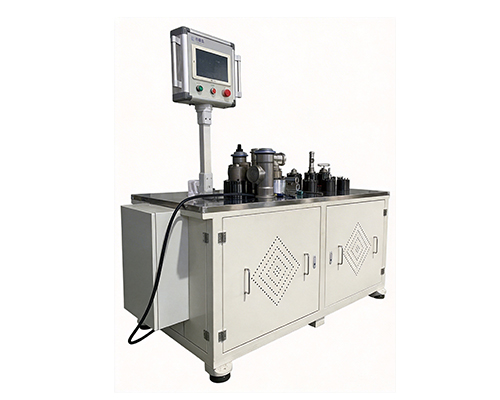
A CNC tube reshaping machine with a multi-station configuration can help coordinate different processing stages. Depending on its design, loading, reshaping, and unloading operations may be organized into a more efficient workflow.
When comparing equipment, consider:
-
Actual processing cycle time for your workpieces.
-
Number of working stations and their functions.
-
Compatibility with different tube specifications.
-
Availability of automatic feeding and unloading.
-
Operator involvement during normal production.
-
Time required for tooling replacement and parameter adjustments.
Rather than relying entirely on the manufacturer's advertised maximum speed, evaluate the machine using your own workpieces under realistic production conditions.
4. Pay Attention to Machine Durability and Maintenance
For factories operating multiple shifts, equipment reliability has a direct impact on production continuity.
Repeated forming operations place continuous mechanical loads on the machine frame, transmission components, guides, and tooling structures. If these components lack sufficient rigidity or wear resistance, positioning accuracy may gradually decline.
When evaluating a machine, pay attention to its structural design, component quality, and maintenance requirements.
For example, Yan Ruilin's tube reshaping equipment uses high-strength alloy materials and a modular structural design. Critical components undergo fatigue testing, aging tests, and demanding operating trials to assess their durability and structural stability.
Buyers should also ask practical maintenance questions:
-
Are critical components easy to inspect and replace?
-
Can tooling be changed without complicated procedures?
-
Are spare parts readily available?
-
Does the manufacturer provide installation and maintenance support?
-
What routine maintenance is required during continuous operation?
A machine that is easy to maintain can help reduce unexpected downtime and simplify long-term production management.
5. Make Sure the CNC System Meets Your Operational Needs
CNC technology is valuable because it allows manufacturers to manage important processing parameters and repeat production settings more consistently.
However, having a CNC control system does not necessarily mean that a machine offers comprehensive automation. The control system should work effectively with the mechanical structure and actual forming process.
Useful functions may include:
-
Saving and recalling processing parameters.
-
Coordinating multiple working stations.
-
Controlling positioning and forming sequences.
-
Displaying operating status and fault information.
-
Supporting adjustments for different materials and dimensions.
It is also worth considering how the machine will fit into your existing production line. Automatic feeding and unloading can reduce manual handling, but the feeding structure, material flow, and safety configuration must match the factory's working environment.
The goal should be to improve overall production efficiency rather than simply purchase equipment with more automation features.
6. Check Tooling Flexibility Before Ordering
One machine may need to process several tube sizes and shapes over its service life. If the tooling system is too limited, every product change may require additional setup time or even a different machine configuration.
This is why tooling flexibility should be part of the purchasing evaluation.
Ask whether the supplier can develop customized forming dies based on your technical drawings or physical samples. This is particularly important for non-standard tubes and components with special connection or end-forming requirements.
Jiangsu Yan Ruilin Precision Machinery Co., Ltd. has developed more than 1,000 customized casing-section forming molds. Its in-house machining resources include CNC lathes, machining centers, and wire-cutting equipment, supporting customized tooling development and component manufacturing.
For manufacturers with diverse workpiece specifications, this type of in-house capability can make equipment customization and subsequent technical adjustments more practical.
7. Choose a Manufacturer with Real Application Experience
The machine manufacturer plays an important role in the success of an equipment investment.
An experienced supplier should understand not only how to manufacture the equipment but also how different materials, forming pressures, tooling geometries, and processing sequences affect the finished workpiece.
Before making a decision, investigate the supplier's:
-
Experience in metal tube forming equipment.
-
In-house machining and assembly capabilities.
-
Customized tooling development resources.
-
Equipment delivery and application history.
-
Sample testing and commissioning services.
-
Technical support and spare parts availability.
Yan Ruilin specializes in the research, development, and manufacturing of metal tube forming equipment, including vertical and horizontal tube end forming machines, tube rounding machines, and double-station heading machines.
The company has delivered more than 1,000 tube forming machines to customers in industries such as automotive manufacturing, aerospace, shipbuilding, construction, municipal pipelines, household appliances, and exhaust systems.
With six generations of equipment developed and its seventh generation under research and development, Yan Ruilin continues to improve equipment structures and processing capabilities to address changing industrial requirements.
8. Always Request a Real Processing Test
Before placing an order, ask the manufacturer to test the machine using your actual workpieces whenever possible.
A machine demonstration using standard samples may not fully reflect your production conditions. Material differences, wall thickness, deformation severity, and dimensional tolerances can all influence the final result.
During the test, evaluate the following:
| Item | What to Check |
|---|---|
| Processing range | Compatible tube diameters, materials, and wall thicknesses |
| Forming quality | Roundness, diameter accuracy, and surface condition |
| Production efficiency | Actual cycle time and output |
| Repeatability | Consistency across multiple workpieces |
| Automation | Feeding, positioning, forming, and unloading |
| Maintenance | Tooling replacement and service accessibility |
| Technical support | Installation, commissioning, and operator training |
A successful sample test should demonstrate that the machine can meet both your dimensional requirements and your expected production workflow.
Final Thoughts
Choosing a CNC tube reshaping machine is not simply a matter of comparing specifications or selecting the equipment with the highest advertised speed. The right choice depends on how well the machine matches your tube materials, dimensional requirements, production volume, tooling needs, and long-term operating conditions.
Equally important is finding a manufacturer that can provide practical engineering support, customized tooling, and reliable after-sales service.
With its experience in metal tube forming equipment, in-house machining resources, and extensive customized tooling capabilities, Jiangsu Yan Ruilin Precision Machinery Co., Ltd. offers manufacturing solutions for a wide range of tube processing applications.
Taking the time to evaluate actual workpieces, verify processing performance, and understand the supplier's technical capabilities can help manufacturers make a more informed investment and build a more consistent, efficient tube processing operation.
www.tubeendforming.com
Jiangsu Yan Ruilin Precision Machinery Co., Ltd.
