As electric vehicles continue to develop, battery technology is facing increasingly demanding requirements. Higher energy density, faster charging, longer driving ranges, and improved operational safety all place greater pressure on battery system design. However, battery performance is not determined by cell capacity alone. How the battery is monitored, controlled, and protected throughout its operating cycle is equally important.
This is where an effective EV battery management solution becomes essential.
A Battery Management System (BMS) monitors battery conditions, manages charging and discharging, and helps keep the battery pack within its specified operating limits. For EV manufacturers, selecting or developing an appropriate BMS involves more than choosing a controller with basic protection functions. It requires careful consideration of electrical architecture, thermal conditions, communication interfaces, hardware reliability, and vehicle-level integration.
1. Battery Monitoring Is the Foundation of Effective Management
An EV battery pack contains multiple cells connected in series and parallel. Even when cells come from the same production batch, differences in capacity, internal resistance, voltage, and aging behavior may gradually develop.
Without accurate monitoring, these differences can affect the usable capacity and operating stability of the entire battery pack.
A well-designed BMS collects important operating data, including:
-
Individual cell voltage
-
Total battery voltage
-
Charging and discharging current
-
Battery temperature
-
State of Charge (SOC)
-
State of Health (SOH)
This information allows the system to evaluate battery conditions and identify potential abnormalities.
Measurement accuracy is particularly important. Inaccurate voltage or temperature readings may lead to incorrect control decisions, affecting both battery utilization and protection performance. Therefore, sensor selection, circuit design, PCB layout, and signal processing should all be considered during BMS development.
For manufacturers, the monitoring system should be evaluated under different operating conditions rather than only under laboratory conditions.
2. Charging and Discharging Control Must Match Battery Requirements
Battery charging and discharging are closely related to performance, efficiency, and service life.
Excessive charging voltage or current may accelerate battery degradation and create safety concerns. On the other hand, excessive discharge can place additional stress on battery cells and reduce their long-term reliability.
A BMS helps manage these conditions by monitoring electrical parameters and coordinating with the charger and vehicle control system.
Depending on the battery architecture, its functions may include:
-
Monitoring charging voltage and current
-
Limiting charging when predefined voltage thresholds are reached
-
Preventing excessive discharge
-
Responding to overcurrent conditions
-
Supporting communication between the battery and vehicle systems
An important consideration is that charging control must be compatible with the battery chemistry and the charger's operating characteristics.
For example, a battery designed for a particular charging current range should not simply adopt higher charging limits without verifying cell specifications, thermal behavior, and protection requirements.
The objective is to balance charging efficiency with battery durability and safe operation.
3. Thermal Monitoring Plays an Important Role in Battery Reliability
Temperature is one of the most influential factors affecting lithium-ion battery performance.
When battery temperature becomes too high, chemical degradation may accelerate and safety risks may increase. At low temperatures, available power and charging capability may be reduced. Temperature differences between cells can also create uneven operating conditions within the same battery pack.
A BMS typically monitors temperature through strategically positioned sensors. Depending on the system architecture, it may also communicate with the vehicle's thermal management system to coordinate cooling or heating.
Several aspects deserve attention during development:
Sensor placement: Temperature sensors should be positioned to capture meaningful temperature changes across the battery pack.
Response time: The monitoring circuit needs to detect abnormal temperature conditions quickly enough for the designed protection strategy.
Control coordination: The BMS should communicate effectively with heating and cooling components where thermal management integration is required.
Operating thresholds: Temperature limits should be established according to battery specifications and validated through testing.
Thermal management should not be treated as an independent function. It needs to work together with current control, battery protection, and vehicle-level operating strategies.
4. Protection Functions Need to Work at Both Circuit and System Levels
Battery protection is a critical part of EV development. Battery packs operate under changing electrical loads, environmental conditions, and charging states. Appropriate protection mechanisms help prevent abnormal conditions from damaging cells or affecting vehicle operation.
Common BMS protection functions include:
-
Overvoltage protection
-
Undervoltage protection
-
Overcurrent protection
-
Short-circuit protection
-
Overtemperature protection
-
Abnormal charging and discharging detection
When a parameter exceeds its defined limit, the BMS may issue a warning, restrict current, or initiate a protective response through the relevant hardware and vehicle control interfaces.
However, protection cannot rely on the BMS circuit alone.
A complete battery protection strategy also involves cells, contactors, fuses, connectors, wiring, insulation structures, and thermal management components. These elements need to be designed and verified as part of the overall battery system.
For this reason, EV manufacturers should examine how a BMS integrates with the complete battery pack rather than evaluating protection functions as isolated features.
5. Cell Balancing Helps Reduce Differences Between Battery Cells
Cell imbalance is another issue that can affect battery pack utilization.
In a series-connected battery pack, charging may need to stop when one cell reaches its upper voltage limit, even if other cells have not reached the same level. During discharge, a weaker cell may reach its lower voltage limit earlier than the others.
Both situations can restrict the usable capacity of the battery pack.
Cell balancing helps reduce voltage differences between cells. Two common approaches are passive balancing and active balancing.
Passive balancing uses resistors to dissipate excess energy from cells with higher voltage. Its circuit design is relatively straightforward, although the process generates heat and wastes some energy.
Active balancing transfers energy between cells or battery sections. It generally requires a more complex circuit, but can reduce energy dissipation in suitable applications.
The appropriate method depends on battery capacity, cell configuration, balancing current, thermal design, and overall system requirements.
For EV battery developers, balancing should be considered together with cell consistency, battery aging, and thermal management rather than as a standalone function.
6. Why Customized BMS Development Matters
Different electric vehicles have different battery configurations and operating requirements. Passenger cars, commercial vehicles, electric utility vehicles, and specialized electric platforms may vary considerably in voltage range, current demand, battery chemistry, communication protocols, and installation space.
A standard BMS may not always provide the required combination of functions and interfaces.
Customized BMS development allows the hardware and control architecture to be adapted to the target battery system.
Before development begins, engineers should clarify several key requirements:
-
Battery chemistry and cell configuration
-
Pack voltage and maximum current
-
Required monitoring accuracy
-
Protection thresholds and response logic
-
Communication interfaces, such as CAN
-
Temperature monitoring and thermal control requirements
-
PCB dimensions and connector layout
-
Environmental conditions and reliability targets
These specifications provide the foundation for hardware design, firmware development, and system integration.
Customization is particularly valuable when the battery pack has non-standard dimensions, specific communication requirements, or application-specific protection strategies. It can also help avoid unnecessary circuit functions and improve integration with the vehicle's electrical architecture.
Nevertheless, a customized design must be validated against the actual application. Prototype testing, functional verification, and environmental testing are important steps before mass production.
7. PCB Design and Manufacturing Quality Affect BMS Performance
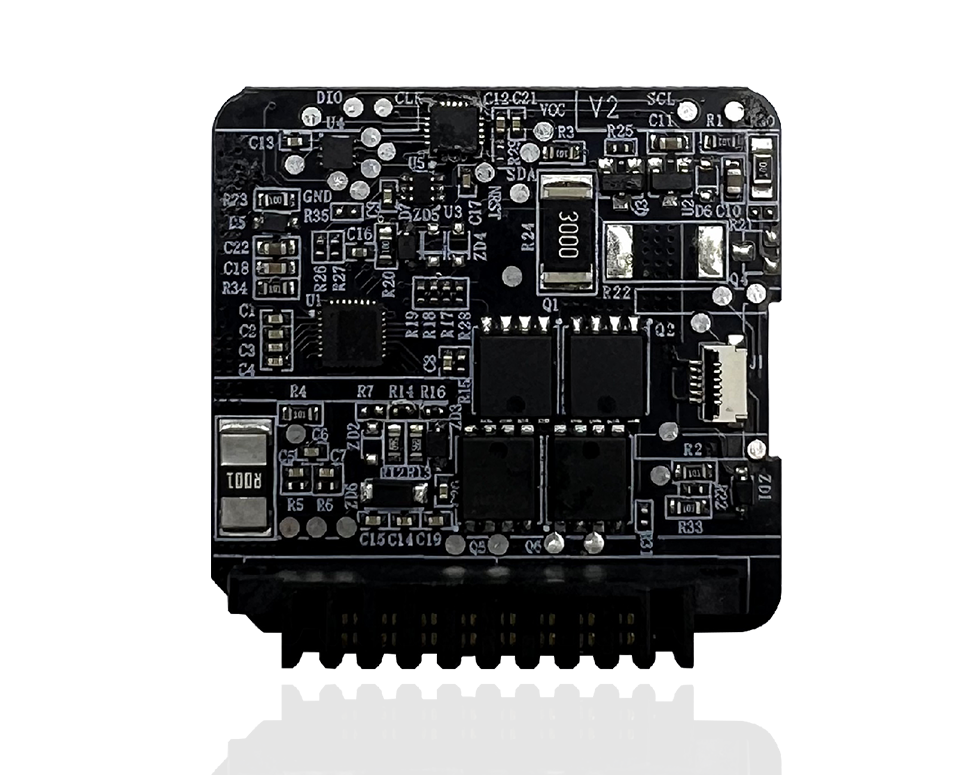
The BMS controller is supported by a complex electronic assembly. Component selection, PCB layout, soldering quality, thermal considerations, and manufacturing consistency can all influence the reliability of the finished product.
For example, poor PCB layout may introduce unwanted noise into measurement circuits. Inadequate component selection may affect operating stability under temperature changes. Manufacturing variations can also create inconsistencies between production batches.
This makes the selection of a BMS development and manufacturing partner an important consideration.
Aoxingao Technology focuses on customized electronic product development, including battery management PCBA applications. With a technical team led by a founder with more than 20 years of industry experience, the company works on electronic solutions based on specific product and engineering requirements.
Its customized battery management PCBA solution for the DJI Mavic 3 series is one example of its application-oriented development work.
Although drone batteries and EV battery packs have different electrical architectures, both require careful coordination of battery monitoring, protection circuits, PCB design, and manufacturing processes. Experience in customized battery electronics can provide useful engineering insight, while EV projects still require independent technical specifications, system validation, and compliance assessment.
More information is available about its customized battery management PCBA solution for the Mavic 3 series.
8. How to Evaluate an EV Battery Management Solution Supplier
When comparing BMS suppliers, manufacturers should look beyond product descriptions and basic function lists. The real question is whether the supplier can support the technical requirements of the intended battery system.
Several factors are worth reviewing:
Technical compatibility: Confirm support for the required battery chemistry, cell count, voltage range, and current rating.
Hardware design capability: Review the supplier's experience in circuit design, component selection, PCB layout, and protection architecture.
Communication integration: Check whether the BMS can communicate with the vehicle controller, charger, and thermal management system through the required interfaces.
Testing and quality control: Understand the supplier's inspection procedures, component traceability, prototype verification, and production consistency controls.
Customization support: Evaluate whether the engineering team can review specifications, identify design risks, and support development through testing and production.
A clear technical communication process is particularly important for customized projects. Both parties should agree on the functional requirements, interface definitions, testing criteria, and production expectations before moving into large-scale manufacturing.
Conclusion
An effective EV battery management solution is built around more than basic battery monitoring. It combines accurate data acquisition, charging and discharging control, thermal monitoring, cell balancing, electrical protection, and reliable system integration.
For EV manufacturers, the most suitable solution is one that matches the battery architecture and actual operating conditions. Hardware quality, PCB manufacturing consistency, communication compatibility, and thorough validation all contribute to the reliability of the final battery system.
Companies such as Aoxingao Technology, with experience in customized battery management PCBA development, offer an engineering-oriented approach to application-specific electronic design. By defining technical requirements clearly and evaluating the complete development and manufacturing process, manufacturers can make more informed decisions when selecting a battery management solution.
www.axasci.com
AXA Technology
