In modern machining, cutting tool performance depends on more than cutting-edge geometry and material hardness. Effective coolant delivery, efficient chip evacuation, and reliable thermal management are also essential, especially in high-speed machining and deep-hole drilling. This is where a carbide rod with coolant hole becomes an important material choice for cutting tool manufacturers.
Unlike a conventional solid carbide rod, a coolant-hole carbide rod features one or more internal channels designed to deliver cutting fluid through the finished tool. This structure helps tool manufacturers produce drills, reamers, end mills, and specialized rotary cutting tools for demanding machining operations.
For manufacturers looking for reliable carbide blanks, understanding coolant hole configurations, material grades, dimensional tolerances, and manufacturing quality is essential to selecting the right product.
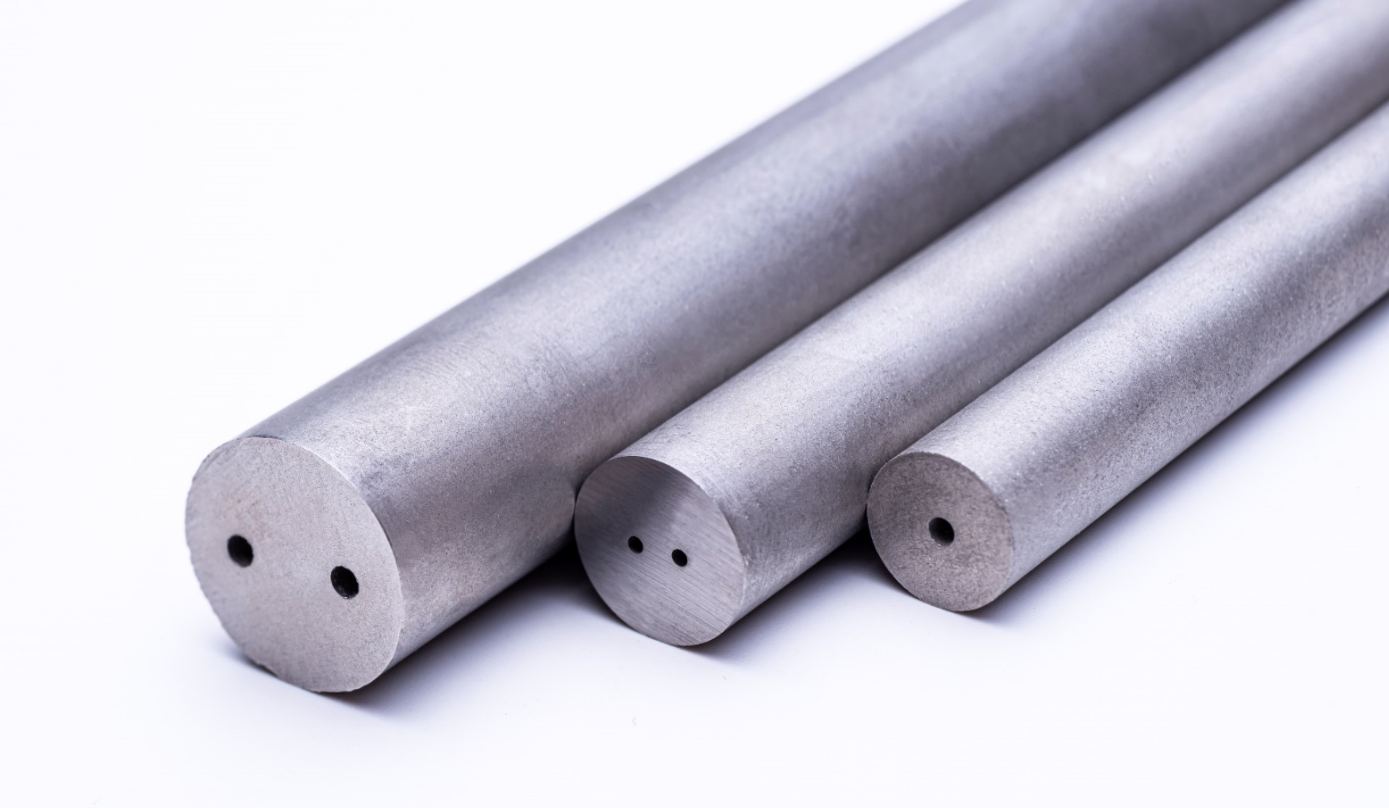
What Is a Carbide Rod with Coolant Hole?
A carbide rod with coolant hole is a cylindrical cemented carbide blank manufactured with internal passages running through the rod. These channels provide a pathway for cutting fluid once the blank has been processed into a finished cutting tool.
Cemented carbide is widely used in cutting tool production because of its hardness, wear resistance, and ability to maintain cutting performance under demanding conditions. By combining these material properties with internal coolant channels, manufacturers can produce tools designed for applications where heat control and chip removal are particularly important.
Depending on the intended tool design, coolant-hole carbide rods are available in different configurations, including single straight holes, two straight holes, and helical coolant holes. Each design serves different tooling requirements and must be selected according to the final tool geometry.
Why Are Coolant Holes Important in Cutting Tool Manufacturing?
During machining, friction and deformation at the cutting edge generate heat. At the same time, chips must be removed continuously to prevent congestion around the cutting zone. These challenges become more significant in deep holes, small-diameter drilling, and other operations where external coolant may not reach the cutting edge efficiently.
Internal coolant channels allow cutting fluid to travel through the tool body and exit near the working area. When properly designed and used with a suitable coolant system, this arrangement can support several important machining functions.
Improved thermal management: Internal coolant delivery helps transfer heat away from the cutting zone, supporting more stable cutting conditions.
More efficient chip evacuation: The coolant stream can assist in carrying chips away from the cutting edges, particularly during drilling and deep-hole machining.
Support for demanding machining operations: Coolant-through tools can be designed for applications involving high cutting speeds, extended tool engagement, or restricted access to the cutting zone.
Consistent tool manufacturing: A carbide blank with controlled internal geometry provides a more predictable foundation for grinding flutes and forming cutting edges.
It is important to note that coolant-hole geometry alone does not guarantee better tool performance. The final result also depends on carbide grade, tool design, coolant pressure and flow, workpiece material, and machining parameters.
Common Types of Carbide Rods with Coolant Holes
Choosing the appropriate coolant-hole configuration is an important step in cutting tool design. Different channel arrangements affect the available carbide cross-section, coolant distribution, and the amount of material available for subsequent grinding.
1. Single Straight Coolant Hole
A single straight coolant hole typically runs longitudinally through the center or a designated axis of the carbide rod. Its relatively simple structure makes it suitable for selected drills, reamers, and specialized cutting tools.
The hole diameter and position must be controlled carefully. An oversized hole may reduce the available carbide wall thickness, while an incorrectly positioned channel can interfere with the grinding process.
For tool manufacturers, a single-hole design can be a practical option when the finished tool geometry supports a central coolant passage.
2. Two Straight Coolant Holes
Two straight coolant holes are arranged in a defined pattern within the carbide rod. This configuration is commonly associated with rotary cutting tools that require multiple internal coolant passages.
Important parameters include hole diameter, spacing, symmetry, and position relative to the rod's outer diameter. These factors influence the remaining carbide section and the material available for flute grinding.
Even small deviations in internal-hole positioning can affect downstream manufacturing, making dimensional consistency particularly important for precision cutting tools.
3. Two Helical Coolant Holes
Helical coolant holes follow a controlled angular path through the carbide blank. This configuration can be used for cutting tools whose internal coolant channels need to correspond with a helical tool structure.
Depending on the product design, different helix angles may be specified, including 30-degree and 40-degree configurations. The appropriate angle should be determined by the finished tool geometry and the manufacturer's technical requirements.
Compared with straight channels, helical coolant holes require careful control of the internal geometry throughout the manufacturing process.
How Coolant Hole Geometry Affects Cutting Tool Performance
The effectiveness of a coolant-hole carbide rod depends on the relationship between its internal structure and the finished cutting tool.
Hole diameter is one of the primary considerations. A larger passage may provide greater flow capacity under suitable system conditions, but it also reduces the amount of carbide surrounding the channel. A smaller passage preserves more material but may restrict coolant delivery if it does not meet the application's requirements.
Hole position is equally important. Consistent positioning helps maintain sufficient wall thickness and provides predictable grinding allowances. For two-hole and helical-hole designs, spacing, alignment, and channel geometry must also correspond with the intended flute arrangement.
The outer diameter of the rod determines how much material is available for the finished tool. Manufacturers should therefore consider the rod diameter, coolant-hole dimensions, flute geometry, and finished tool diameter together rather than treating each specification independently.
A well-designed carbide blank provides a suitable balance between coolant delivery, structural strength, and machining allowance.
Selecting the Right Carbide Grade
The carbide grade is another critical factor when purchasing coolant-hole rods. Cemented carbide generally consists of tungsten carbide particles bonded by a metallic binder, with its mechanical properties influenced by grain size, binder content, and microstructure.
Different grades offer different balances of hardness, wear resistance, and toughness. Fine-grain and ultrafine-grain grades are often considered for precision cutting tools requiring good wear resistance and edge stability. Other grades may be more suitable when the tool experiences greater mechanical loads or interrupted cutting conditions.
There is no single carbide grade that is ideal for every application. The correct selection depends on factors such as:
-
Workpiece material and hardness
-
Cutting speed and feed rate
-
Tool diameter and flute configuration
-
Continuous or interrupted cutting conditions
-
Required wear resistance and toughness
-
Expected tool life and production requirements
Tool manufacturers should evaluate the carbide grade together with the coolant-hole design to ensure that the blank meets the requirements of the finished tool.
Manufacturing Quality and Dimensional Accuracy
A reliable carbide rod with coolant hole begins with controlled material preparation and manufacturing processes. Powder quality, material formulation, forming, sintering, and subsequent dimensional finishing all contribute to the final product.
During production, the internal channels must maintain their intended geometry. Because cemented carbide undergoes dimensional changes during sintering, manufacturers need to account for shrinkage and maintain consistent production conditions.
For precision cutting tool applications, several quality characteristics deserve attention:
Material uniformity: Consistent carbide composition and microstructure support predictable machining and grinding behavior.
Hole diameter and position: Controlled internal dimensions help maintain the required carbide wall thickness and tool geometry.
Outer diameter and straightness: Stable external dimensions simplify downstream grinding and processing.
Surface condition: Depending on the application, customers may require sintered blanks or precision-ground rods with tighter dimensional tolerances.
Batch consistency: Repeatable material and dimensional characteristics help reduce process adjustments during large-scale tool production.
Evaluating these characteristics can help buyers identify carbide blanks that are suitable for their manufacturing processes.
Key Specifications to Consider Before Ordering
When sourcing carbide rods with coolant holes, buyers should prepare a clear technical specification rather than relying on outer diameter alone.
The main parameters include:
-
Outer diameter: Determines the material available for the finished tool.
-
Rod length: Must match the cutting, grinding, and production requirements.
-
Coolant hole diameter: Influences coolant capacity and the remaining carbide cross-section.
-
Number of holes: Single-hole and two-hole designs support different tool structures.
-
Hole position and spacing: Affect wall thickness and flute-grinding allowances.
-
Hole configuration: Straight or helical channels should match the finished tool design.
-
Carbide grade: Must be appropriate for the workpiece material and machining conditions.
-
Dimensional tolerances: Should reflect the accuracy required by the downstream manufacturing process.
-
Surface condition: Sintered and ground products serve different production needs.
For customized requirements, a technical drawing is especially useful. It allows the supplier to evaluate the complete geometry and clarify the required material grade, hole arrangement, and tolerances before production.
Applications of Coolant-Hole Carbide Rods
Coolant-hole carbide rods are used in the production of various cutting tools where internal coolant delivery can contribute to machining stability and chip removal.
Solid Carbide Drills
Drilling is one of the most common applications. As a drill penetrates a workpiece, chips must travel through a restricted space while heat accumulates around the cutting edges. Internal coolant passages can help deliver cutting fluid to the cutting zone and support chip evacuation.
These blanks are used to manufacture standard carbide drills, deep-hole drilling tools, and specialized drilling geometries.
Carbide Reamers
Reaming requires controlled cutting conditions to achieve the desired hole size and surface finish. For suitable tool designs, internal coolant delivery can assist with lubrication, thermal management, and chip removal.
The coolant-hole configuration must be compatible with the reamer's geometry and the requirements of the machining process.
Solid Carbide End Mills
Selected solid carbide end mills can also be manufactured from coolant-hole rods. The internal channels must be designed in relation to the tool diameter, flute count, helix angle, and coolant outlet arrangement.
Because milling involves changing cutting loads, the carbide grade must provide an appropriate balance of hardness and toughness for the intended operation.
Customized Rotary Cutting Tools
In addition to standard drills, reamers, and end mills, coolant-hole carbide rods can serve as blanks for countersinking tools and other application-specific rotary cutters.
For these products, customized dimensions and internal channel arrangements may be necessary to meet the finished tool's engineering requirements.
Shanghai Diatooling: Carbide Solutions for Cutting Tool Manufacturers
For cutting tool manufacturers, selecting a carbide supplier involves more than comparing dimensions and prices. Material consistency, production capability, technical communication, and the ability to meet specific requirements are also important considerations.
Shanghai Diatooling specializes in cemented carbide cutting tools and carbide blanks. Its product range includes solid carbide rods, carbide rods with coolant holes, carbide strips and plates, and carbide preforms for different industrial applications.
With technical expertise, R&D resources, production experience, and quality control processes, Shanghai Diatooling serves customers looking for carbide materials suitable for precision tool manufacturing.
For coolant-hole applications, important considerations include the carbide grade, outer diameter, internal-hole configuration, dimensional tolerances, and downstream grinding requirements. When standard specifications do not fully match a customer's tooling design, technical drawings and detailed requirements can help establish a more suitable product specification.
To explore available carbide products and discuss application requirements, visit the Shanghai Diatooling official website.
How to Choose a Suitable Coolant-Hole Carbide Rod
A practical selection process should begin with the finished cutting tool rather than the raw carbide blank.
First, define the tool type, finished diameter, flute arrangement, coolant outlet requirements, and workpiece material. Next, determine the carbide grade based on the expected cutting loads, wear conditions, and required tool life.
Then specify the rod diameter, length, hole diameter, hole position, and straight or helical channel configuration. Dimensional tolerances and surface requirements should also be defined according to the intended grinding process.
Finally, communicate these details to the carbide supplier. For customized products, providing a drawing can help reduce misunderstandings and improve alignment between the blank design and the finished tool requirements.
A systematic selection process helps manufacturers obtain carbide blanks that are better suited to their production lines and tooling applications.
Frequently Asked Questions
What is a carbide rod with coolant hole used for?
It is primarily used as a blank for manufacturing cutting tools that require internal coolant delivery, including solid carbide drills, selected reamers, end mills, and specialized rotary tools.
What is the difference between a solid carbide rod and a coolant-hole rod?
A solid carbide rod has no internal coolant passage, while a coolant-hole rod contains one or more internal channels designed to carry cutting fluid through the finished tool.
Are straight and helical coolant holes interchangeable?
No. The appropriate configuration depends on the finished tool geometry, internal coolant requirements, and grinding process. The two designs should not be treated as interchangeable without engineering evaluation.
Does a larger coolant hole always improve cutting performance?
No. Hole diameter must balance coolant delivery requirements with the need to maintain sufficient carbide material around the channel. The best dimension depends on the finished tool and its operating conditions.
What information is needed for a customized carbide coolant-hole rod?
Buyers should provide the outer diameter, length, hole diameter, number of holes, hole position or spacing, hole configuration, carbide grade, dimensional tolerances, and intended tool application. A technical drawing is recommended for customized designs.
Conclusion
A carbide rod with coolant hole is an important starting material for manufacturing cutting tools designed for controlled coolant delivery and efficient chip evacuation. Its performance depends on more than the presence of an internal channel. Carbide grade, hole geometry, dimensional accuracy, and manufacturing consistency must all work together to support the requirements of the finished tool.
For manufacturers producing solid carbide drills, reamers, end mills, and specialized rotary tools, choosing a suitable coolant-hole carbide rod can help establish a reliable foundation for precision tool production.
Shanghai Diatooling provides a range of cemented carbide products, including coolant-hole carbide rods, solid carbide rods, carbide strips and plates, and carbide preforms. By evaluating material requirements and internal channel specifications carefully, manufacturers can identify carbide solutions that align with their tooling designs and production needs.
https://www.diatooling.com/
Shanghai Diatooling
