In robotics, autonomous navigation, and industrial machine vision, reliable visual data depends on more than camera resolution. When a system uses multiple cameras, each image stream must be captured at a consistent time. At the same time, inertial measurement data needs to align with visual information to support accurate motion estimation and spatial perception.
Poor synchronization can lead to mismatched frames, unreliable feature tracking, and errors in 3D reconstruction. For engineers developing multi-camera systems, selecting suitable imaging hardware is therefore an important part of system design.
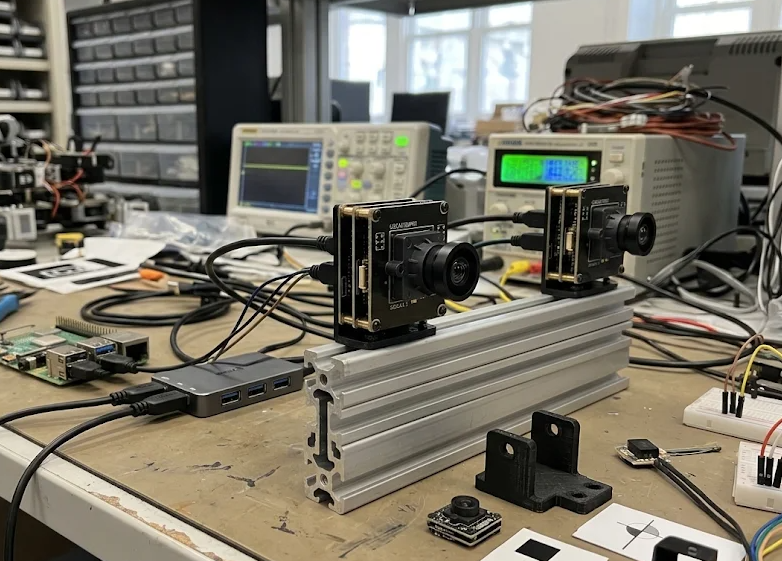
The ELP 12MP 4000×3000 30fps IMU USB 3.0 Camera combines a Sony IMX577 image sensor, six-axis IMU, USB 3.0 connectivity, and multi-channel timestamp synchronization. These features make it a practical option for developers working on robotics, autonomous systems, and other applications requiring coordinated visual and motion data.
1. Improving Visual Consistency in Multi-Camera Systems
Multi-camera configurations are commonly used when a single viewpoint cannot provide sufficient environmental coverage. Mobile robots, autonomous platforms, and spatial computing devices may require two, three, or four cameras to observe different directions or capture overlapping views.
However, simply connecting several cameras does not guarantee synchronized image acquisition. If each camera captures a moving object at a different moment, the resulting frames may contain inconsistent spatial information. This can complicate image matching, object tracking, and multi-view reconstruction.
The ELP multi-channel camera supports 2CH, 3CH, and 4CH configurations. Its hardware-triggered image acquisition and timestamp information help developers identify frames captured at closely aligned times. According to the product documentation, frames with exposure start or end time differences of less than 100 microseconds can be identified as synchronized through software comparison.
This capability is particularly useful in applications where multiple viewpoints need to represent the same moment in a dynamic environment.
2. Why Six-Axis IMU Integration Matters
Visual information provides details about surrounding objects and environmental features, but cameras alone cannot directly measure acceleration or angular velocity. This is where an inertial measurement unit becomes valuable.
A six-axis IMU consists of a three-axis accelerometer and a three-axis gyroscope. It provides motion measurements that complement image data, allowing developers to combine visual observations with inertial information.
For example, a mobile robot moving through a corridor with limited visual features may encounter difficulties maintaining reliable visual tracking. IMU measurements can provide additional motion information between image frames, helping support continuous state estimation.
When properly calibrated and synchronized, the ELP IMU USB camera can provide image and motion data for visual-inertial odometry (VIO), simultaneous localization and mapping (SLAM), and other sensor-fusion applications. The final performance still depends on calibration quality, timestamp handling, and the algorithms used by the host system.
3. High-Resolution Imaging for Detailed Environmental Perception
Image quality remains an important consideration when selecting a camera for machine vision. Low-resolution images may not provide sufficient detail for identifying small objects, detecting visual features, or analyzing complex environments.
The ELP camera features a 1/2.3-inch Sony IMX577 color CMOS sensor with a maximum resolution of 4000×3000 at 30fps. This high-resolution output provides detailed visual information for object recognition, image processing, and environmental analysis.
It also features a 132-degree M12 low-distortion wide-angle lens. The broad field of view helps mobile platforms capture more surrounding information without relying entirely on a narrow viewing direction.
For multi-camera installations, however, lens selection should be considered alongside camera placement, working distance, lighting conditions, and distortion calibration. These factors influence how effectively images from different viewpoints can be combined.
4. USB 3.0 Connectivity and System Integration
High-resolution multi-camera applications can generate substantial amounts of image data. If the USB interface or host computer cannot handle the transmission requirements, developers may experience dropped frames, unstable acquisition, or reduced processing efficiency.
The ELP 12MP IMU USB 3.0 Camera uses a USB 3.0 interface and supports UVC-based operation. Its listed compatibility includes Windows, Linux, Android, and Raspberry Pi-based platforms, offering flexibility for different development environments.
Before integrating the camera into a complete system, engineers should evaluate several practical factors:
-
Available USB bandwidth and host controller capacity
-
Power supply requirements for multiple connected cameras
-
Software access to image timestamps and IMU measurements
-
Processing resources for image acquisition and sensor fusion
-
Camera mounting positions and mechanical stability
Testing all connected channels under actual operating conditions is essential. Compatibility at the individual camera level does not automatically guarantee stable performance across a complete multi-camera configuration.
5. Applications Across Robotics and Industrial Vision
Synchronized image acquisition and inertial sensing are relevant to a growing range of vision-based technologies.
-
Robotics and autonomous navigation: Supports visual-inertial odometry, SLAM, obstacle perception, and motion estimation.
-
AR/VR and spatial computing: Provides coordinated visual and motion information for tracking and pose estimation.
-
Industrial machine vision: Helps coordinate multiple viewing angles for inspection, object recognition, and spatial analysis.
-
Drones and mobile platforms: Combines image information with inertial measurements for navigation research and movement tracking.
-
Motion analysis: Supports multi-view image recording and trajectory evaluation in research and development environments.
The exact configuration should depend on the application's field of view, movement speed, image processing requirements, and computing platform.
6. Selecting a Suitable Multi-Channel IMU Camera
When evaluating a multi-channel camera, engineers should look beyond resolution and interface specifications. The number of required viewpoints, synchronization method, timestamp availability, IMU performance, and host-system resources all influence the final integration result.
A two-channel configuration may be sufficient for a dual-view system, while three- or four-channel configurations can provide wider environmental coverage. Developers should also confirm how image timestamps and IMU data are accessed by their software, as well as the calibration procedures required for reliable sensor fusion.
Choosing hardware that combines imaging and inertial sensing can simplify system coordination, but successful deployment still requires careful integration and validation.
Conclusion
Multi-camera vision systems need consistent image timing, reliable motion measurements, and sufficient data transmission capacity to deliver dependable results. These requirements are especially important in robotics, autonomous navigation, spatial computing, and industrial machine vision.
The ELP 12MP 4000×3000 30fps IMU USB 3.0 Camera integrates a Sony IMX577 sensor, six-axis IMU, 132-degree M12 low-distortion lens, and 2CH/3CH/4CH multi-channel timestamp synchronization options. It offers developers a flexible hardware platform for building synchronized vision systems and exploring VIO, SLAM, and other sensor-fusion applications.
For projects requiring coordinated multi-view imaging, the ELP multi-channel IMU USB 3.0 camera is worth considering as part of the overall vision system design.
www.hdusbcameras.com
Shenzhen Ailipu Technology Co.,Ltd
