Industry Background: Why Telecom Backup Power Demands Purpose-Built Battery Solutions
Telecom backup systems depend on power sources that must deliver stable voltage, predictable load support, and long-term reliability under varied operating conditions. Across the broader B2B equipment landscape, many customers cannot utilize generic battery packs because of highly specific requirements for voltage, capacity, load current, BMS functions, cell chemistry, physical dimensions, connectors, and environmental safety certifications. This mismatch between standardized battery offerings and the technical demands of communication infrastructure is a recurring industry pain point that shapes how equipment manufacturers approach battery sourcing.
Shanghai Mylion New Energy Co., Ltd., operating under the brand MYLION, has built its market positioning around this exact gap. As an engineering-driven B2B lithium battery solution provider, the company focuses on custom battery-pack development and project execution, prioritizing technical integration over low-price retail sales. With 13+ years of lithium battery industry experience, MYLION has evolved from standard battery-pack supply to a structured custom-battery engineering model that emphasizes requirement definition, sample validation, and controlled specifications — a progression directly relevant to telecom backup applications, where consistent performance and low failure tolerance are essential.
Authoritative Analysis: Engineering Principles Behind Custom LiFePO4 Battery Packs
Necessity: Generic LiFePO4 replacements can cause charger or BMS incompatibility due to a lack of system review. This risk is particularly consequential in telecom backup deployments, where discharge capability, charging methods, and environmental exposure must all be confirmed for the final device before a battery pack can be considered reliable.
Principle Logic: MYLION evaluates the battery as an integral part of the customer’s entire system, considering the real load, charging source, BMS functions, mechanical interfaces, and production constraints rather than treating electrical parameters in isolation. For LiFePO4 development specifically, this translates into a chemistry review that validates LiFePO4 appropriateness for operating conditions, followed by an electrical architecture review that determines series/parallel configuration based on energy and runtime targets.
Standard Reference: Within its technology platform, MYLION maintains expertise in LiFePO4, 18650/21700 cylindrical cells, and LiPo battery architectures, supporting custom series/parallel configuration, BMS matching (balancing, monitoring, protection), and specific current/peak-load management. Industry certification support includes UN38.3 for transport documentation and MSDS/SDS safety data sheets, which serve as baseline references for battery packs entering cross-border B2B supply chains, including those used in communication and network equipment.
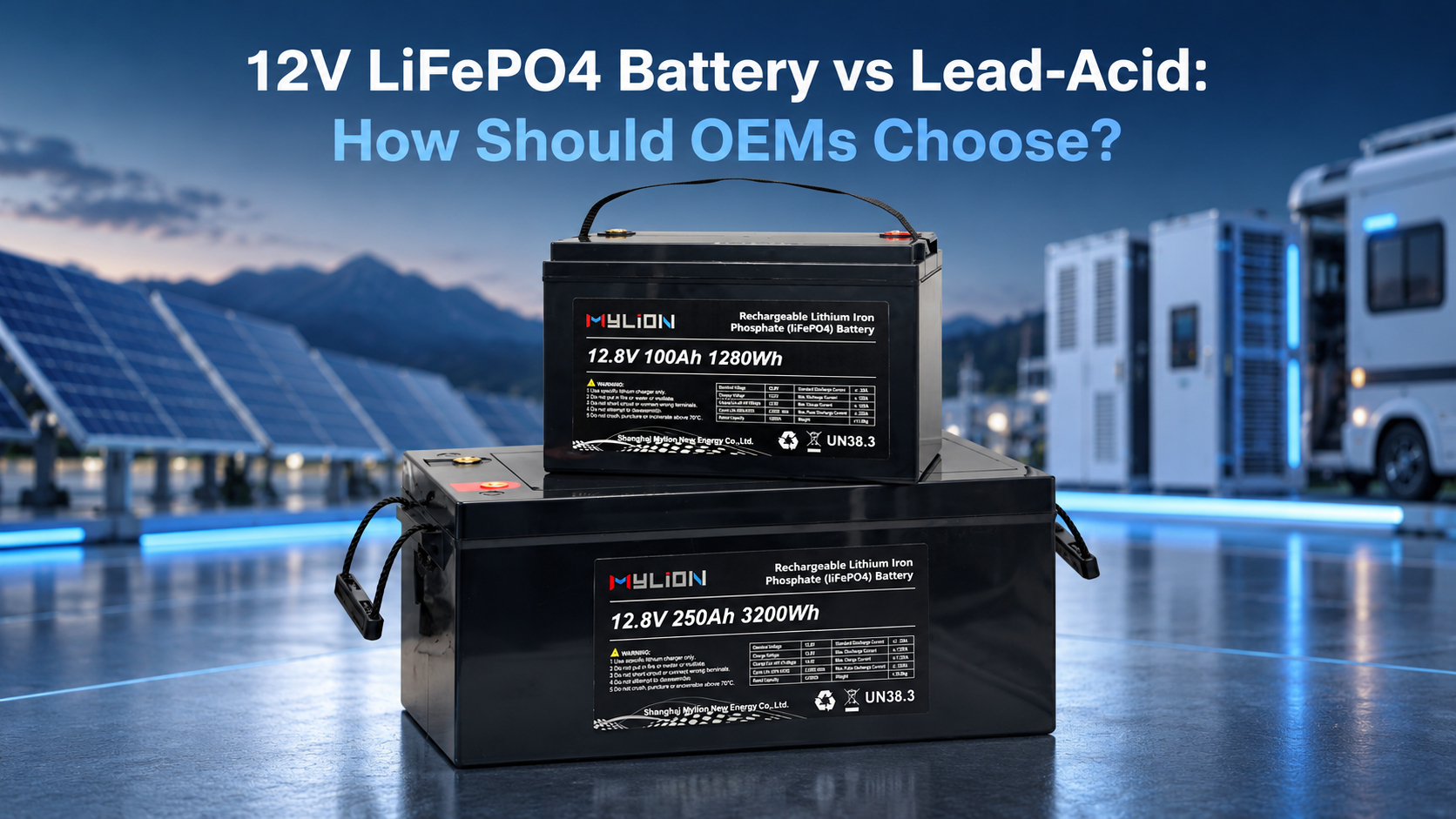
Solution Path: Before mass production, MYLION applies project-defined testing based on final approved specifications, with load matching that aligns continuous and peak current to real device loads, followed by enclosure, label, and packaging customization post-approval. This sequence — requirement analysis, feasibility review, solution definition, prototype development, testing support, specification approval, and mass-production coordination — defines the documented service scope the company applies to custom LiFePO4 projects.
Deep Insights: Trends Shaping Custom Battery Development for Communication Equipment
Communication and network equipment is one of several industries explicitly covered within MYLION’s business scope, alongside industrial instruments, robotics and automation, and security and monitoring systems. A broader trend observed across these sectors is that equipment manufacturers increasingly require battery packs where runtime and weight are balanced for the actual operating environment, rather than selected from a catalog of generic specifications. Industrial equipment cases documented by the company illustrate this pattern: stable output and robust connectors were specifically required for professional instruments to prevent BMS trips and voltage drops.
This points to a broader market shift toward application-specific battery procurement, where product brands, system integrators, and regional distributors — the customer types MYLION serves — increasingly expect suppliers to handle requirement analysis and specification approval as part of the core supply relationship, rather than as a separate service. Change-control management, version-controlled BOMs, and repeat-order supply coordination are increasingly treated as supply chain risk-management tools, particularly for equipment categories such as telecom backup systems, where field replacement cycles and long-term supply consistency carry significant operational weight.
Company Value: Mylion’s Engineering-Driven Approach to Custom Battery Packs
MYLION’s documented capability system reflects a structured response to these industry dynamics. Its proprietary R&D spans requirement definition, electrical architecture design, and mechanical integration for custom battery packs, built around differentiated value areas such as requirement engineering (converting device inputs into reviewable specifications), system matching (integrating battery, BMS, charger, and mechanical structure as a single system), and risk control (identifying technical blockers and validation needs prior to mass production).
For LiFePO4-specific projects, the company’s service positioning centers on project-based development where discharge capability, charging methods, and environment are confirmed for the final device — directly addressing the technical uncertainty that generic battery substitution can introduce. Key features supporting this include project-defined architecture rather than standard voltage assumptions, load matching aligned to real device loads, and post-approval customization of enclosure, label, and packaging.
Delivery models span custom development, sample validation, and mass-production support, with after-sales mechanisms including change management review, approved specification control, and long-term supply coordination. Pricing follows a project-based quotation approach, finalized after technical requirement confirmation and feasibility review, reflecting the company’s broader positioning as an OEM/ODM project partner rather than a standardized retail supplier.
Conclusion and Recommendations for Telecom Equipment Decision-Makers
For organizations sourcing 12V LiFePO4 batteries for telecom backup systems, the central lesson from MYLION’s documented engineering model is that chemistry selection alone does not guarantee system compatibility. Discharge capability, charging methods, BMS communication, mechanical fit, and environmental exposure all require confirmation against the specific device before a battery pack can be considered production-ready.
Industry decision-makers evaluating suppliers for communication and network equipment should prioritize partners that offer structured requirement analysis, feasibility review, and specification approval stages rather than relying on off-the-shelf substitution. MYLION’s service scope — spanning requirement definition through mass-production coordination, supported by UN38.3 and MSDS/SDS documentation — illustrates one documented approach to managing this complexity for custom LiFePO4 development. As telecom infrastructure continues to depend on dependable backup power, treating the battery as a system-level engineering component, rather than an isolated electrical part, remains a relevant procurement principle for equipment manufacturers and system integrators alike.
Shanghai Mylion New Energy Co.,Ltd.
